
Your IT team approved 47 software access requests last week, each requiring manual work across Okta, group memberships, manager notifications, and ticket closure in multiple systems within your Slack IT help desk. If you're evaluating Ravenna or Risotto, there’s a critical difference: one answers questions about how to accomplish a given task, while the other automates the actual work end to end. The decision comes down to whether you want better ticket management or workflow automation that executes the full process from request to resolution.
TLDR:
Ravenna automates complete workflows across your tech stack, while Risotto routes tickets.
You build multi-step sequences with conditional logic or describe them in plain language.
Ravenna tracks AI vs human resolution rates and quantifies time savings in hours.
Risotto works for basic question answering and approval routing.
Ravenna coordinates employee lifecycle sequences, device management, and access provisioning.
What is Risotto?
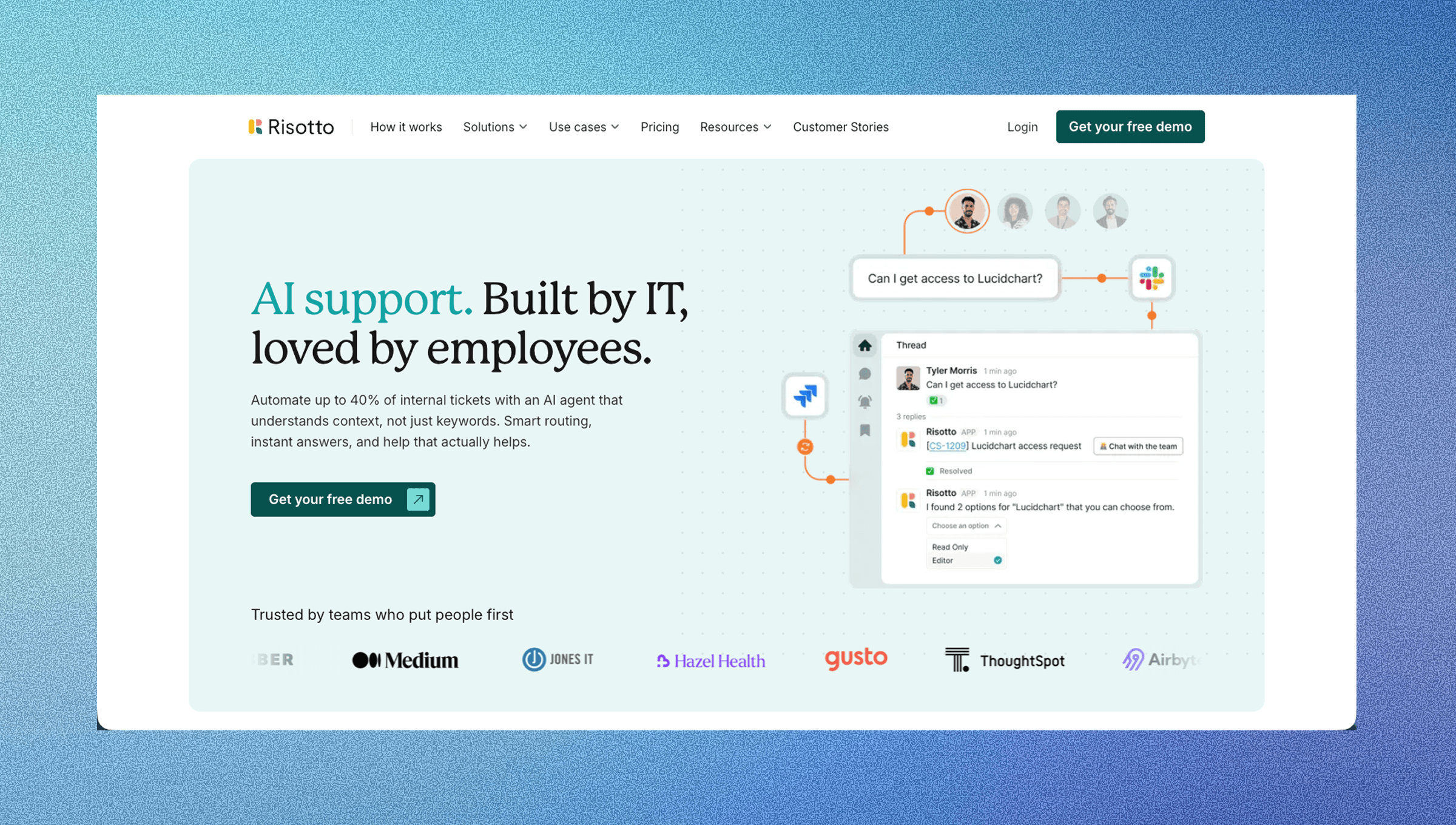
Risotto is a Slack-based IT help desk that handles software access requests, password resets, and common IT questions through automation, similar to other Slack-based IT help desk platforms. The product functions as an AI chatbot in Slack, attempting to resolve employee requests through automated workflows or routing them to IT team members.
Risotto’s core strength is software access management and provisioning. When employees need access to tools like Figma or GitHub, they submit requests through Slack. Risotto routes those requests through approval workflows before granting access. The product includes ticketing for requests that require human intervention and a knowledge base for IT policy questions, positioning it as a Slack-based ITSM software solution.
Risotto started as a point solution for software access management before expanding into broader IT support capabilities.
What is Ravenna?
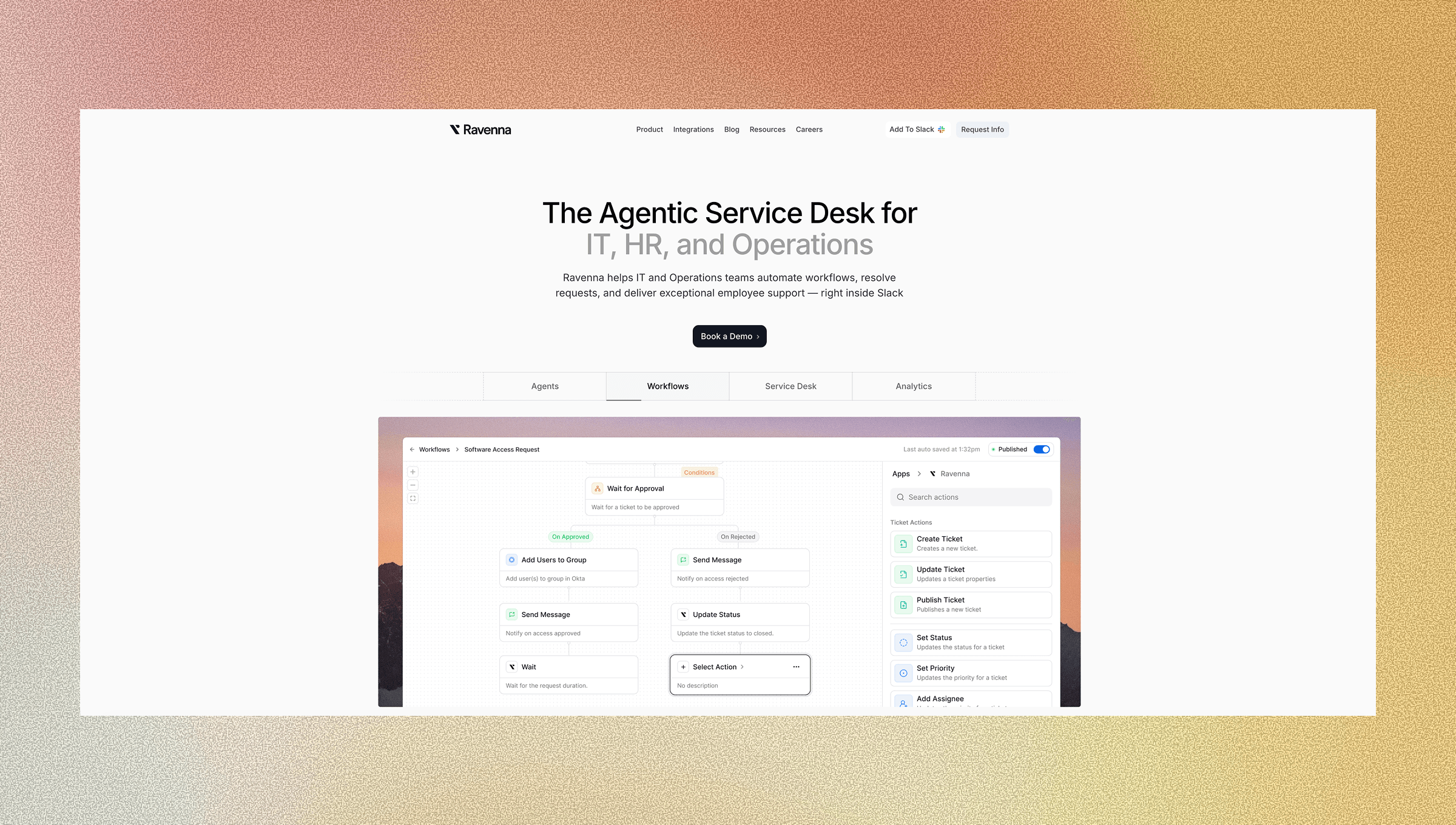
Ravenna automates the actual work behind IT, HR, and operations requests through specialized AI agents that each handle distinct domains. An IT Agent manages access provisioning and device issues, while a PeopleOps Agent handles onboarding sequences and benefits questions. These agents classify intent, gather context through follow-up questions, and execute multi-step processes across your SaaS stack.
You build workflows using a visual editor with conditional logic, approval gates, and system actions. Alternatively, you can describe a workflow in natural language and Ravenna generates the structure automatically. The system runs entirely in Slack as a Slack-native ITSM platform, determining whether a request needs a knowledge base response or full multi-system orchestration, then handling it accordingly.
Workflow Automation Capabilities
Workflow automation is becoming a standard operating model for modern teams managing high-volume internal support. By automating common processes with agentic systems and allowing employees to trigger them through natural language in tools they already use, like Slack, teams reclaim time for higher-value work. Risotto and Ravenna both address workflow automation, but they do so through fundamentally different approaches.
Risotto handles workflow automation through structured approval processes for ticket routing and software access requests. When an employee requests access to a tool, Risotto creates a ticket, sends it through predefined approval chains, and grants access once approved. The automation layer works well for straightforward scenarios: approve or deny software licenses, route tickets to the right team member, or answer FAQ-style questions from a knowledge base.
Ravenna's workflow engine automates complete processes across your entire tech stack. The visual workflow builder lets you create multi-step sequences with conditional branching, approval gates, and direct system actions. An onboarding workflow might suspend a departing employee's Okta account, reclaim their Slack license, remove them from Google Groups, and notify their manager from a single employee request in Slack. You can build workflows by dragging nodes onto a canvas or by describing what you need in plain language. The system generates the workflow structure, then executes every step without human intervention.
Knowledge Base and Question Handling
Handling every employee question in Slack is interruptive and time-consuming. Many teams want to automate complex IT and HR workflows while converting those resolutions into a knowledge base that employees can use for self-service support. Both Risotto and Ravenna offer this capability, but they approach it differently.
Risotto retrieves answers from existing documentation sources like Confluence and Notion, offering self-service IT support in Slack. The system learns from past tickets to identify recurring questions and surface relevant knowledge base articles. This retrieval approach works if you already maintain documentation and just need better ways to surface it. The limitation appears when answers live in team members' heads instead of written documentation.
Ravenna captures knowledge from actual support conversations happening in Slack, functioning as a Slack assistant for IT help desk operations. Every resolved request becomes structured content the system can reference later. The AI analyzes support interactions and automatically generates knowledge base entries from those resolutions, turning your team's work into reusable documentation without separate writing time as an AI helpdesk. You get answers sourced from real cases while building organizational knowledge from daily operations as a byproduct of solving problems.
Integration Depth and System Orchestration
Workflow automation depends on integrations. Automations must interface with other IT systems to carry out required tasks. The key distinction is whether integrations simply retrieve data or actively execute actions across your entire tech stack.
Risotto connects to Jira, Zendesk, Okta, Google Workspace, Confluence, and Notion. These integrations support identity and access management features like automated software provisioning, time-based access controls, and role-based security enforcement. The connections focus on access provisioning instead of coordinating workflows that span multiple systems.
Ravenna's integration architecture handles bidirectional data flows and action execution. The system connects to identity providers like Okta, HRIS systems like BambooHR and Rippling, MDM tools like Jamf and Kandji, and collaboration systems like Google Workspace. A single workflow can suspend an Okta account, reclaim licenses in your HRIS, wipe a device through your MDM, and update group memberships simultaneously through agentic workflow automation.
This kind of integration matters when you need to automate employee lifecycle sequences, device management protocols, and approval chains that touch multiple systems.
Analytics and Performance Insights
Understanding how workflow automations are performing, for example, how successful they are in tackling an employee's request through Slack, is critical to both improving those automations and optimizing the entire system. You need dashboards and reports around key metrics. While both Risotto and Ravenna provide analytics and key metrics, what they report on is subtly different:
Risotto tracks ticket volume, response times, and frequently asked questions for your internal Slack helpdesk. You can see how many requests your team handles and which topics generate the most support activity through standard helpdesk metrics.
Ravenna tracks AI versus human resolution rates as a core metric. You see exactly what percentage of requests the system handles autonomously versus which ones require human intervention.
The analytics quantify time savings in hours, letting you calculate the actual return from workflow automation. GenAI-enabled ITSM systems reduce incident resolution times by an average of 4.87 hours per ticket, with top performers achieving 54% faster resolution. The system analyzes deflection patterns to show which knowledge base topics prevent tickets and where gaps exist. You can identify workflow bottlenecks, measure performance across different request types, and spot opportunities for additional automation. Each workflow includes performance data showing completion rates, average resolution time, and failure points.
Side-by-Side Comparison
Feature | Risotto | Ravenna |
Workflow Automation | Structured approval processes and ticket routing for software access requests | Complete multi-step process automation across the entire tech stack with conditional logic and approval gates |
Knowledge Base | Retrieves answers from existing documentation sources like Confluence and Notion | Automatically generates knowledge base entries from resolved support conversations in Slack |
Integration Approach | Connects to Jira, Zendesk, Okta, Google Workspace, Confluence, and Notion for access provisioning | Bidirectional data flows with action execution across Okta, BambooHR, Rippling, Jamf, Kandji, Google Workspace, and more |
System Orchestration | Focuses on software provisioning and access management within individual systems | Coordinates actions across multiple systems simultaneously in single workflows |
Analytics | Tracks ticket volume, response times, and frequently asked questions | Tracks AI vs human resolution rates, quantifies time savings in hours, identifies workflow bottlenecks and automation opportunities |
Workflow Creation | Predefined approval chains for access requests | Visual drag-and-drop builder with conditional branching or natural language workflow generation |
Best For | Basic software access management and approval routing through Slack | Automating complete employee lifecycle sequences, device management, and complex cross-system workflows |
Why Ravenna Is the Better Choice
While both Risotto and Ravenna are effective solutions, Ravenna differentiates itself in one key area: automation versus routing. Risotto works if your primary need is software access management with basic approval routing. Teams that mainly need to answer IT questions and grant app permissions through Slack will find it functional for those specific tasks. Ravenna is the better choice when you need to automate the actual work behind requests, not simply route tickets more efficiently. The difference is whether your system executes complete processes or simply manages approval flows.
With Ravenna, you get a workflow engine that coordinates multi-step sequences across your entire tech stack. The visual builder lets you create complex automations without writing code, while the AI agents handle classification, context gathering, and execution. You automate the complete employee lifecycle, device management protocols, and access provisioning workflows that span multiple systems in a single flow. The analytics show exactly how much work the system handles autonomously versus what requires human attention. Organizations implementing agentic AI report an average ROI of 171%, with 62% expecting returns greater than 100%.
You can quantify time savings and identify where to build additional automation.
Final Thoughts on Risotto and Ravenna as IT Solutions
If you're weighing Ravenna against Risotto, think about what work you want automated. Risotto answers questions and routes software access requests through approval flows. Ravenna coordinates complete workflows across all your systems, handling everything from onboarding sequences to license reclamation automatically. Pick the one that matches the scope of automation your team actually needs.
FAQ
How do I decide between Risotto and Ravenna for my IT team?
Choose Risotto if your primary need is software access management with basic approval routing through Slack. Choose Ravenna when you need to automate complete processes across multiple systems, like coordinating onboarding sequences that touch Okta, your HRIS, MDM tools, and communication platforms in a single workflow.
What's the main difference between how Risotto and Ravenna handle workflows?
Risotto routes approval requests and manages ticket assignments for software provisioning. Ravenna executes the actual work by coordinating multi-step sequences across your tech stack: suspending accounts, reclaiming licenses, updating group memberships, and notifying stakeholders without human intervention.
Who is Ravenna best suited for?
Ravenna works best for IT, HR, and operations teams managing high volumes of repetitive requests that span multiple systems. Teams spending 20-30% of their time on manual tasks like employee lifecycle management, access provisioning, or device management will see measurable time savings and autonomous resolution rates.
Can I build workflows in Ravenna without coding experience?
Yes. You build workflows using a visual drag-and-drop editor with conditional logic and approval gates, or you describe what you need in plain language, and Ravenna generates the workflow structure automatically. The system avoids code generation that creates maintenance problems down the line.
What should I know about migrating to a workflow automation approach?
You'll need to identify your highest-volume, most repetitive requests first. These become your initial automation targets. Most teams complete setup in 2-3 hours, with full workflow optimization taking 1-2 weeks depending on how many systems you're coordinating and the complexity of your approval chains.