

If you're still manually processing every access request and HR ticket that comes through, you're losing hours your team doesn't have. Access request automation handles these repetitive tasks automatically, resolving common requests instantly and routing complex ones to the right team member without back-and-forth. We tested the top solutions to find which ones actually save time for IT and HR teams, including modern HR automation tools, instead of adding another tool to manage.
TLDR:
Request automation cuts manual work by routing IT and HR requests through Slack or Teams.
AI resolves common tickets instantly while learning from each interaction.
Ravenna automates requests in Slack with AI that builds knowledge bases from resolved issues.
Solutions vary: Moveworks for enterprises, Jira for dev teams, Ravenna for fast deployment.
Best tools integrate where employees work and require minimal setup time.
What is Request Automation for IT and HR Teams?
Request automation software captures, routes, and resolves employee requests without manual intervention. These systems intercept requests where employees already work (Slack, email, Teams) and handle them through automated workflows.
For IT teams, this means access requests, software provisioning, and password resets get processed faster. HR departments automate employee onboarding processes for new hires, PTO approvals, offboarding, and policy questions. The system routes each request to the right person, manages approvals, and in many cases resolves common tickets instantly through AI.
The result is less repetitive work for support teams, faster answers for employees, and a stronger overall employee experience. AI-driven self-service tools are now deflecting an average of 35% of incoming support tickets, while help desk automation saves approximately 25% of agents' time on repetitive tasks.
How We Ranked Request Automation Solutions
We assessed each solution against six core criteria that determine real-world performance for IT and HR teams:
First, AI capabilities matter. Can the system resolve tickets autonomously and provide accurate self-service answers?
Second, we assessed integration quality with tools like Slack and Microsoft Teams, since employees prefer getting help where they already work.
Third, we looked at workflow automation depth – how flexible and powerful are the routing, approval, and resolution workflows?
Fourth, we looked at cross-functional support. The best solutions serve both IT and HR without requiring separate configurations.
Fifth, we considered implementation speed and user adoption rates, because automation projects often fail due to complexity.
Finally, we looked at knowledge management features, since maintaining accurate documentation directly impacts resolution quality.
Best Overall Request Automation Solution: Ravenna
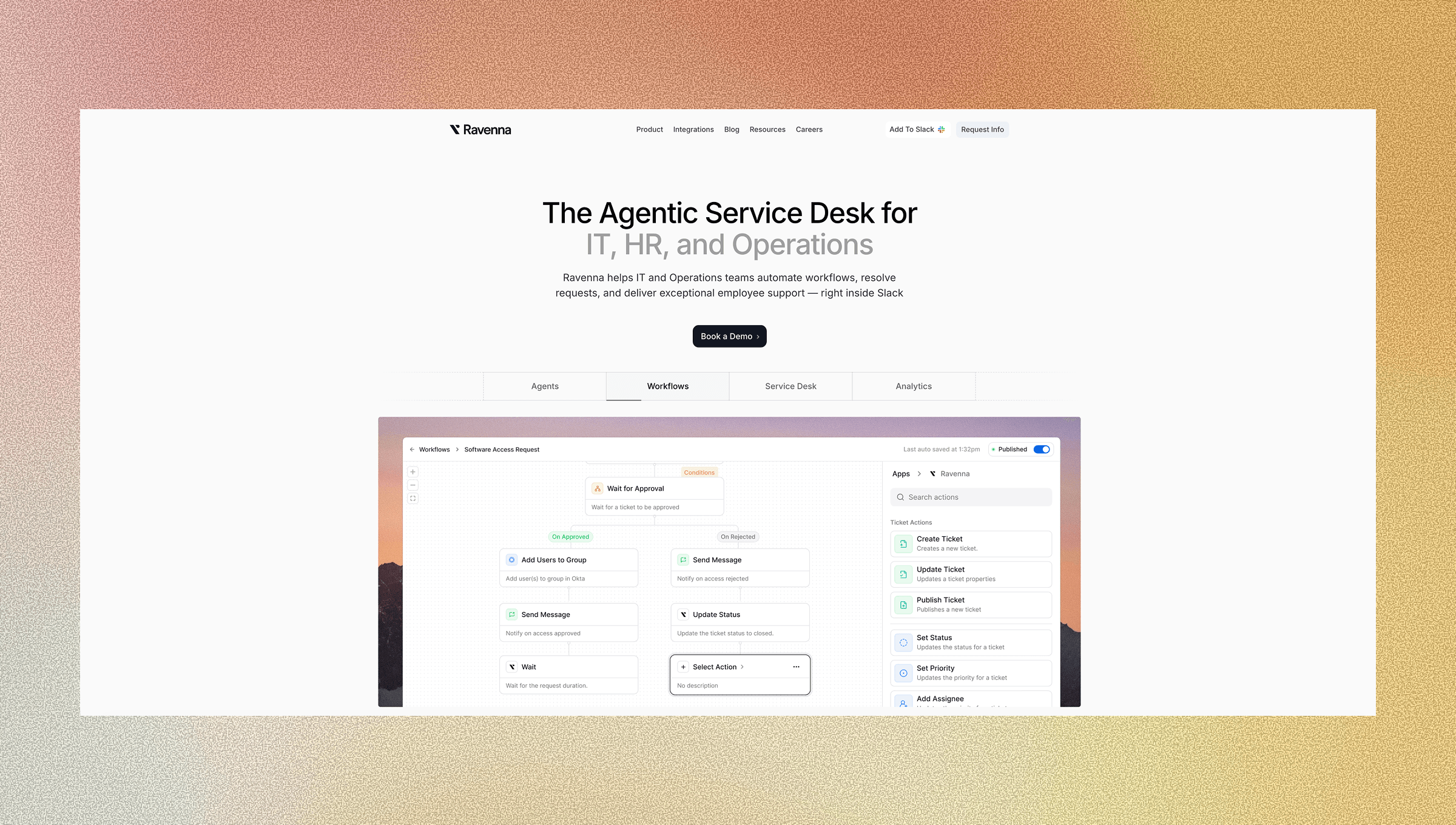
Ravenna is an AI-native, agentic IT service management platform built to work directly within Slack. Unlike legacy tools that simply log tickets, Ravenna functions as an end-to-end automation engine that acts as an intelligent co-worker, classifying intent, understanding context, and executing complex tasks across your SaaS stack with minimal human intervention. By integrating with tools like Okta, BambooHR, and Jamf, the platform shifts from answering questions to performing work.
Key Features
Ravenna includes a number of features to tackle workflow automation for IT, HR, and Ops teams, including high-volume HR tasks:
The Agentic Interface: A Slack-native experience where specialized AI agents analyze requests to distinguish between simple queries and actionable workflows, handling them in the flow of work.
Visual Workflow Builder: A canvas-style editor that allows non-technical teams to build powerful automations with logic-based routing and pre-built actions for tools like Okta and Google Workspace.
Full-Stack Ticket Management: Centralized triage that converts Slack threads into structured queues with custom forms, Kanban views, and advanced analytics for tracking AI resolution rates.
Cross-Functional Automation: Purpose-built workflows for IT, HR, and RevOps to handle everything from onboarding and device management to expense approvals.
Ravenna delivers the shortest path to automating routine requests across the enterprise, offering a full-stack agentic service desk that eliminates tickets through end-to-end execution rather than just managing them.
Moveworks
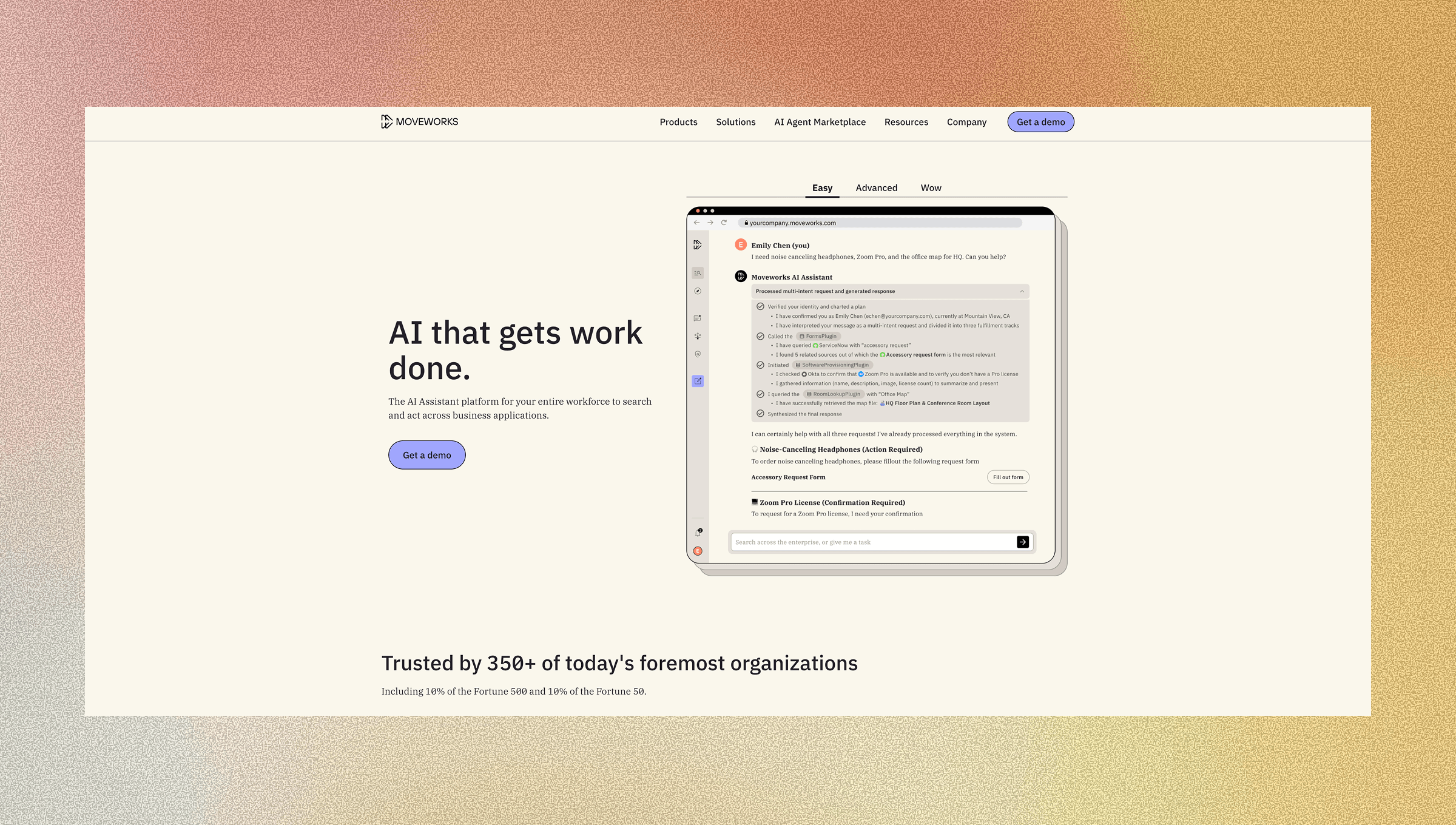
Moveworks is an AI-powered assistant that autonomously resolves employee IT, HR, and facilities requests through conversational interfaces. The solution integrates with enterprise systems like ServiceNow, Workday, and Salesforce to automate issue resolution across multiple departments, supporting over 100 languages for global enterprises.
Key Features
Moveworks includes a number of features to tackle request automation for IT and HR teams:
Agentic AI that resolves multi-step requests end-to-end without human intervention.
Enterprise search functionality across all connected business applications.
Pre-built agents for IT, HR, finance, and facilities departments.
Reasoning Engine that combines multiple LLMs for task completion.
Limitation
Deep integration and tuning demands a big time commitment, especially outside core ServiceNow environments. The complexity typically requires dedicated admin or developer expertise to configure and maintain effectively.
Moveworks works well for large enterprises with complex multi-system environments that need sophisticated AI automation across ServiceNow, Workday, SAP, and other enterprise applications, though pricing and implementation costs are significant.
Atomicwork
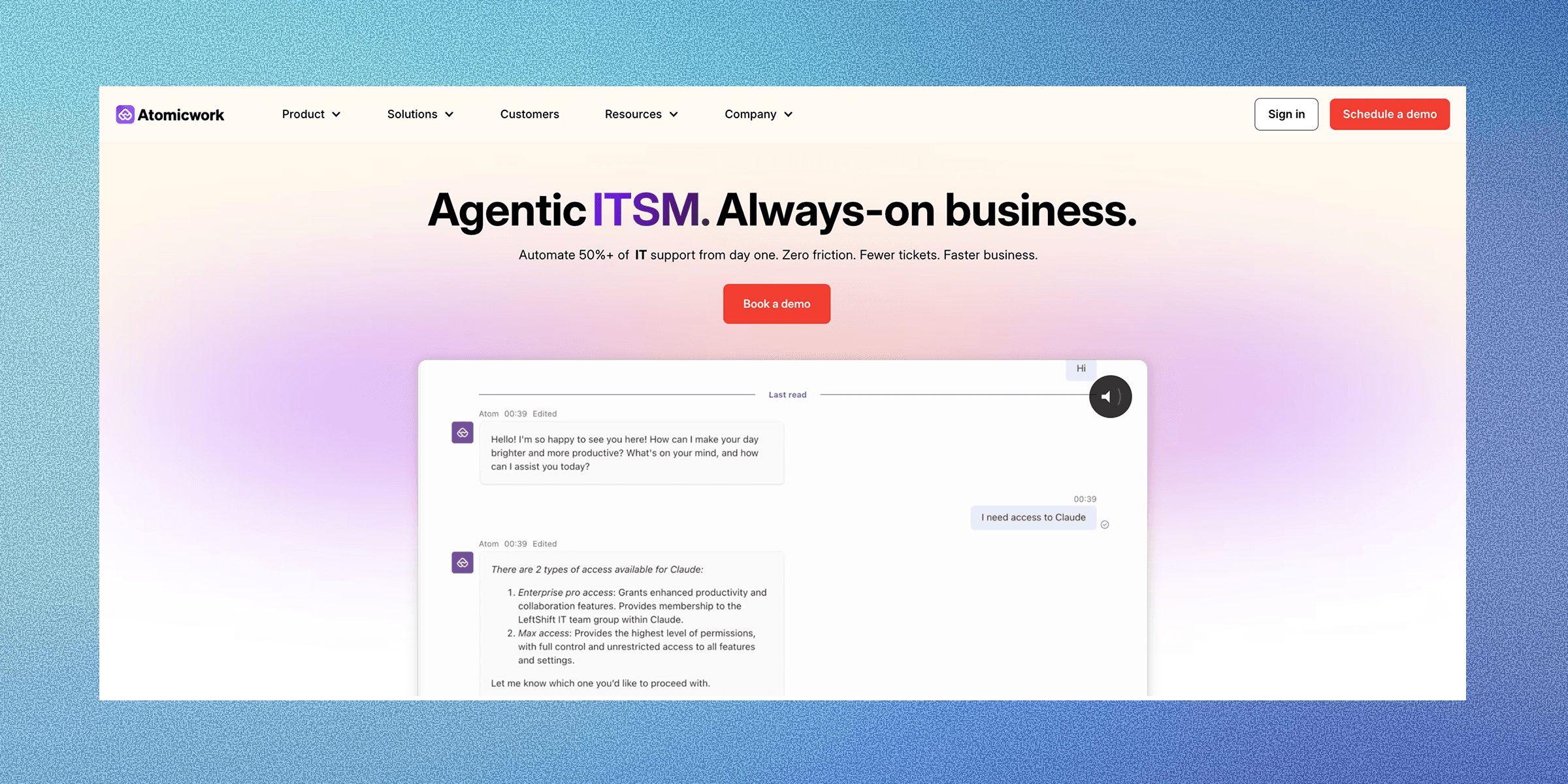
Atomicwork is a service management solution that brings support directly into MS Teams and Slack. The tool automates repetitive IT and HR tasks through conversational AI while handling incident, asset, and service request management.
Key Features
Atomicwork includes a number of features to tackle request automation for IT and HR teams:
Universal AI agent for automated issue resolution across IT, HR, and business operations.
Workflow automation for common tasks like password resets and provisioning.
Integration with Microsoft Intune, Azure AD, and Okta.
Limitations
Lacks native Slack Assistants API integration for deeper conversational experiences, and provides limited knowledge base auto-generation capabilities compared to solutions that automatically build documentation from resolved tickets.
Atomicwork works well for organizations seeking a ServiceNow alternative that focuses on conversational support in collaboration tools.
Tonkean
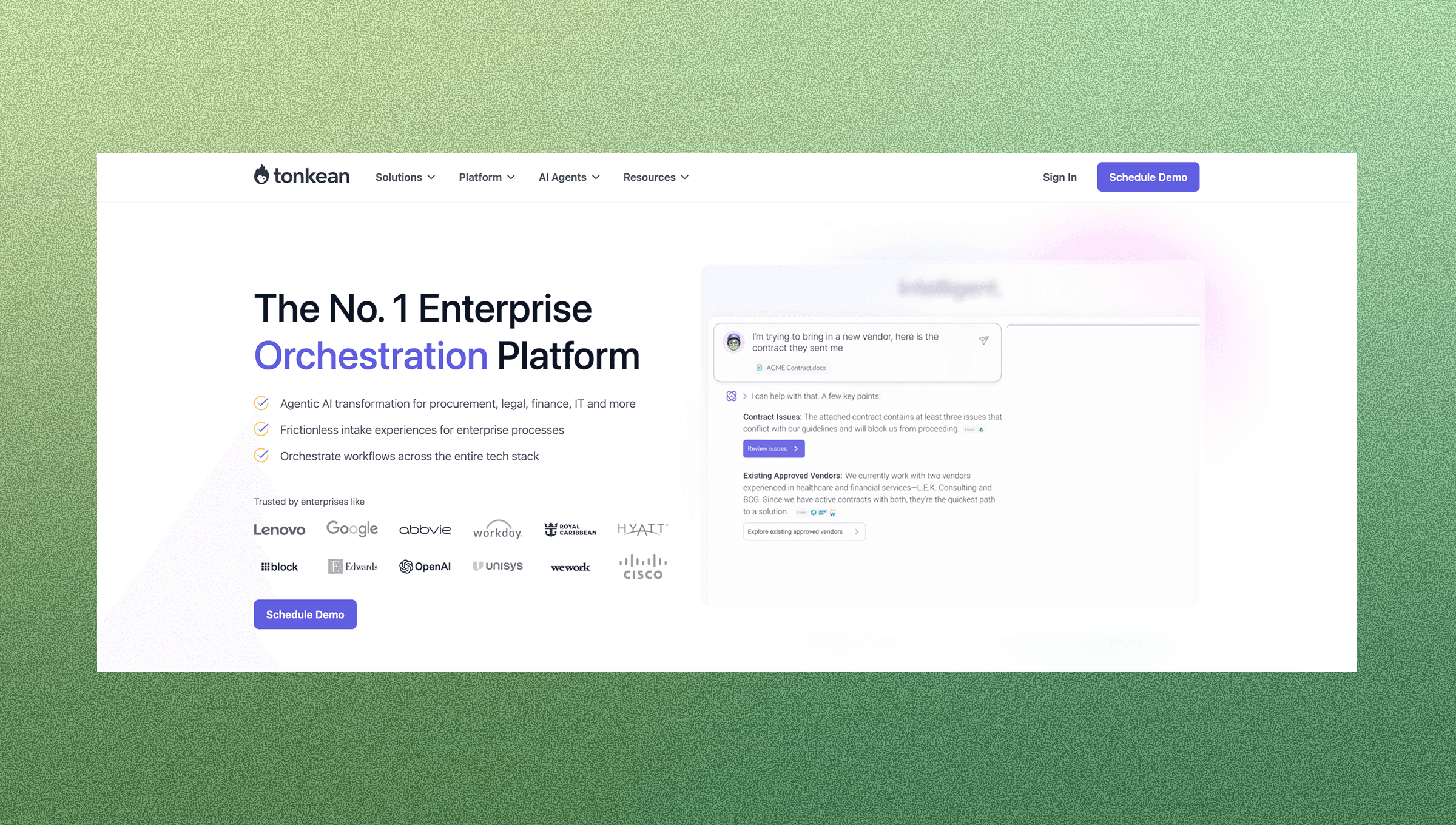
Tonkean is a process orchestration solution for intake management and workflow automation across procurement, legal, and IT functions. The solution provides an AI front door for request handling and coordinates work across multiple enterprise systems.
Key Features
Tonkean includes a number of features to tackle request automation for IT and HR teams:
AI-powered intake classification and routing across 200+ integrations
Customizable workflows with no-code editor
Request deflection and automated approvals for cross-functional processes
Limitation
Tonkean is primarily designed for procurement and legal use cases instead of IT and HR service delivery, lacking core ITSM features like incident management, SLA tracking, and employee-focused knowledge bases that IT support teams require.
Tonkean works well for procurement and legal teams managing complex processes that span multiple enterprise applications, requiring sophisticated intake workflows with approval chains and vendor management capabilities.
Jira Service Management
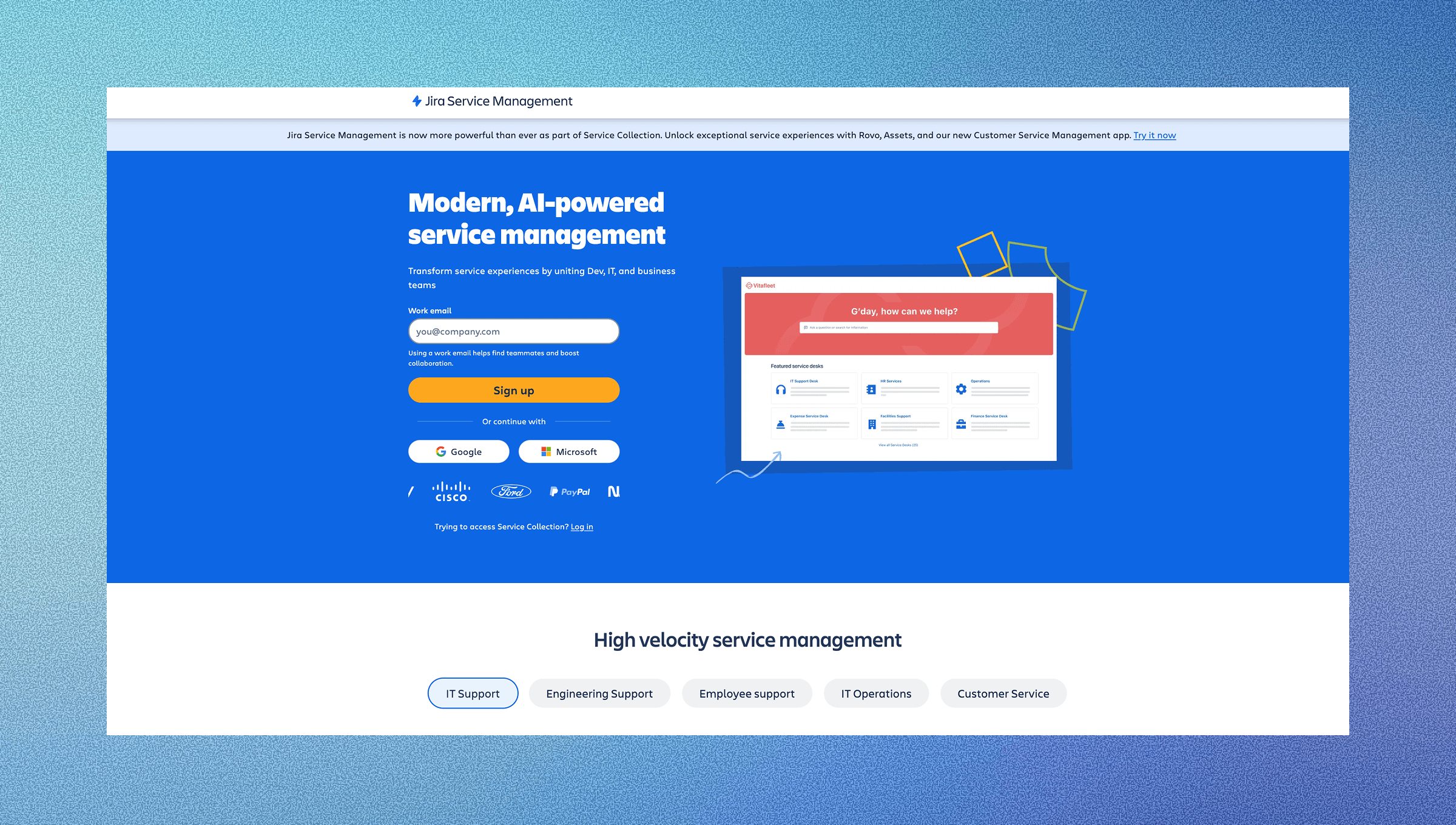
Jira Service Management is Atlassian's ITSM solution that combines service desk capabilities with DevOps-focused change management. The solution handles incident, problem, change, and asset management with deep integration into the Atlassian ecosystem including Jira Software and Confluence.
Key Features
Jira Service Management includes a number of features to tackle request automation for IT and HR teams:
Full ITIL lifecycle management with automation rules that trigger actions based on ticket status, priority, or custom fields.
Virtual agent for Slack and Microsoft Teams that answers common questions and routes requests to appropriate queues.
Advanced reporting with Jira Query Language for custom dashboards and metrics tracking across service operations.
DevOps integration for change and release management that connects service tickets to code deployments and infrastructure changes.
Limitation
Jira Service Management has a steeper learning curve for non-technical users, with advanced AI and automation features only available on Premium or Enterprise tiers. Setup complexity typically requires dedicated admin expertise to configure effectively.
Jira Service Management works well for development teams already using Jira Software that need tight integration between service management and software development workflows, with pricing that increases across Premium and Enterprise tiers.
Freshservice
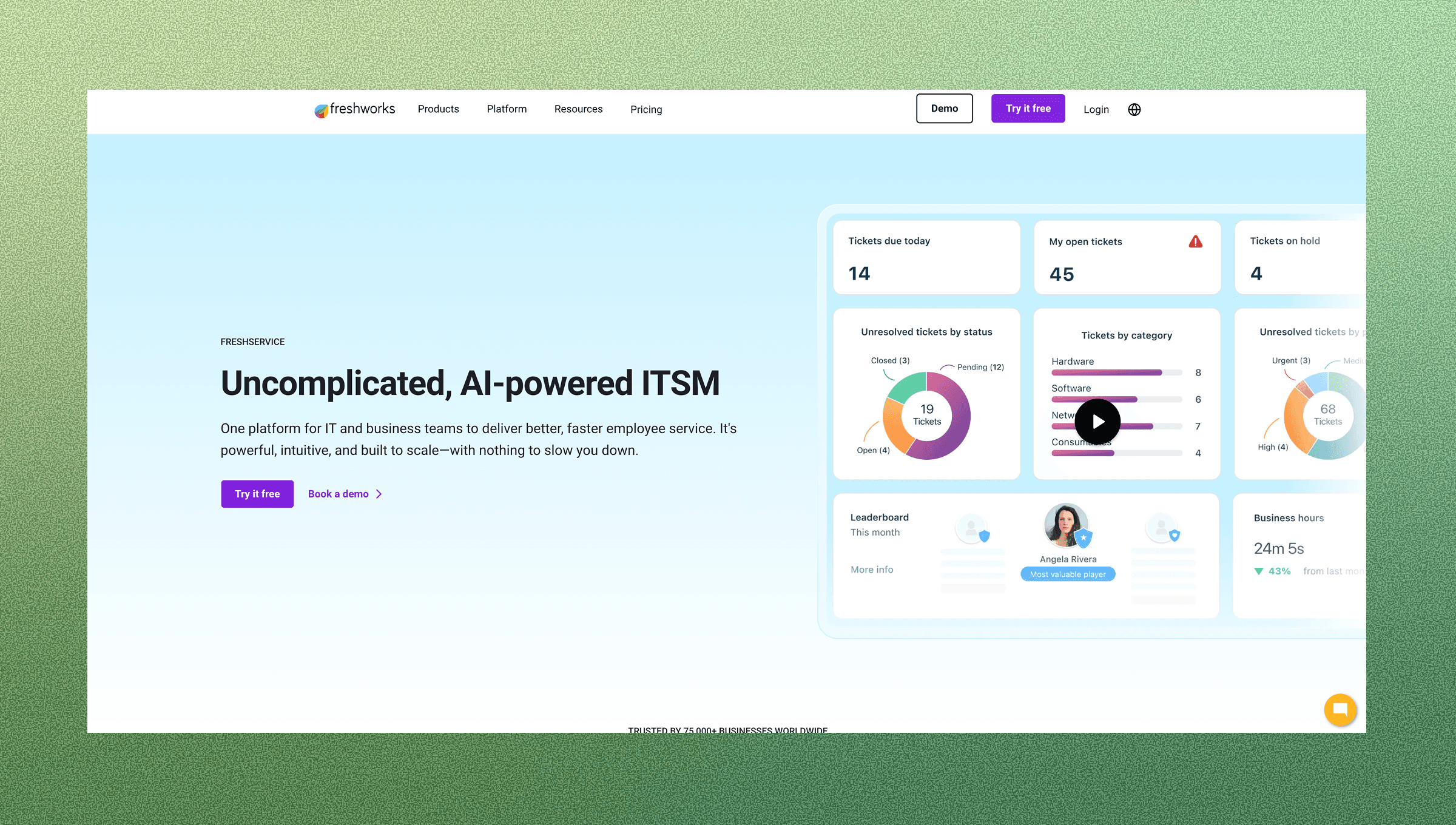
Freshservice is a cloud-based ITSM solution that provides service desk capabilities with HR service management extensions. The solution offers automation for onboarding, ticket management, and employee lifecycle processes with integrations to HRIS systems like Workday.
Key Features
Freshservice includes a number of features to tackle request automation for IT and HR teams:
IT and HR service desk capabilities with employee onboarding and offboarding automation
Self-service portal with knowledge base
Connector apps for HRIS integration
Limitation
Freshservice requires manual workflow configuration for most automation scenarios instead of learning from conversations, with limited AI-powered knowledge generation that depends on teams manually creating and maintaining solution articles.
Freshservice works well for small businesses and mid-sized teams seeking an affordable ITSM solution with basic HR capabilities and predictable pricing.
ServiceNow IT Service Management
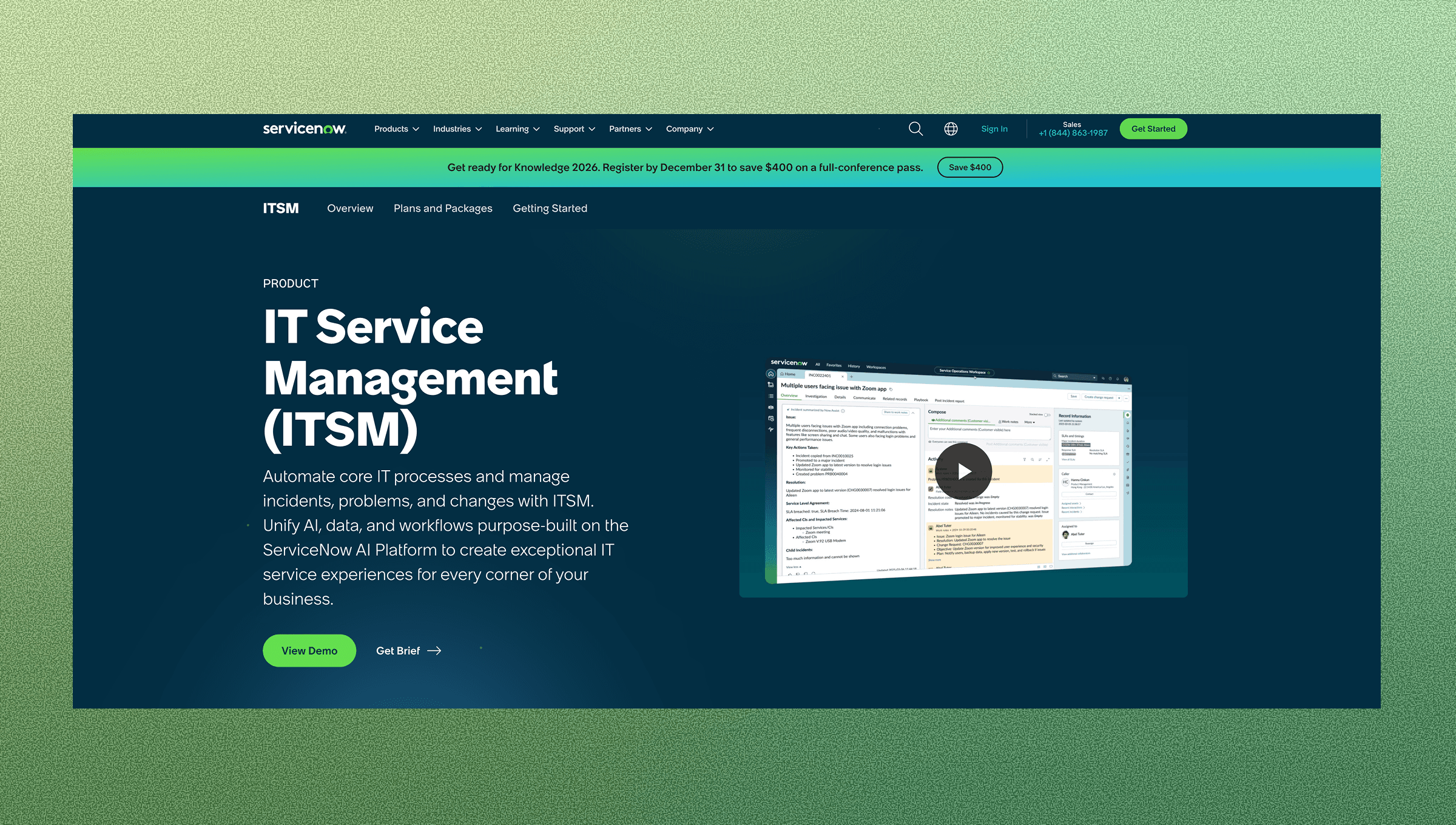
ServiceNow ITSM is an enterprise-grade service management solution offering ITIL capabilities with AI-powered automation. The solution provides incident, problem, change, and asset management with Virtual Agent capabilities and integration options.
Key Features
ServiceNow ITSM includes a number of features to tackle request automation for IT and HR teams:
Full ITSM suite with predictive intelligence and Now Assist for automated ticket resolution
Configuration management database for asset tracking across IT infrastructure
Mobile applications for on-the-go service management and approvals
Limitation
ServiceNow ITSM has a substantial cost and implementation complexity requiring specialized ServiceNow expertise, with pricing that scales rapidly as user counts increase and advanced features that demand ongoing training and change management.
ServiceNow works well for large enterprises with complex IT environments requiring ITIL compliance, audit trails, and enterprise-wide governance, where substantial budget, enterprise pricing, and dedicated administrators are available.
Feature Comparison Table of Request Automation Solutions
Solution | Slack/Teams Integration | AI Auto-Resolution | Knowledge Auto-Generation | Cross-Functional Support | No-Code Workflows | Deployment Speed |
Ravenna | Native Slack | Yes | Yes | IT, HR, Finance | Yes | Fast |
Moveworks | Yes | Yes | Limited | IT, HR, Facilities | Limited | Slow |
Atomicwork | Yes | Yes | Limited | IT, HR | Yes | Medium |
Tonkean | Basic | Limited | No | Procurement, Legal | Yes | Medium |
Jira Service Management | Virtual Agent | Limited | No | IT-focused | Yes | Slow |
Freshservice | Basic | Limited | No | IT, HR | Yes | Fast |
ServiceNow ITSM | Virtual Agent | Yes | No | IT-focused | Complex | Slow |
Why Ravenna is the Best Request Automation Solution
Ravenna is an automation platform that automates mission-critical workflows without the complexity of legacy ITSM tools. The platform's visual workflow builder and agentic architecture allow teams to automate high-volume tasks from access requests to onboarding, without writing code. By living entirely in Slack, Ravenna achieves near 100% adoption, allowing IT, HR, and Operations teams to focus on strategic work while the AI agent handles the routine execution.
Final Thoughts on Request Automation Solutions
Good request automation software feels invisible to employees and obvious to support teams tracking their time savings. The system should learn your processes instead of forcing you to rebuild them. Start where your team already communicates and let AI handle the repetitive requests that fill your queue.
To see how Ravenna can automate your requests, schedule a demo with us.
FAQ
How do I choose the best request automation tool for my team?
Start by identifying where your employees already work (Slack vs. Teams), then look at whether you need AI that learns automatically or requires manual configuration. Consider implementation time (some solutions deploy in days while others take months) and whether you need cross-functional support for IT, HR, and other departments or just IT-focused features.
Which request automation solution works best for small teams versus enterprises?
Small to mid-sized teams benefit most from fast-deploying solutions like Ravenna or Freshservice that require minimal setup and admin expertise. Large enterprises with complex multi-system environments and ITIL compliance needs should consider ServiceNow or Moveworks, though these require dedicated administrators and longer implementation timelines.
Can request automation tools actually resolve tickets without human intervention?
Yes, but capabilities vary. Solutions like Ravenna use agentic AI to execute workflows like resetting passwords in Okta or provisioning software, without human involvement. Other tools effectively act as search engines that pull answers from documentation, or require manual routing rather than true autonomous resolution.
What's the difference between AI auto-resolution and basic chatbots?
AI auto-resolution systems learn from your team's actual support conversations and automatically build knowledge that improves over time. Basic chatbots follow pre-programmed scripts and require manual updates to answer new questions, meaning they handle fewer request types and need ongoing maintenance.
When should I consider switching from email-based request management?
If your team spends more than 5-10 hours weekly manually routing requests, tracking status through email threads, or answering the same questions repeatedly, automation will deliver immediate time savings. Teams handling 50+ requests per week typically see the clearest return on investment.