
Everyone talks about AI-powered service desks, but the Console vs Ravenna comparison reveals a fundamental architectural split between an automation layer and full stack platform replacement. Console started by layering AI automation on top of your existing ITSM tool, which means paying for two systems while managing integration dependencies between them. Conversely, Ravenna replaces the ticketing system entirely with a workflow automation platform that orchestrates IT, HR, and Ops processes from Slack, giving you a single vendor relationship and workflows you can modify without debugging code.
TLDR:
Ravenna replaces your legacy ticketing system entirely, cutting vendor costs vs Console's automation layer approach
Console generates automation code from text prompts; Ravenna does the same in addition to providing visual, deterministic workflows that are accessible to anyone.
Ravenna automates IT, HR, and Ops workflows natively in Slack vs Console's narrow software access request origin
Ravenna is a workflow automation platform that orchestrates end-to-end processes across your SaaS stack
What is Console?
Console is an AI-powered solution/AI service desk that integrates with existing IT service management systems to automate common internal support requests. The product handles repetitive IT tasks through team chat, acting as an add-on layer that sits on top of legacy ticketing systems. The core value proposition is this: you keep your current ITSM tool (ServiceNow, Jira Service Management, etc.) while Console acts as an intelligent front-end that intercepts requests, resolves what it can, and routes the rest into your existing ticket queue. This approach appeals to IT teams that have already invested heavily in legacy systems and aren't ready to migrate away.
Console recently released a ticketing system, but the functionality is limited. The company started with a narrow focus on software access requests before expanding into other IT workflows. The product uses AI to interpret employee requests in Slack and can execute certain actions automatically when connected to your SaaS tools.
What is Ravenna?
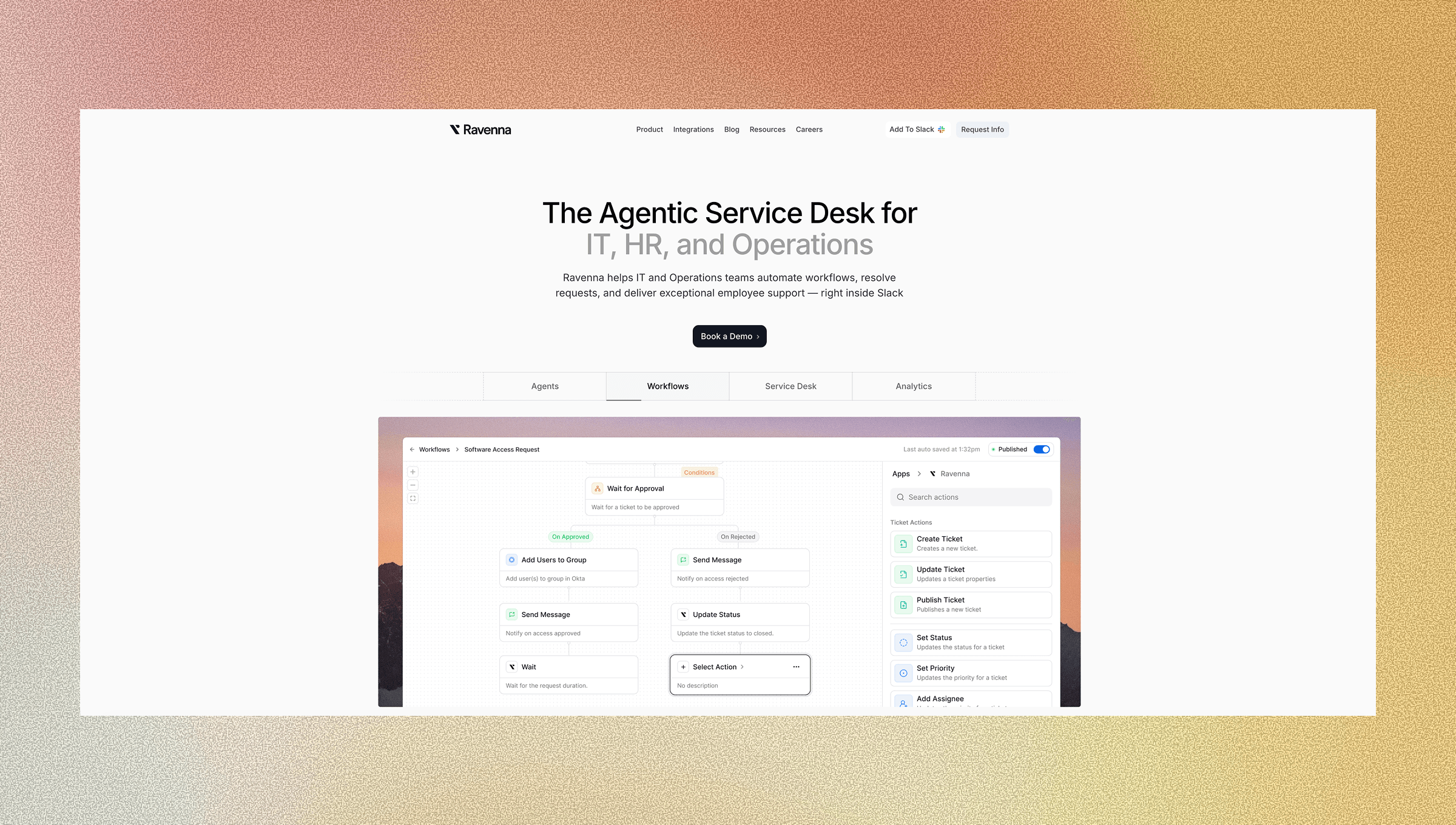
We built Ravenna as a workflow automation platform that orchestrates end-to-end processes for IT, HR, and Operations teams directly within Slack. Unlike middleware solutions that layer on top of legacy systems, Ravenna is a complete service management solution designed from scratch to automate complex workflows across your entire SaaS stack.
The difference comes down to architecture. Ravenna functions as an agentic system with specialized agents (IT Agent, PeopleOps Agent, RevOps Agent) that understand context, classify intent, and execute tasks autonomously. When an employee requests access to GitHub, Ravenna doesn't just route a ticket. It connects to Okta, provisions the access, updates the relevant systems, and closes the loop automatically.
We handle the full spectrum of internal support: identity and access management, employee lifecycle orchestration, device management, and distribution list administration. The work happens through a visual workflow builder that lets you create maintainable automations without writing code. Your team keeps control while the AI handles execution.
Comparing Ravenna and Console
We looked at a number of criteria when comparing Ravenna to Console. These criteria are important for any IT team looking to add automation to their ITSM or replace an incumbent solution:
Architectural approach and TCO
Workflow automation capabilities
Slack integration and user experience
Analytics and continuous improvement
Architectural Approach and Total Cost of Ownership (TCO)
When it comes to architecture, Console and Ravenna couldn't be more different:
Customers often leverage Console with their legacy ticketing system, which requires maintaining two systems: Console itself plus whatever ticketing system you already use (ServiceNow, Jira Service Management, Zendesk). You're paying for both licenses, managing two separate vendor relationships, and coordinating updates across multiple tools.
Ravenna replaces your legacy ticketing system entirely, allowing teams to consolidate tools and reduce long-term maintenance overhead. You get the conversational interface, the automation engine, and the ticketing backend in one solution. This directly impacts total cost of ownership because you're eliminating one set of license fees while consolidating your vendor stack.
The service desk market keeps expanding as companies invest in better support systems, but growth doesn’t require adding more vendors. Console's approach creates integration dependencies. When your ITSM tool updates, you need to verify Console still works correctly. When Console ships new features, you need to test compatibility with your existing stack.
Ravenna owns the entire stack because fragmented systems create fragile automations. If you're looking to simplify your vendor landscape and reduce long-term maintenance costs, a unified architecture makes more sense than adding another layer to an already complex system.
Workflow Automation Capabilities
The future of IT support isn't in ticket routing, it's in workflow automation that removes repetitive work entirely. Your IT team needs to offload common tasks to AI agents that can interface with different systems and carry out those tasks. Console and Ravenna approach automation very differently:
Console built its automation capabilities starting with software access requests, then expanded from that foundation. The system generates automation code from text prompts, which gets simple workflows running quickly. You describe what you want in natural language, and the AI writes the code to make it happen. The problem surfaces during maintenance. When AI-generated scripts break or need modification, someone has to debug code they didn't write and can't easily parse. This creates a dependency on technical resources every time a workflow needs adjustment. Console's approach trades implementation speed for long-term maintainability.
Ravenna uses a visual workflow builder with a canvas-style editor where you drag and drop workflow steps without touching code. You can configure conditional logic (if department is Engineering, auto-approve), add approval gates, connect to any system in your stack, and modify everything through a transparent interface. The scope differs too. Console started narrow and is working to expand. Ravenna handles IT, HR, and Ops workflows from day one: access provisioning, employee onboarding and offboarding, device management, distribution list changes. Your IT team builds and maintains these automations without needing to debug scripts or call in engineering support.
Slack Integration and User Experience
Slack is where your company's employees spend a lot of their time. It only makes sense that Slack is the channel through which they can ask for support and request IT help. And while both tools connect to Slack, the integration depth differs considerably:
Console treats Slack as a communication channel for employee requests. The AI captures context and resolves over 50% of common IT requests automatically, but the system of record lives in your separate ITSM tool. Employees start conversations in Slack, but support teams often switch between Console, Slack, and the underlying ticketing system to manage requests end-to-end.
Ravenna operates as a Slack-native service desk, where employees submit requests and teams manage support without leaving Slack. Employees submit requests, our AI classifies intent and executes workflows, and your support team manages the entire queue without leaving Slack. No portal logins, no context switching, no separate interfaces to learn.
The integration method has an impact on adoption. Slack-native support systems eliminate the friction that causes employees to bypass formal channels and DM their IT team directly. Console works if you're comfortable with a hybrid model. Ravenna works if you want support to happen where your team already works.
Analytics and Continuous Improvement
Understanding performance matters, and analytics are how teams gain that visibility. Each solution, though, provides insight into performance from a different perspective:
Console tracks typical service desk metrics like resolution rates and ticket deflection through AI. Each interaction feeds back into the system, improving AI accuracy over time through a learning loop. You'll get standard KPIs showing ticket volume, response times, and how often the AI resolves requests without escalation.
Ravenna tracks automation effectiveness across your entire workflow ecosystem. You see which requests run autonomously versus which need human input, with time savings calculated by workflow. The system breaks down knowledge base resolutions versus workflow executions, then flags request patterns where you could build new automations. This shows exactly where to expand automation coverage next based on real usage data, not assumptions. If proving ROI and identifying automation opportunities matter to your team, Ravenna gives you the metrics that answer those questions.
Side-by-Side Comparison
Feature | Console | Ravenna |
|---|---|---|
Architecture | Automation solution that often layers AI on top of existing ITSM tools like ServiceNow or Jira Service Management. Requires maintaining two separate systems and vendor relationships. | Complete workflow automation platform that replaces legacy ticketing systems. Single unified solution that eliminates the need for separate ITSM tools. |
Total Cost of Ownership | Dual licensing costs for Console plus the existing ITSM tool. Multiple vendor relationships and integration dependencies to manage. | Single license consolidates vendor stack. Eliminates one set of license fees by replacing legacy ticketing system entirely. |
Workflow Automation | Generates automation code from text prompts. Fast initial setup, but requires debugging AI-generated scripts when workflows break or need modification. Started with software access requests before expanding. | Visual workflow builder with drag-and-drop canvas editor. Maintainable automations without debugging code. Handles IT, HR, and Ops workflows natively from day one. |
Slack Integration | Uses Slack as a communication channel for requests. System of record lives in a separate ITSM tool. Support teams often switch between Console, Slack, and underlying ticketing system. | Fully Slack-native solution. Employees submit requests, AI executes workflows, and support teams manage the entire queue without leaving Slack. No portal logins or context switching required. |
Workflow Scope | Started with a narrow focus on software access requests. Expanded from this foundation to other IT workflows. | Orchestrates end-to-end processes for IT, HR, and Operations. Handles access provisioning, employee lifecycle, device management, and distribution list administration. |
Analytics | Tracks standard service desk metrics like resolution rates, ticket deflection, and AI accuracy. Provides typical KPIs for ticket volume and response times. | Tracks automation effectiveness across the entire workflow ecosystem. Shows which requests run autonomously versus needing human input. Flags request patterns where new automations could be built based on real usage data. |
Why Ravenna is the Better Choice
Console works well for organizations committed to keeping existing ITSM tools like ServiceNow or Jira Service Management while adding AI automation on top. If you need incremental improvements within strict change management constraints and can justify another middleware layer, Console may fit your requirements.
Ravenna, though, delivers better value because you get complete workflow automation without adding complexity to your stack. Lower total cost of ownership, fewer vendor relationships, and no need to maintain integrations between multiple systems. You automate end-to-end workflows across IT, HR, and Operations from a single Slack-native solution.
The maintainability gap widens over time. Visual workflows you can modify without debugging AI-generated code, native Slack integration that eliminates context switching, and analytics that prove ROI across departments. You're choosing a solution that scales with your needs instead of one limited by its original software access request design.
Final Thoughts on Selecting Your Workflow Automation Solution
Ravenna delivers complete workflow automation across IT, HR, and Operations without forcing you to maintain two separate systems like Console requires. You get visual workflow building, native Slack integration, and lower total cost of ownership because you're replacing your legacy ticketing system instead of layering on top of it. Console serves teams that need to preserve existing ITSM investments, but that approach creates long-term maintenance challenges and vendor dependencies. Ready to see the difference? Book a demo to explore how Ravenna transforms internal support.
FAQ
How should I decide between Console and Ravenna for my IT team?
Your decision comes down to whether you're committed to keeping your existing ITSM tool or ready to consolidate your stack. Console works if you want to add AI capabilities while maintaining ServiceNow or Jira Service Management. Ravenna makes sense if you want to replace legacy ticketing entirely with a Slack-native workflow automation solution that reduces vendor complexity and total cost of ownership.
What's the main difference in how Console and Ravenna handle workflow automation?
Console generates automation code from text prompts, which creates fast initial setup but requires debugging when scripts break or need changes. Ravenna uses a visual workflow builder where you configure automations through a drag-and-drop interface, making workflows maintainable by your IT team without needing to parse AI-generated code or call in engineering support.
Who is Console best suited for versus Ravenna?
Console fits IT organizations with heavy investments in legacy ITSM systems who need incremental AI improvements within strict change management constraints. Ravenna works better for teams ready to automate end-to-end workflows across IT, HR, and Operations from a single solution without maintaining multiple vendor integrations.
What should I consider about migration and onboarding when switching to Ravenna?
Ravenna replaces your legacy ticketing system entirely, which means you'll need to plan for data migration and team onboarding to the visual workflow builder. The tradeoff is eliminating one set of license fees and vendor relationships while gaining a Slack-native system that your employees already know how to use, driving higher adoption rates than traditional portals.