
Console sits on top of your existing ticketing system to automate workflows, which sounds convenient until you're managing two separate platforms with different interfaces and data models. When leverage a tool lik Console plus Jira Service Management or Zendesk, the cost can add up fast. Teams looking for Console alternatives typically want one full stack platform that handles both ticketing, agents, and workflow automation, without the friction of another solution. Let's compare what's available and which tools give you complete workflow execution without requiring a separate ITSM backend.
TLDR:
Console started as a software access tool and is still expanding beyond that original focus.
Console is often used with legacy ITSM system like Jira or Zendesk to function, which doubles costs.
Ravenna automates complete workflows across IT, HR, and Ops in one Slack-native system.
ServiceNow portals see 5% adoption rates while Slack-native tools achieve near-universal use.
Ravenna executes work across Okta, BambooHR, and Jamf without maintaining multiple systems.
What is Console and How Does It Work?
Console started as a point solution for automating software access requests and has since expanded into a broader IT support tool. The core concept: employees submit requests through team chat, and Console processes them by triggering automations across your tech stack.
When someone asks for access to GitHub or Salesforce, Console can automatically route the request, gather approvals, and provision access through Slack workflows without manual IT intervention. Console integrates with ITSM tools like Jira Service Management or Zendesk to create tickets in your existing system while handling automation logic separately. The result? You maintain two systems: your legacy helpdesk for ticket tracking and reporting, and Console for automation. The interface, though, lives in team chat, where employees interact with a bot to submit requests or check status. IT teams manage approvals and exceptions through a web dashboard that shows pending requests, automation health, and analytics.
Console targets teams looking to automate specific, high-volume workflows like access provisioning, software requests, and basic onboarding tasks without overhauling their entire service management infrastructure. The trade-off is maintaining multiple systems and dealing with the complexity that comes with a layered architecture.
Why Consider Console Alternatives?
Console fits a specific use case: you have an existing ITSM system and need specialized software access automation. If you're comfortable managing multiple systems, Console can work. But Console does have some limitations that would warrant teams to look for an alternative:
The cost structure drives teams to alternatives. Console is often used along side separate ticketing system like Jira Service Management or Zendesk. In this case, you're paying for two systems to accomplish what other tools handle in one.
Console started as a point solution for software access requests and KB answers. While the company has expanded into broader service management, teams automating across IT, HR, and Operations workflows often find the feature set still catching up to that original focus.
Console has a limited ticketing backend, so you may not be able to use it standalone. Console recently released a ticketing platform, but the functionality is limited.
Leveraging Console as automation middleware can be challenging for teams seeking unified automation. Instead of one system handling requests end-to-end, you get fragmented workflows split across multiple tools, each with its own interface, data model, and maintenance requirements.
Ravenna (Best Overall Alternative)
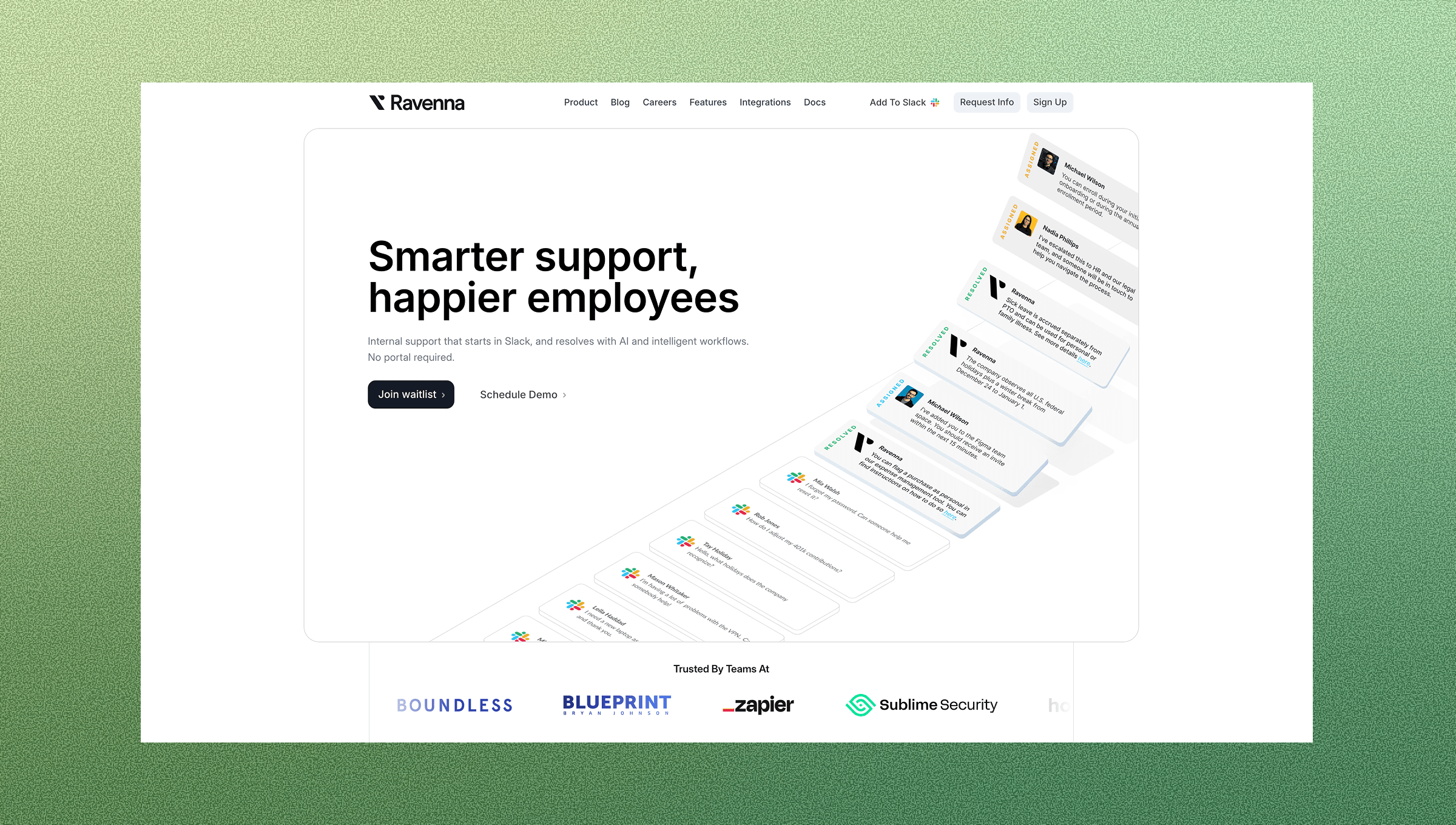
Ravenna is a Slack-native workflow automation engine built to execute end-to-end internal support workflows across IT, HR, and Operations. Unlike middleware solutions that sit on top of existing systems, Ravenna provides the complete stack: conversational interface, automation engine, and ticketing backend unified in one platform.
The platform's core strength lies in its AI agents that actually execute tasks across your SaaS stack (Okta, BambooHR, Jamf, Google Workspace) instead of just routing requests to other systems. When someone asks for Salesforce access, Ravenna doesn't simply create a ticket; it gathers approvals, provisions the license, and adds the user to the right groups automatically. The visual workflow builder with approvals and conditional logic lets teams design these automations without code, using drag-and-drop logic, conditional branching, and approval steps that anyone on the IT team can maintain.
What sets Ravenna apart is the built-in analytics that track AI versus human resolution rates and quantify time savings, giving teams clear visibility into automation impact. The system handles cross-functional workflows spanning IT, HR, and Operations in one unified platform, eliminating the need to maintain separate tools for different departments. Because Ravenna includes a full ticketing backend integrated directly with Slack, organizations can retire their separate service management systems entirely instead of adding another layer to their tech stack.
That said, Ravenna is a newer platform compared to legacy ITSM solutions that have decades of market presence. The platform depends entirely on Slack, which means organizations not using Slack as their primary communication tool will face adoption barriers. While Ravenna excels at automating high-volume workflows, it focuses on execution over complete ITIL process management, so teams requiring extensive governance frameworks may find gaps. The integration marketplace is smaller than enterprise platforms offering thousands of pre-built connectors, and legacy system support is limited compared to platforms designed for complex on-premise infrastructure.
Ravenna works best for Slack-first organizations that want automated execution of high-volume workflows without portal friction or maintaining multiple systems. The system fits teams seeking to augment IT, HR, and Operations staff with AI-powered workflow automation, though it falls short for organizations requiring complete ITIL governance, extensive legacy system support, or enterprise-scale configuration management without Slack as their primary workplace hub.
Jira Service Management
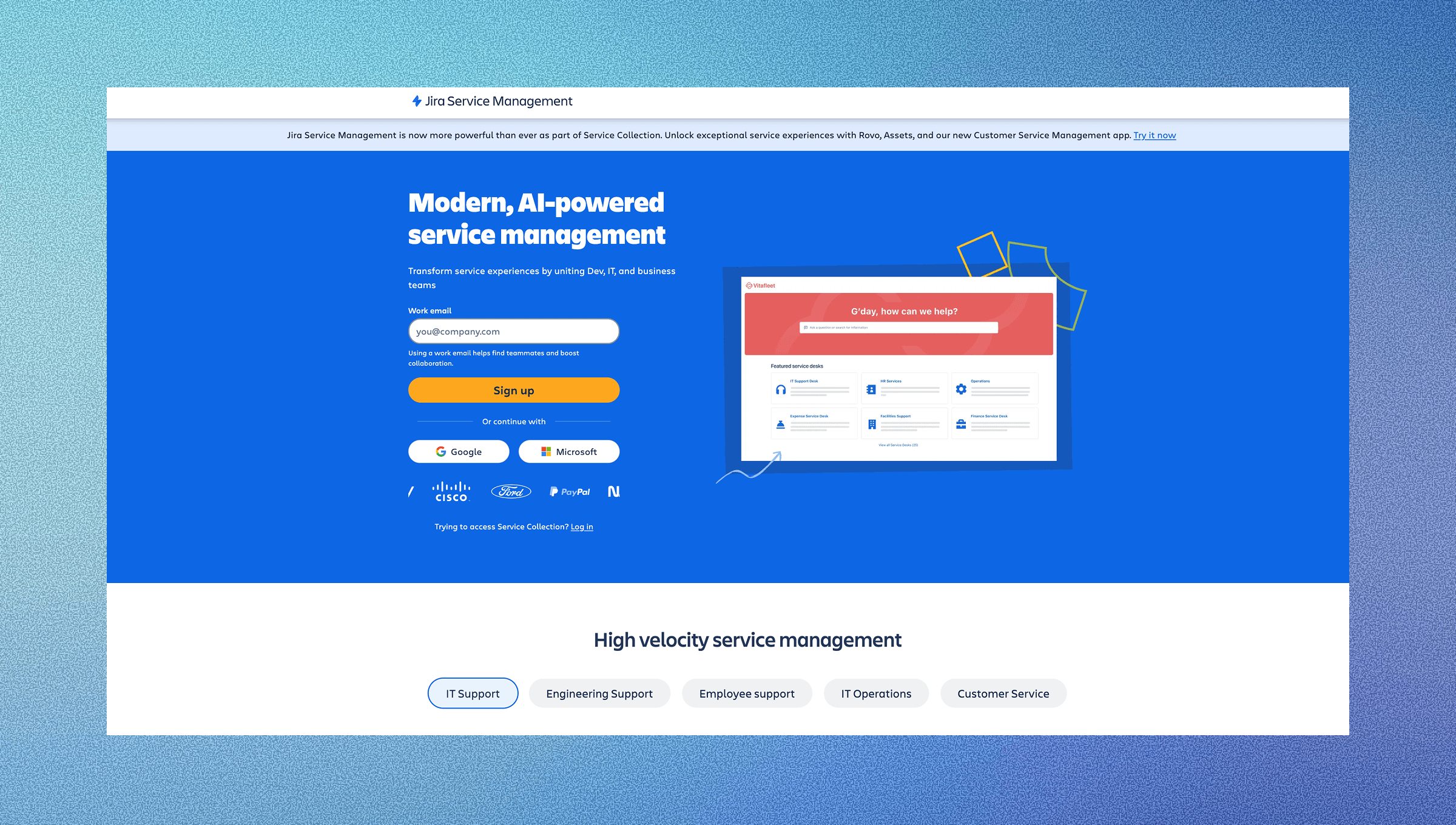
Jira Service Management is an ITSM platform from Atlassian designed for ticket-first service management with queues, SLAs, and ITIL workflows. It operates through service portals and agent consoles within the Jira ecosystem, requiring a lot of configuration to automate workflows beyond basic ticket routing. Teams already invested in Atlassian products can integrate JSM with their existing Jira workflows, though the system focuses on structured ticket management over cross-system workflow execution.
The platform offers ITIL-aligned service management with incident, problem, and change management modules built directly into the system, along with native integration with the Atlassian ecosystem including Jira Software, Confluence, and Opsgenie for unified workflows. Teams can build customizable service catalogs with request forms and approval processes, while SLA tracking and reporting help monitor response times and service level compliance. The platform also includes asset and configuration management for tracking IT assets and their relationships across the organization.
However, Jira Service Management requires extensive configuration to automate workflows beyond basic ticket routing and assignment. The portal-based experience creates adoption barriers compared to Slack-native tools where employees already work, and the platform offers limited out-of-box automation for executing work across external SaaS tools like Okta, BambooHR, or Jamf. Teams need separate projects for cross-functional support spanning IT, HR, and Operations workflows, and the agent console complexity requires training and creates friction for teams managing high-volume requests.
Jira Service Management works best for teams already using Atlassian products that focus first on structured ticket management and ITIL processes over workflow execution. The system fits organizations comfortable with portal-based service delivery and willing to invest configuration time to build automations, though it falls short for teams needing Slack-native automation or cross-system workflow orchestration without heavy customization.
ServiceNow ITSM
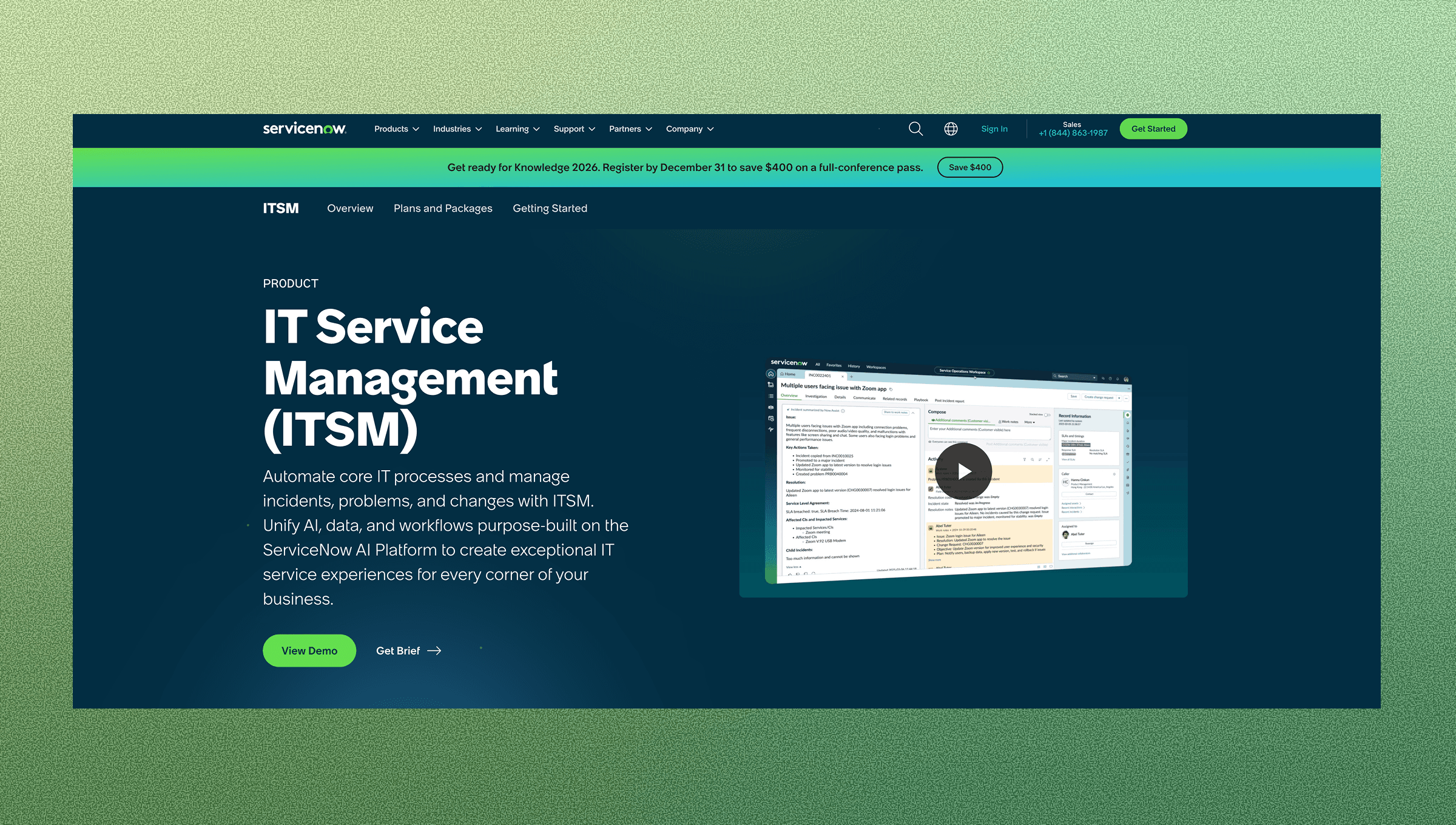
ServiceNow is an enterprise-grade ITSM platform designed for large organizations needing highly configurable governance, complete service catalogs, and full ITIL process management. It requires a lot of implementation resources, specialized administration teams, and months-long rollouts to deploy effectively. The system offers extensive customization capabilities but operates primarily through service portals that struggle with user adoption, with some organizations reporting only 5% user adoption of Service Portals.
The platform provides an enterprise-scale ITIL framework covering incident, problem, change, release, and configuration management processes, along with advanced governance and compliance tools for managing complex organizational policies and audit requirements. ServiceNow boasts an extensive integration marketplace with thousands of pre-built connectors to enterprise applications, while its customizable workflows and business rules operate through a proprietary low-code development environment. The system also delivers complete reporting and analytics with dashboards tracking service performance and operational metrics.
That said, ServiceNow requires dedicated admin teams to configure, maintain, and optimize the platform on an ongoing basis, with implementation timelines spanning months due to complexity of setup, customization, and organizational change management. The portal-based interface suffers from low adoption as employees prefer working in tools like Slack over separate service portals, and the high total cost of ownership includes licensing, implementation services, and ongoing administrative overhead. The platform also offers limited workflow execution across modern SaaS stack without extensive custom development or third-party integrations.
ServiceNow works best for large enterprises with dedicated ServiceNow admin teams that need governance-first service management and can invest in long-term platform optimization. The system fits organizations with complex compliance requirements and existing ITIL processes, though it falls short for teams seeking rapid deployment, high user adoption, or Slack-native workflow automation without heavy customization and maintenance overhead.
Risotto
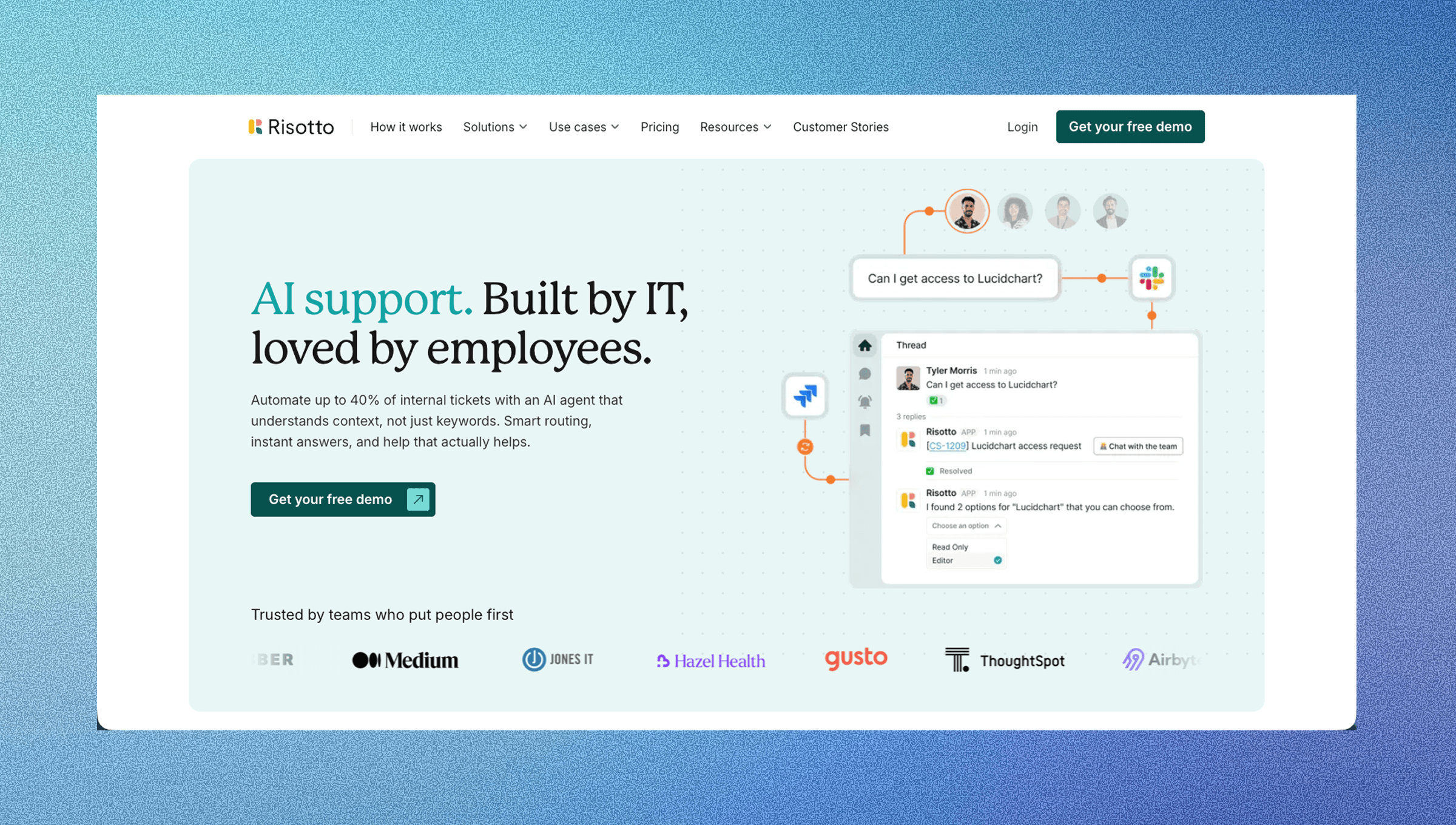
Risotto represents the smaller end of the market with limited public information available about specific capabilities. The platform offers IT support automation through a Slack-based interface, providing basic IT automation workflows for common support tasks and requests. The system integrates with popular IT tools for connecting to existing tech stacks and includes self-service capabilities allowing employees to resolve simple requests independently. Risotto is designed for quick deployment with minimal configuration, making it a lightweight implementation option for teams looking for entry-level IT automation.
However, the limited public documentation makes it difficult to assess the full feature set and capabilities of the platform. The automation scope is narrow compared to platforms handling cross-functional IT, HR, and Operations workflows, and there's small vendor risk as a lesser-known player in the market with unclear long-term viability. Teams needing advanced workflow orchestration across multiple systems will encounter feature gaps, and there are scalability concerns for organizations growing beyond small team use cases.
Risotto works best for small teams with basic IT automation needs who want a simple Slack-based interface. The system fits organizations looking for entry-level automation without complex requirements, though it falls short for teams needing complete workflow automation, extensive integrations, or proven enterprise-grade capabilities with transparent feature sets and long-term vendor stability.
Feature Comparison: Console vs Top Alternatives
The table below breaks down how Console stacks up against other service desk and workflow automation tools across the features that matter when assessing a replacement.
Feature | Console | Ravenna | Jira Service Management | ServiceNow | Risotto |
Slack-Native Experience | Yes | Yes | Integration only | Integration only | Yes |
Full Ticketing Backend | No (requires separate system) | Yes | Yes | Yes | Limited |
Workflow Execution Across SaaS Stack | Limited (specific integrations) | Yes (IAM, HRIS, MDM, SaaS apps) | Depends on configuration | Depends on configuration | Limited |
Visual Workflow Builder | Limited | Yes (drag-and-drop with logic) | Yes (requires configuration) | Yes (complex) | Basic |
AI vs. Human Resolution Analytics | No | Yes | Basic reporting | Advanced (with add-ons) | No |
Cross-Functional Support (IT + HR + Ops) | No (IT-focused) | Yes | Limited (separate projects) | Yes (heavy rollout) | No (IT-focused) |
Time to Value | Moderate (requires existing ITSM) | Fast (weeks) | Moderate (configuration needed) | Slow (months) | Fast (minimal setup) |
Maintenance Model | Customer manages + separate ITSM | Ravenna maintains integrations | Customer configures | Heavy admin required | Lightweight |
Console requires pairing with a separate ticketing system to handle end-to-end request management. Jira Service Management and ServiceNow offer Slack integrations but operate primarily outside Slack. Serval focuses on code generation instead of visual workflow building.
Why Ravenna is the Best Console Alternative
Ravenna solves the fundamental problem that pushes teams away from Console: you need complete workflow automation, not middleware that still requires separate ITSM tools like Jira or Zendesk. Console's approach means paying for two systems while Ravenna handles everything in one.
Console started with software access requests and is still expanding from that narrow focus. Ravenna was built as a full service desk for IT, HR, and Operations workflows from the start. Our AI agents execute work automatically across your existing tools instead of just routing requests. The technical approach differs. While tools like Serval generate TypeScript code that customers must maintain, Ravenna uses a visual workflow builder your IT team can manage without debugging scripts. Legacy systems create real costs: ServiceNow portals see 5% adoption rates and require dedicated admin teams to keep running.
Ravenna works in Slack where your team already operates, automating workflows across Okta, BambooHR, Jamf, and Google Workspace without forcing users into separate portals or requiring IT to juggle multiple systems.
Final Thoughts on Finding the Right Console Alternative
The best Console alternative depends on whether you want to maintain multiple systems or consolidate into one. Console requires pairing with a separate ITSM tool, which works for some teams but creates unnecessary complexity for most. You can automate your high-volume workflows in Slack without splitting your operations across different tools and interfaces.
FAQs
When should you consider moving away from Console?
Consider alternatives if you're paying for both Console and a separate ITSM system like Jira or Zendesk, or if you need to automate workflows beyond software access requests across IT, HR, and Operations. The middleware architecture creates friction when you need unified automation instead of split systems.
What features should you focus on first when comparing Console alternatives?
Look for a full ticketing backend so you're not maintaining two systems, visual workflow builders that don't require code maintenance, and cross-functional support for IT, HR, and Operations workflows. Slack-native execution and analytics tracking AI versus human resolution help measure real automation impact.
How does Ravenna's workflow automation differ from Console's middleware approach?
Ravenna executes complete workflows across your SaaS stack (Okta, BambooHR, Jamf) in one system, while Console routes requests between your existing ITSM tool and integrations. You get the conversational interface, automation engine, and ticketing backend unified instead of managing separate systems for tracking and execution.
Can you automate HR and Operations workflows with Console alternatives?
Ravenna automates across IT, HR, and Operations from the start, handling onboarding sequences, access provisioning, and device management in one workflow engine. Console focuses primarily on IT workflows, while legacy tools like ServiceNow require separate projects and heavy configuration for cross-functional support.
What's the typical implementation timeline for switching from Console?
Most teams complete Ravenna setup in 2-3 weeks, with full workflow optimization taking 1-2 months depending on complexity. You eliminate the separate ITSM system during migration, simplifying your stack instead of adding another layer to maintain.