
If you're looking for a Serval alternative, you're likely weighing how much automation code your team will own over time. Serval generates TypeScript workflows your team customizes and maintains, while Ravenna executes complete workflows end-to-end through managed API integrations.
This Ravenna vs Serval comparison looks at how each handles workflow automation, maintainability, and time-to-value so you can reduce support burden without months of configuration.
TLDR:
Ravenna's AI Agents resolve common requests like access provisioning and password resets autonomously, with no ongoing code maintenance. Serval's generated automations via TypeScript your team can customize. Code-generated automations may require additional technical resources over time.
Ravenna supports agentic automation alongside deterministic workflows, letting IT teams maintain automation without debugging or owning a generated codebase.
Ravenna works natively in Slack with no portal or context switching, driving near 100% adoption compared to legacy systems.
Ravenna is a full-stack platform that replaces legacy ITSM tools entirely
What is Serval?
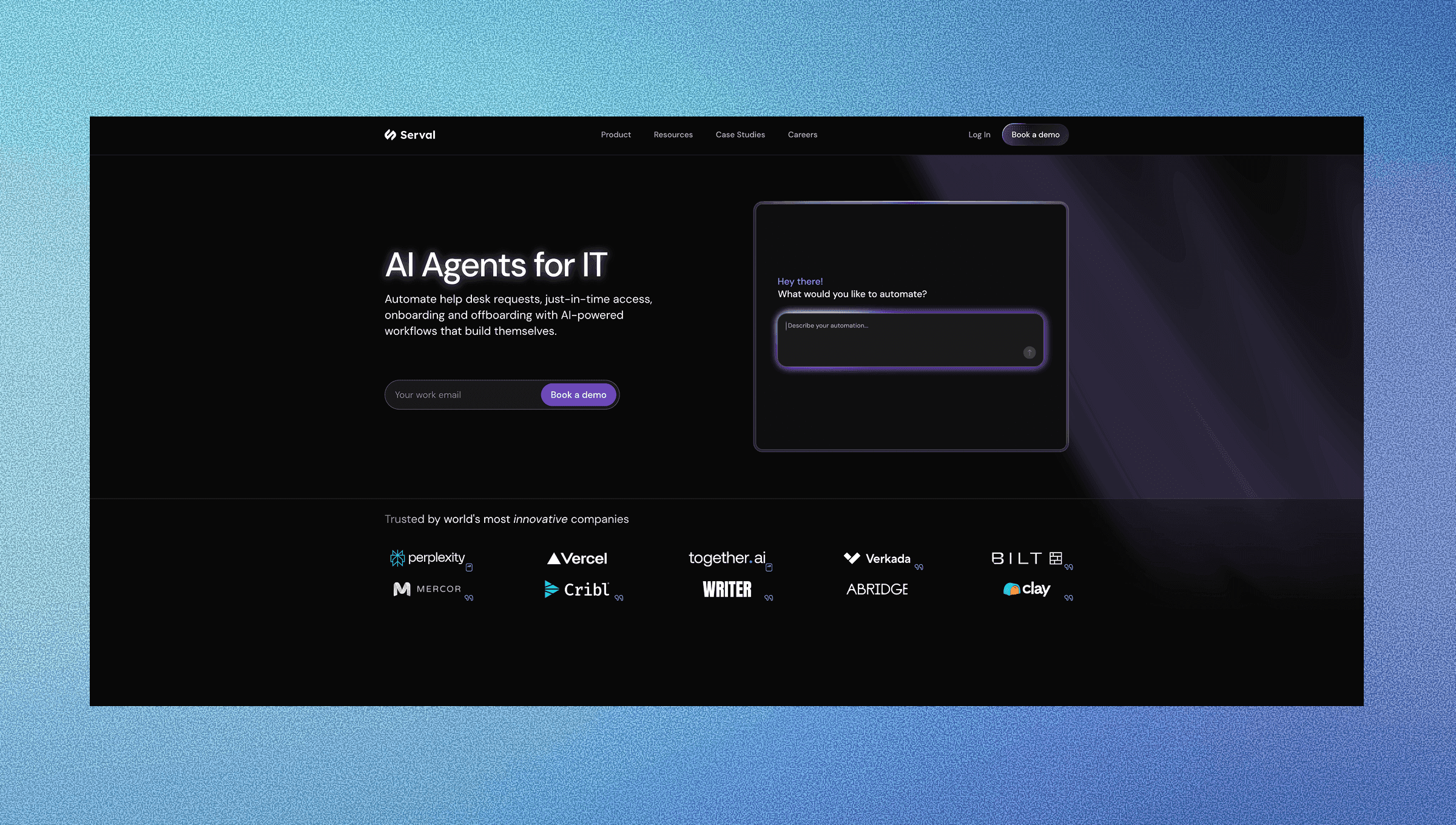
Serval is a workflow automation platform built for IT, spanning help desk, ticketing, access management, and workflow automation. It lets customers describe automations in plain English, which Serval generates as TypeScript the customer then customizes and maintains. This model fits teams with engineering resources to own that code.
What is Ravenna?
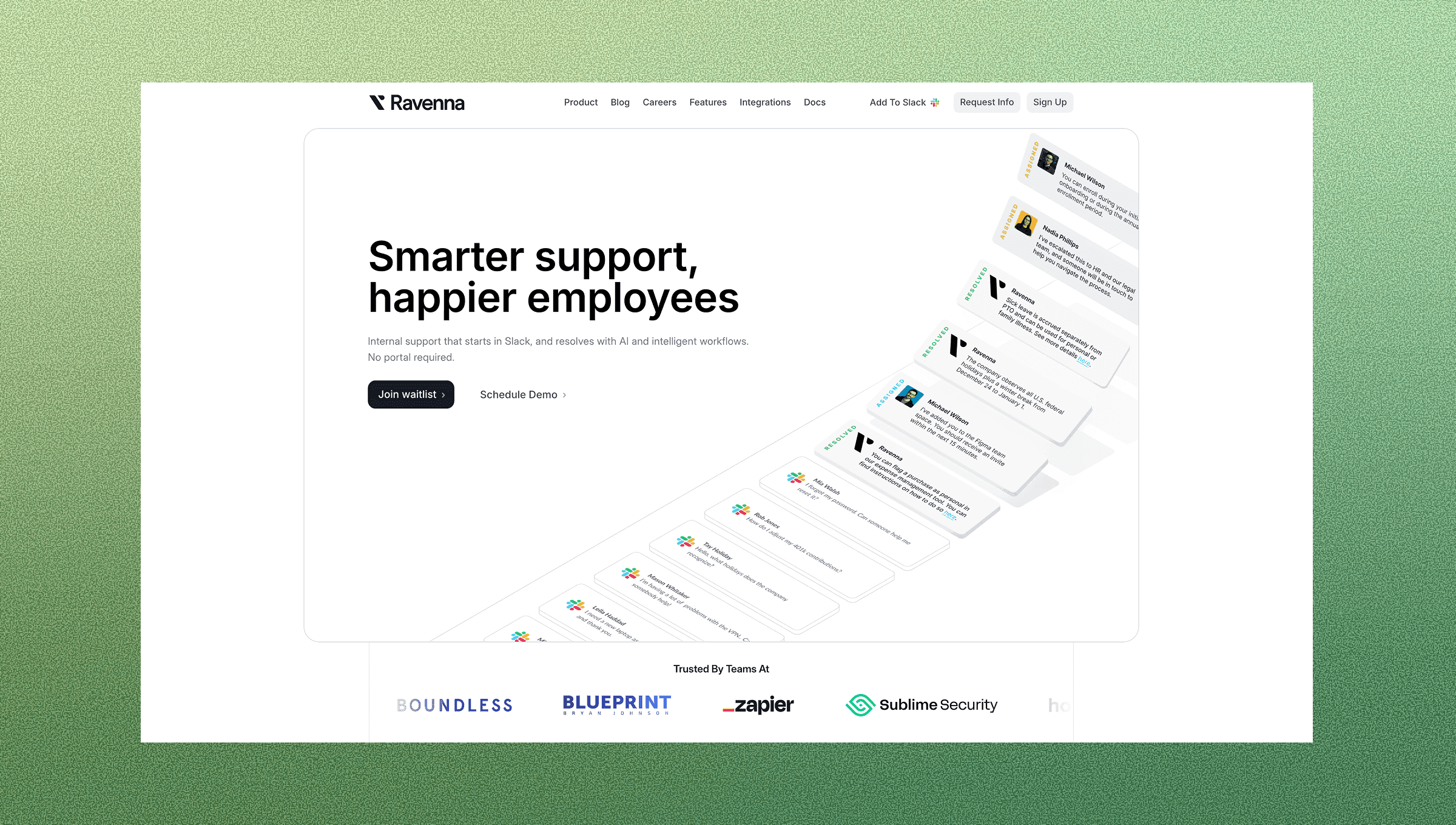
Ravenna is a workflow automation platform built directly into Slack. When an employee requests software access, Ravenna doesn't just create a ticket. It integrates directly with Okta to provision it automatically. Password resets happen through Google Workspace. Onboarding sequences orchestrate across BambooHR, Jamf, and your identity management system without human intervention. Your IT team focuses on complex problems while AI handles the repetitive work that consumes a good chunk of their time.
For informational queries, Ravenna pulls instant answers from Notion or Confluence. It continuously improves by auto-generating knowledge base articles from resolved tickets, creating a self-strengthening support loop that frees your IT team for high-value tasks.
Comparing Ravenna and Serval
The fundamental difference comes down to automation preference and automation maintainability: Serval generates code-based automations while Ravenna generates workflows the run via our workflow engine and leverage direct API integrations that we maintain.
We've compared the two solutions across five key decision factors:
Time to value and set up requirements
Employee adoption and user experience
Automation depth and workflow execution
Maintainability and technical overhead
ROI visibility and proving business impact
Time to Value: Setup Requirements
How quickly you see results depends on what's required before AI can start helping employees.
With Ravenna, you simply connect to your existing knowledge sources and its agents start answering questions immediately. Employees send messages in Slack just as they would to a coworker, and those messages become tickets automatically. Workflow automation begins as soon as you connect your SaaS tools and no custom development is required.
Ravenna delivers value in days. Your team isn't building tools or training employees on new systems. You connect existing knowledge bases, integrate your SaaS stack, and AI starts resolving requests immediately.
Employee Adoption and User Experience
Portal fatigue is real. Legacy service desks suffer from low engagement because employees avoid logging into separate systems. The result: shadow IT, requests lost in DMs, and support teams constantly chasing down information.
Ravenna meets employees where they work brings the service desk to Slack. Employees send a message just as they would to a coworker with no portal to bookmark, no separate login, and no switching between systems. That message becomes a ticket when needed, and the entire resolution lives in the same Slack thread.
Slack-native support drives near 100% adoption because employees already live there. No training required, no portal fatigue, no tickets lost in email. Your IT team handles fewer interruptions while employees get faster help.
Automation Depth: What Actually Gets Automated
The difference between answering questions and completing work determines how much time your team actually saves.
Ravenna's agentic approach executes workflows end-to-end without requiring custom tool development. When an employee requests software access, Ravenna doesn't just create a ticket. It integrates directly with Okta or Google Workspace to provision access automatically. Password resets happen through direct API integration. Onboarding sequences orchestrate across multiple systems (HRIS, identity management, device management) without human intervention.
Ravenna's Visual Workflow Builder provides the same customization depth as custom-built tools such as conditional logic, approval chains, and multi-system orchestration through drag-and-drop configuration instead of code maintenance. You get department-specific routing (e.g., "Engineering requests auto-approve VS Code, Finance requests require manager approval"), complex approval hierarchies, and workflows that span multiple systems. The difference is that you configure this through visual nodes instead of building API connectors and scripts from scratch.
AI-based automation in ITSM can reduce incident resolution times by almost 50%, but that metric only matters if you're automating actual work, not just deflecting questions to knowledge articles.
Maintainability: Two Dimensions of Technical Overhead
The real cost of automation isn't setup, it's maintenance. When business requirements change or integrations break, who fixes it? Maintainability breaks down into two critical dimensions:
System Consolidation
Ravenna replaces legacy ITSM tools entirely. Slack messages become tickets automatically with customizable forms, statuses, and queue views. Historical ticket data migrates during onboarding, so you maintain reporting continuity and the AI learns from past resolutions. IT incidents, HR onboarding, and finance approvals run through one interface. Manager approvals happen in Slack with a button click.
Workflow Maintenance
Ravenna generates workflows based on natural language prompts. Customers can explore and edit workflows using our no-code workflow canvas instead of debugging AI-generated code. Your IT team sees exactly what happens at each step and maintains workflows without debugging scripts. When you need to add a new approval step or change routing logic, you update the visual canvas instead of code that might break other workflows.
Ravenna eliminates technical debt from automation on both fronts. You consolidate from two systems to one, reducing licensing costs and integration complexity. Your IT team maintains workflows through a visual interface they can understand and modify confidently with no debugging AI-generated code, no vendor lock-in to legacy ITSM infrastructure.
ROI Visibility: Proving Business Impact
Without clear metrics showing what AI actually accomplishes, you can't prove ROI or optimize automation strategy. Ravenna provides granular visibility into automation performance:
AI Agent vs. Human Resolution Metrics: See exactly how many tickets AI resolves autonomously versus those requiring human intervention. Track which workflow types succeed and where humans still need to step in.
Time Saved Calculations: The system quantifies hours saved per workflow type, giving you concrete ROI numbers. Not just "tickets deflected" but "workflows completed autonomously."
Workflow Performance Analytics: Track ticket volumes, SLA compliance, and CSAT scores in one dashboard. Identify which workflows consistently need human intervention so you know where to refine automation logic.
When you can show that AI Agents resolved 40% of tickets last month, completed 200 access provisioning workflows automatically, and saved 60 hours of agent time, you have provable ROI. This level of detail is critical for justifying investment and continuously improving automation effectiveness.
Ravenna provides the specific metrics executives need to see: AI vs. human resolution rates, time saved per workflow type, and ROI calculations that prove business value. Rather than guessing at impact, you're actually measuring it.
Side-by-Side Comparison
Feature | Ravenna | Serval |
Primary Approach | Full-stack workflow automation platform | IT focused workflow automation platform |
Setup Requirements | Connect knowledge sources and SaaS tools, start immediately | Installable workflows deploy in a click; custom workflows are authored as code |
Employee Experience | Meet employees where they work. Slack, Teams, Email, Portal all supported. | Slack, Teams, Email, Portal all supported. |
AI Automation Method | Agentic workflows powered by Ravenna Agents + deterministic workflows | Prebuilt and customer-generated workflows |
Workflow Customization | Natural language + visual builder with drag-and-drop nodes, no code maintenance | Plain-English generation into code via TypeScript |
Analytics & ROI Visibility | AI Agent vs. human resolution metrics, time saved calculations, workflow completion tracking | Automation performance tracking; specific metrics not publicly detailed |
Knowledge Management | Auto-generates KB articles from resolved tickets; pulls from existing documentation | Integrates with existing knowledge bases; approach not extensively detailed |
Total Cost of Ownership | Single platform license; no legacy ITSM costs | Serval license; optional existing ITSM system license |
Best For | Fast adoption across IT, HR, and finance with minimal setup time | Teams with engineering capacity to author workflow code |
Final Thoughts on Comparing AI-Powered Service Management Options
For organizations seeking to transform support across IT, HR, and Finance with a modern, integrated approach, Ravenna is the superior choice.
The decision comes down to whether you want to author and maintain workflow code in-house or use a platform with managed integrations. If your priority is speed to value, visual maintenance, and proven ROI, Ravenna eliminates the friction of traditional service desks and delivers automation from day one.
Ready to see the difference? Book a demo to explore how Ravenna transforms internal support.
FAQs
What's the main difference between how Ravenna and Serval handle automation?
Serval generates TypeScript automations your team customizes and maintains. Ravenna generates Agentic + deterministic automations that don't require your team to maintain code.
What happens to our existing tickets and historical data when switching to Ravenna?
Ravenna imports your historical ticket data during onboarding to preserve institutional knowledge and reporting continuity. The AI learns from past resolutions to improve its automation accuracy from day one. Your team maintains access to historical trends, SLA performance, and resolution patterns without starting from scratch. Migration typically takes 1-2 weeks, depending on data volume and source system complexity.
We've invested heavily in our current ITSM system. Is migration worth it?
If your current system requires employees to log into a portal, create tickets manually, and doesn't automate workflows end-to-end, you're likely losing a meaningful share of IT capacity to repetitive work. Ravenna's migration process preserves historical data while eliminating the friction that causes low adoption and shadow IT. Most customers see positive ROI within 3-6 months.
How do we maintain control over what AI can and cannot do?
Ravenna's Visual Workflow Builder gives you complete control over automation logic. You define approval requirements, set conditional routing based on department or role, and specify exactly which actions AI can take autonomously. The system never executes workflows you haven't explicitly configured.