
Modern IT teams are under pressure to deliver stable services while keeping pace with rapid change. That tension often leads to confusion between ITIL vs DevOps as if the two approaches are competing. In reality, rather than choosing one over the other, the challenge is understanding how structure and speed can coexist. This matters because most teams rely on a mix of formal ITSM processes and fast-moving engineering workflows, yet they struggle to unify them across tools and communication channels.
As organizations grow, the need for predictable processes increases, but so does the expectation for rapid delivery. ITIL offers the governance needed to support reliability, while DevOps emphasizes agility and automation. The question for many teams isn’t which framework is best, but rather how to bring both into their daily workflows without slowing down the workflows. That’s where operational tooling and especially Slack, where cross-functional work already happens, becomes part of the answer.
This article breaks down the core differences between ITIL and DevOps, explores how they work together in practice, and shows how teams are using Slack-native workflows to merge governance with agility.
TL;DR
ITIL provides structure, governance, and standardized processes for service delivery.
DevOps emphasizes automation, collaboration, and speed in software operations.
The two aren’t competing; most organizations benefit from a hybrid model.
Ravenna brings ITIL workflows into Slack so teams can achieve ITIL structure at DevOps speed.
What Is ITIL?
Any conversation about ITIL vs DevOps begins with understanding what ITIL actually provides. ITIL, AKA information technology infrastructure library, is a structured framework for IT Service Management (ITSM) that helps teams align technology operations with business needs. It defines clear processes for incident management, change management, problem management, SLAs, and governance. The goal is simple: create predictable, reliable, and repeatable service delivery practices.
ITIL’s core goals
At its foundation, ITIL focuses on standardization. Defined workflows reduce ambiguity, minimize risk, and help teams deliver stable services. This consistency becomes especially important as organizations scale, where informal communication isn’t enough to manage complex environments.
Where ITIL is strongest
ITIL optimization shines in enterprise settings where accountability and approvals are essential. Teams benefit from clear roles, documented workflows, and structured escalations that guide service behavior. These strengths make ITIL a cornerstone of many ITSM platforms and a familiar reference point for IT managers and service desk leaders. With this structure in place, it becomes easier to understand how newer operational models like DevOps can complement traditional ITSM.
Check out our visual guide on ITIL vs ITSM for an in-depth look.
What Is DevOps?
DevOps emerged as a response to slow, fragmented delivery cycles in traditional IT environments. Instead of emphasizing governance, DevOps focuses on culture, collaboration, and automation between development and operations. The goal is to accelerate software delivery while improving quality through continuous improvement and shared responsibility.
DevOps principles
DevOps encourages teams to adopt CI/CD pipelines, build automated test and deployment systems, and learn from incidents through blameless postmortems. Continuous feedback loops help engineering and operations teams improve reliability while reducing friction in delivery. These principles also encourage a mindset where tooling and automation are the default, not an afterthought.
Where DevOps is strongest
DevOps is particularly effective in fast-changing, engineering-driven organizations. Agile environments benefit from rapid releases and streamlined processes that minimize bottlenecks. By reducing handoffs, DevOps creates a smoother operational flow that emphasizes outcomes instead of approvals. These strengths explain why DevOps practices increasingly influence ITSM teams who want to move faster without sacrificing service quality.
Together, ITIL and DevOps represent different responses to the same challenge: delivering reliable services at scale. Understanding their differences sets the stage for exploring how modern teams integrate the two.
ITIL vs DevOps: Key Differences
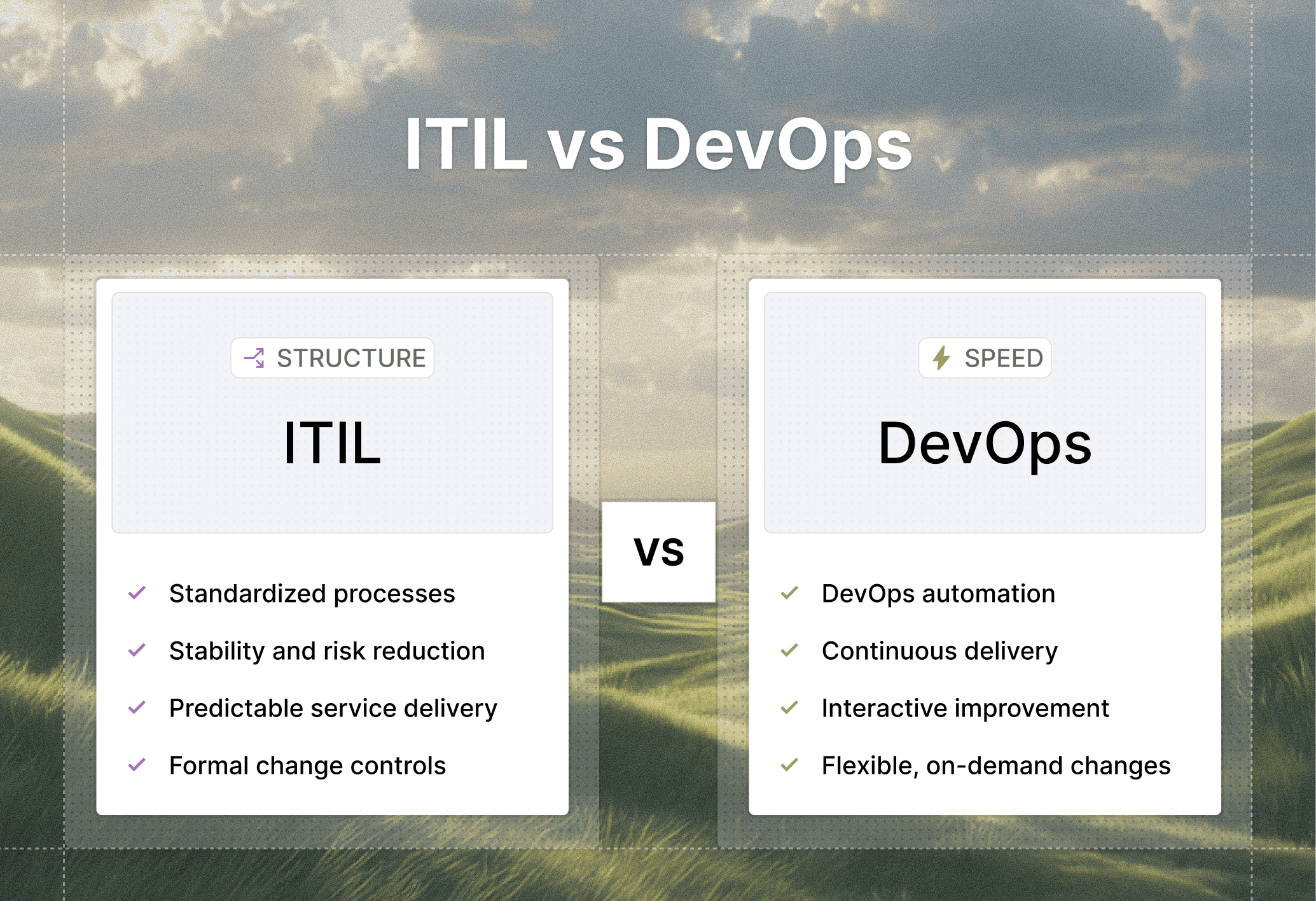
While often compared, ITIL and DevOps approach service delivery from different angles. ITIL emphasizes structure, consistency, and control, whereas DevOps centers on agility, automation, and continuous delivery. These contrasting emphases create the perception of conflict, but both serve important and often complementary purposes.
Process vs Culture
ITIL outlines what should happen in a service lifecycle, defining processes for incidents, changes, and problems. DevOps, by contrast, focuses on how work actually flows. Its cultural emphasis encourages shared ownership, rapid iteration, and fewer rigid handoffs.
Control vs Agility
ITIL traditionally prioritizes control. Change Advisory Boards (CABs) and detailed workflows help organizations avoid risk. DevOps shifts toward automation-first practices where changes move quickly through pipelines with built-in quality checks. This agility allows teams to release more frequently without compromising safety.
Roles vs Toolchains
ITIL uses clearly defined roles to ensure accountability. DevOps relies on collaborative tooling such as CI/CD pipelines, GitOps workflows, and Slack-centric communication to keep teams aligned. These toolchains reduce friction and make complex processes easier to execute in real time.
Taken together, these differences illustrate why ITIL vs DevOps shouldn’t be framed as a binary choice. Instead, they offer distinct strengths that many teams integrate to suit their environment.
ITIL vs DevOps: Why They Aren’t Opposites
It’s increasingly common for teams to adopt both ITIL and DevOps practices because they address different needs. ITIL provides the structure required for stable operations, while DevOps improves execution speed and responsiveness. Rather than creating tension, modern organizations blend the two into a single operating model.
ITIL defines structure, while DevOps accelerates execution
Many ITIL processes, especially incident, change, and problem management benefit from DevOps automation. For example, an ITIL-defined change process becomes more efficient when paired with automated testing, deployment pipelines, and ChatOps notifications. This hybrid approach maintains governance while improving throughput.
Explore the differences between AI service desk vs traditional helpdesk.
ITIL 4 explicitly incorporates DevOps principles
The introduction of ITIL 4 marked a shift toward agility, value streams, and collaboration. DevOps practices are now embedded into ITIL’s guidance, recognizing that speed and modern tooling improve service outcomes. The framework encourages integrated workflows rather than rigid separation between development and operations.
Understanding this evolution helps teams see ITIL and DevOps as complementary frameworks. The real advantage comes from determining how to apply each one in daily operations.
Practical Examples of ITIL and DevOps Working Together
The most useful way to understand ITIL and DevOps synergy is by looking at real-world workflows. Many teams already blend the two without realizing it, especially when incidents, changes, and service requests require input from engineering teams.
Change Management
ITIL defines how changes should be proposed, reviewed, and approved. DevOps accelerates this process with automated testing, deployment pipelines, and quality gates. When combined, teams maintain governance while reducing lead time for safe releases.
Incident Management
ITIL provides the framework for categorizing and resolving incidents. DevOps contributes automation tools, on-call workflows, and post-incident learning practices. This combination helps teams reduce MTTR while improving service reliability.
Service Requests & Knowledge
ITIL describes how requests should be fulfilled and how knowledge is shared. DevOps speeds up execution using shared repositories, automated responses, and collaborative tools. Together, they streamline support without sacrificing consistency.
These examples illustrate how modern IT operations already blend structured ITSM with the speed and flexibility of DevOps. The next step is choosing the right balance based on team needs.
ITIL vs DevOps: Which One Should Your Team Use?
Choosing between ITIL and DevOps is less about frameworks and more about operational context. Some teams need stronger governance, while others require agility to support rapid development cycles. Most find that a hybrid approach provides the best balance.
Teams that benefit from ITIL-first
Organizations with high compliance requirements, distributed teams, or complex infrastructure often rely on ITIL to maintain order. Structured workflows ensure consistent decision-making and reduce operational risk.
Teams that benefit from DevOps-first
Engineering-led companies, agile environments, and teams with rapid release cycles benefit from DevOps. Automation reduces bottlenecks, while shared ownership improves speed and resilience.
Most teams need a hybrid model
Because modern operations span both infrastructure and software delivery, structure and agility are equally important. A hybrid model allows teams to maintain ITIL’s clarity while adopting DevOps practices that reduce friction and increase throughput.
This decision framework helps clarify where each approach fits into your service ecosystem and how they can reinforce one another.
Where Ravenna Fits in ITIL + DevOps Environments
Bringing ITIL and DevOps together requires operational tooling that supports both governance and speed. Ravenna acts as a Slack-native automation layer that connects ITIL-aligned processes with DevOps execution, simplifying how teams manage incidents, approvals, and service requests.
Ravenna aligns with ITIL processes
Ravenna streamlines incident creation and triage by capturing requests directly from Slack, applying consistent categorization, and routing issues to the right teams. Approvals and SLAs can be managed within the same environment, giving IT teams the oversight they need without relying on portals. Knowledge surfaced inside Slack makes documented processes easier to access in the flow of work.
Ravenna accelerates DevOps execution
DevOps teams benefit from automated workflows that connect Slack with existing tools such as Jira, ServiceNow, and GitHub. Auto-classification, channel creation for incidents, and CI/CD-triggered updates help reduce manual steps and speed up response. These capabilities reinforce DevOps automation while maintaining the clarity of ITIL-defined workflows.
The result: ITIL structure at DevOps speed
By unifying communication, approvals, and automation inside Slack, Ravenna enables teams to adopt both ITIL and DevOps practices without increasing complexity. The result is a more resilient operational model where governance supports agility instead of limiting it.
Final Thoughts on ITIL + DevOps as the Modern Blueprint
The most effective teams no longer choose between ITIL and DevOps. Instead, they combine ITIL’s structured processes with the automation and speed of DevOps to create a more responsive service model. This hybrid approach supports both stability and agility: two qualities essential for modern operations. As organizations rely more on Slack for cross-functional communication, Ravenna provides the operational foundation that makes this integration real. By bringing ITIL workflows into the tools DevOps teams already use, Ravenna enables teams to adopt both frameworks without compromising productivity.
To see how Ravenna brings ITIL workflows into Slack, book a demo with us.
FAQs
What is the difference between ITIL and DevOps?
ITIL focuses on structured processes for managing IT services, while DevOps emphasizes collaboration, automation, and speed. ITIL defines the “what,” and DevOps focuses on the “how.” Most teams benefit from combining both.
Is ITIL still relevant in 2025?
Yes. ITIL 4 incorporates agile and DevOps principles, making it more adaptable to modern engineering environments. Its guidance on governance, incident management, and value streams remains widely used.
What is replacing ITIL?
Nothing directly replaces ITIL. DevOps, SRE, and agile practices complement ITIL rather than substitute for it. Many teams integrate these frameworks to balance reliability with agility.
What is the difference between ITIL and DevOps vs SRE?
ITIL provides structured ITSM processes, DevOps emphasizes automation and delivery speed, and SRE focuses on reliability engineering using service-level objectives. Together, they form a layered operational model.
How do ITIL vs DevOps vs Agile compare?
ITIL offers governance, DevOps provides automation and shared ownership, and Agile focuses on iterative delivery. All three can work together to improve service outcomes.