

Your buyout review workflow probably works fine for annual renewals. Multi-year contract approval is a different animal. When you're locking in a three to five year commitment, the financial exposure compounds, the legal terms get harder to unwind, and the gap between what sales agreed to and what finance actually modeled can quietly widen until someone finally compares notes. This post walks through how to structure your sales, finance, and legal coordination so that everyone is reviewing the same deal against the same criteria before any of it becomes binding.
TLDR:
A buyout review workflow routes multi-year contracts through sales, finance, and legal in a fixed sequence before any commitment becomes binding.
Sales and finance rarely share the same view of deal value: sales closes on total contract value, finance models on net present value, and without a structured handoff those numbers diverge.
Tier your approval process by contract value and risk: deals over $500K need full multi-function review and C-suite sign-off; deals under $25K need sales sign-off alone.
Parallel review routing breaks when teams assume independence that doesn't exist. Legal redlines can invalidate financial terms finance already approved, creating a longer loop than sequential routing would have.
Ravenna's RevOps Agent routes contract metadata, penalty model inputs, and renewal clause details to each reviewer in a shared Slack or Teams thread the moment a buyout flag is raised.
What Is a Buyout Review Workflow?
A buyout review workflow is the structured internal process an organization runs before a multi-year contract becomes a binding commitment. It routes the agreement through every function with a stake in the outcome: sales to confirm deal economics, finance to model cash flow and budget impact, legal to assess liability and exit terms.
What separates this from a standard contract signature is the scale of exposure. A short-term deal gone wrong costs a quarter. A three-year buyout with compounding penalties, auto-renewal clauses, and volume commitments costs considerably more, and the risk grows with every year the agreement runs. Without a governed review process, that exposure lands on whoever happened to sign, because no single person holds the full picture. The structure exists so that no department's blind spot becomes a company-wide liability.
Why Multi-Year Commitments Demand a Formal Review Process
Multi-year contracts carry a weight that annual renewals simply don't. When a company commits to a three, five, or seven-year vendor relationship, the financial exposure, the legal complexity, and the structural dependencies all compound in ways that make ad-hoc approval processes genuinely dangerous.
The core problem is that most buyout review workflows were designed for shorter commitments. A one-year contract gone wrong is a manageable setback. A poorly structured multi-year deal can lock an organization into unfavorable pricing, restrictive exit clauses, or liability terms that outlast the teams who signed them.
Three structural realities make formal review non-negotiable at this commitment length.
Revenue recognition and cash flow modeling require finance to stress-test payment schedules across multiple fiscal years, accounting for currency exposure, discount rate assumptions, and the timing of deliverables. Without a formal checkpoint, these calculations happen informally, or not at all.
Legal risk compounds over time. Indemnification clauses, IP ownership terms, and dispute resolution provisions that seem minor in a twelve-month deal become material when they govern a relationship measured in years. Legal review at the point of signature is the only moment where those terms can actually be negotiated.
Sales and finance rarely share the same view of deal value. Sales closes on total contract value; finance models on net present value and cash timing. Without a structured handoff, those two numbers can diverge considerably before anyone catches it.
A formal multi-year contract approval process isn't about slowing deals down. It's about making sure the three functions with the most at stake (sales, finance, and legal) are reviewing the same document, against the same criteria, before the commitment becomes binding. A well-structured contract workflow and approval process defines exactly who reviews what, in what order, so nothing falls through the gap between teams.
Stakeholder Roles: What Sales, Finance, and Legal Each Own
Each team arrives at a buyout review with a different definition of "done", and those definitions rarely overlap cleanly.
Sales owns the relationship and the timeline. Their priority is getting a signed commitment before a competing vendor fills the gap or a budget cycle closes. They know the customer's pain points, the verbal agreements made during discovery, and the flexibility the deal needs to move. What they often lack is visibility into the financial exposure a multi-year term creates or the legal risk hiding in a non-standard termination clause.
Finance owns the revenue model. They need to verify that the buyout structure, early termination fees, prorated credits, ramp schedules, maps to how the company actually recognizes revenue. A deal that looks clean from the outside can create deferred liability or recognition timing problems that only surface in the next audit. Finance also runs the credit and counterparty risk checks that protect the business if the customer can't perform across a three- or four-year term.
Legal owns the language. Their job is to make sure the contract says what everyone agreed to, and that it doesn't quietly agree to things nobody discussed. In multi-year buyout structures, the clauses that matter most tend to be the ones that feel routine: auto-renewal language, governing law, limitation of liability, and the specific conditions under which either party can exit without full penalty.
Where Ownership Gets Contested
The friction in most buyout review workflows shows up at the handoff points between these three roles, not inside any one team's lane.
Pricing concessions approved verbally by Sales often reach Legal as a done deal, which puts Legal in the position of documenting a commitment instead of reviewing it. By the time a non-standard discount structure gets flagged, the customer has already been told it's approved.
Finance's credit review runs on its own timeline and rarely integrates with Legal's redline cycle. A deal can clear financial approval and then stall for two weeks while Legal works through the same counterparty risk questions Finance already answered.
Legal's final sign-off sometimes requires changes that affect the pricing model, which sends the file back to Finance for re-approval. Without a clear escalation path, that loop can run more than once.
Defining ownership upfront, who reviews what, in what order, and who has authority to approve exceptions, is what separates a buyout review workflow that closes on time from one that quietly ages past its target date.
Structuring the Approval Chain for Multi-Year Deals
Multi-year commitments move through more approval layers than standard annual contracts, and the sequence of those layers matters as much as the stakeholders involved. Sales, finance, and legal each carry veto power at different points, and when the review order is undefined, deals stall while teams wait to find out whose input comes first.
A clear buyout review workflow removes that ambiguity by assigning each function a defined gate in a fixed sequence.
A Practical Approval Sequence
Most organizations that handle multi-year contract approval well follow a structure that looks roughly like this:
Sales completes deal qualification and documents the buyout terms, including any early termination provisions, before the review chain opens. Finance and legal should not receive an incomplete package.
Finance reviews total contract value, revenue recognition schedule, and exposure under early termination scenarios. This gate should not move in parallel with legal because legal redlines often change the financial terms.
Legal reviews after finance signs off, so any structural changes to payment terms or liability caps get flagged before final signatures.
A designated approver, typically a VP or CFO depending on contract size, provides final sign-off once both reviews are complete.
Tier the Process by Contract Value
Not every multi-year deal carries the same risk, and running every commitment through the full chain wastes time on smaller agreements. A tiered threshold structure keeps high-stakes reviews thorough without slowing routine approvals.
Contract Value | Sales Sign-Off | Finance Review | Legal Review | Executive Approval |
|---|---|---|---|---|
Under $25K | Required | Optional | Not required | Not required |
$25K to $100K | Required | Required | Optional | Not required |
$100K to $500K | Required | Required | Required | VP level |
Over $500K | Required | Required | Required | C-suite |
The exact thresholds should reflect your organization's risk tolerance, but the structure itself is what keeps sales, finance, and legal coordination from becoming a bottleneck on every deal regardless of size.
Sequential vs. Parallel Review Routing
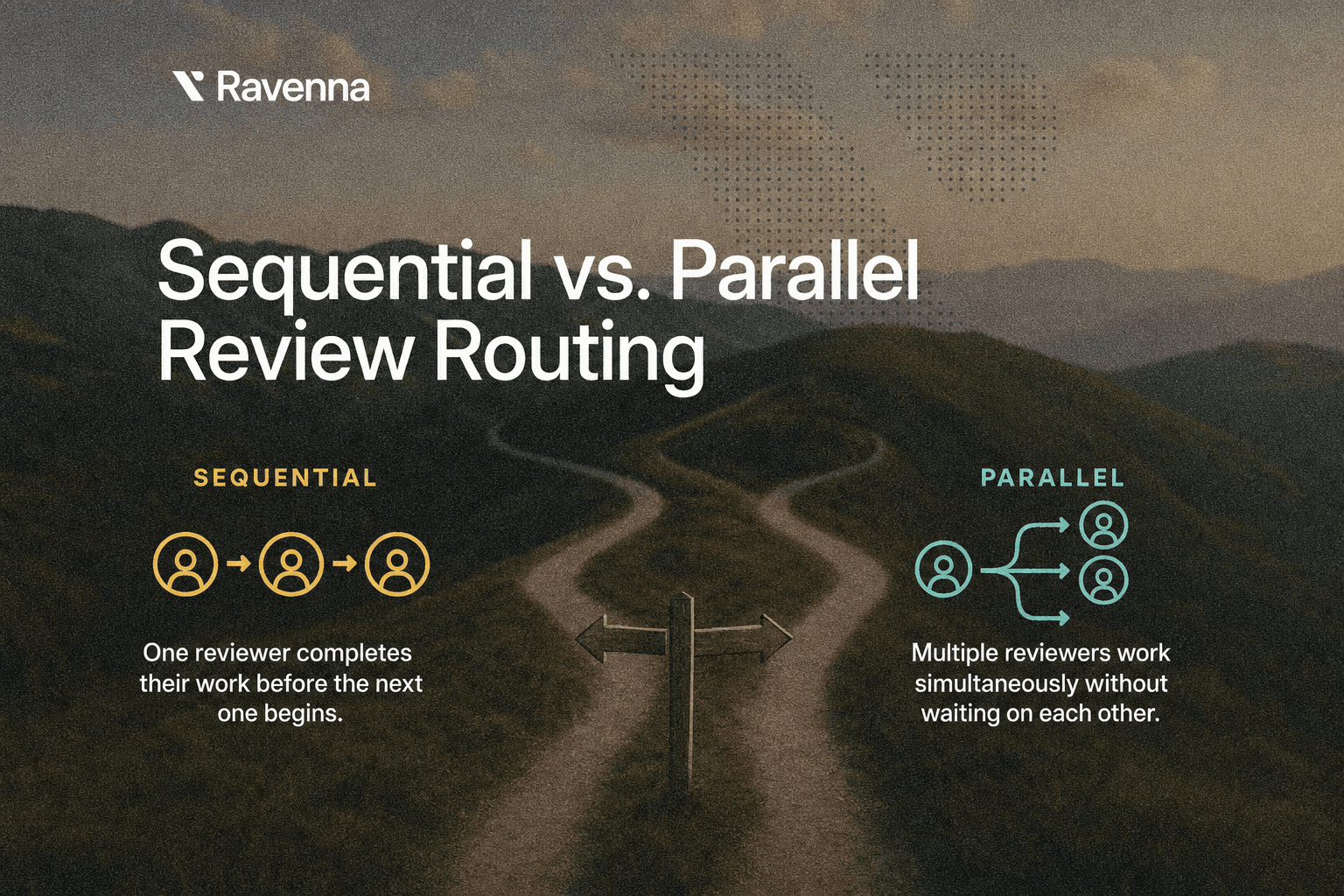
The routing decision comes down to one question: does each reviewer actually need the prior stage's output to do their job?
When dependencies exist, sequential is the right call. Legal cannot finalize indemnification terms without knowing the confirmed payment structure. Running a redline against pricing that is still being modeled generates rework, and that rework eats more time than the sequential gate would have saved.
Parallel routing works when the reviews are genuinely independent. A counterparty credit check and a legal entity verification can run simultaneously without creating downstream conflicts. Regulatory screening, if your deal crosses jurisdictions, can often overlap with Finance's cash flow modeling for the same reason.
The Failure Mode That Slows Multi-Year Contract Approval
The failure mode to watch: teams assume independence when it does not exist, run parallel to hit a close date, and then Legal's redline invalidates a financial term Finance already signed off on. That loop is slower than sequential routing would have been from the start. The buyout review workflow does not break because the team moved too slowly; it breaks because two stages ran on assumptions about each other that were never actually verified.
Common Bottlenecks in Multi-Department Buyout Reviews
Multi-department buyout reviews stall for reasons that are almost too predictable once you've seen a few of them. The delays rarely trace back to a single bad actor or a genuinely hard decision. They come from structural gaps between teams that were never designed to work in sequence.
Here are the failure modes that show up most often.
Sales enters a buyout scenario without a clear handoff trigger, so finance only learns about the commitment when a signature is already expected. By that point, finance is reacting to a timeline it had no hand in setting, and any concerns it raises read as obstruction instead of input.
Finance approval queues treat multi-year buyout requests the same as standard renewals, even though the financial exposure and revenue recognition implications are fundamentally different. A deal that needs a net present value calculation and an ARR scheduling review sits in the same queue as a one-year extension.
Legal receives contract redlines without the commercial context that explains why a specific structure was agreed to. When counsel flags a term, there's no easy way to trace whether the term was a deliberate concession or an oversight, which forces another loop back to sales.
Version control across the three departments collapses into email threads. Sales is working from one draft, legal from another, and finance from a term sheet that predates both.
Nobody owns the overall review clock. Each team completes its step and considers the work done. Without a shared view of where the request sits across all three reviews simultaneously, deals age invisibly until a customer asks for a status update.
The through line is the same in every case: the buyout review workflow was never actually designed. It was assembled from whatever each department already did for simpler approvals and then stretched to cover a multi-year commitment it was never built to handle.
Tiered Approval Based on Contract Value and Risk
Not every contract carries the same weight. A one-year SaaS renewal at $40,000 and a five-year infrastructure commitment at $2 million both technically qualify as "multi-year contracts," but running them through the same buyout review workflow wastes time on the first and undersells the risk on the second.
A tiered approval structure fixes this by matching review depth to actual exposure.
How Tiers Work in Practice
Most organizations land on three tiers, defined by total contract value and term length:
Tier 1 covers lower-value, shorter commitments where a department head sign-off is sufficient. The sales team confirms commercial terms, finance checks budget availability, and legal reviews only if there are non-standard clauses.
Tier 2 covers mid-range contracts requiring VP-level approval. Finance models the multi-year cash flow impact, legal reviews the full agreement, and sales confirms the customer's renewal history.
Tier 3 covers high-value or high-risk commitments that go to executive or board review. Every stakeholder runs a complete analysis, and no signature moves forward without documented sign-off from each function.
Where Risk Adds a Second Dimension
Contract value alone does not capture the full picture. A $300,000 deal with a termination-for-convenience clause and auto-renewal terms carries more exposure than a clean $500,000 contract with standard exit provisions. Risk factors that can move a contract to a higher tier regardless of value include:
Penalty clauses or liquidated damages provisions
Auto-renewal windows shorter than 30 days
Exclusivity requirements that limit future vendor options
Regulatory obligations tied to the customer's industry
When any of these conditions appear, the contract moves up a tier automatically, without waiting for a reviewer to flag it manually.
Putting the Tiers on Paper
The table below maps value thresholds, required approvers, and review scope across the three tiers. Use it as a starting point and adjust thresholds to match your organization's actual deal mix.
Tier | Contract Value | Term | Required Approvers | Review Scope |
|---|---|---|---|---|
1 | Under $100K | 1-2 years | Department Head | Budget check, standard legal terms |
2 | $100K-$500K | 2-3 years | VP level | Cash flow model, full legal review, renewal history |
3 | Over $500K | 3+ years | Executive or Board | Complete multi-function analysis, documented sign-off |
Risk escalation rules override value thresholds. Any contract with penalty clauses, short auto-renewal windows, exclusivity requirements, or regulatory obligations moves to the next tier regardless of dollar amount.
Maintaining Visibility Across the Review Cycle
Buyout reviews fail quietly, not because of bad intent, but because no one has a clear view of where the approval actually stands.
Buyout reviews fail quietly. Not because the deal economics are wrong, but because no one can tell where the approval actually stands. Sales thinks legal is reviewing. Legal thinks finance hasn't signed off yet. Finance sent comments three days ago that nobody read. By the time someone surfaces the gap, the customer's timeline has moved on.
The fix isn't a status meeting. It's a shared reference layer that reflects the current state of every open review without anyone having to ask.
What Visibility Actually Requires
Most teams treat status updates as a communication problem. The real issue is structural: approvals touch three functions that each track progress in different systems, and none of those systems talk to each other by default.
Sales logs deal notes in the CRM, but buyout terms and approval status rarely live there in any structured way, and gaps in Salesforce and HubSpot permission access for revenue teams make it even harder to maintain a shared record.
Finance tracks covenant exposure and multi-year cash flow implications in spreadsheets that only two people can read, and those files don't surface when a rep needs a quick answer.
Legal maintains redline histories in document management tools that are invisible to everyone else until a final version gets sent.
The result is that each function has a locally accurate picture and nobody has a globally accurate one.
A Shared State, Not a Status Call
A buyout review workflow that maintains visibility treats approval state as a single source of truth that each function writes to and reads from. When finance completes its cash flow review, that completion registers in the same place legal checks before starting its covenant analysis. When legal flags a term for renegotiation, sales sees it before the next customer call, not after.
This matters most on multi-year commitments, where approval cycles can span weeks and the original deal context decays fast. A rep who closed the initial opportunity may not remember the specific concessions that triggered a finance hold. A lawyer reviewing month two of a three-month redline cycle needs the full history, not a forwarded email chain.
Visibility across the review cycle means every stakeholder can answer two questions at any moment: where does this stand, and what is blocking it. If either answer requires a phone call to find out, the workflow has a structural gap.
Post-Signature Obligations and Renewal Management
Once the contract is signed, the review work changes focus but does not stop. Multi-year commitments carry ongoing obligations that can quietly create liability if no one owns them after ink dries.
Tracking Deliverables and Milestone Dates
Most post-signature failures trace back to the same gap: the signed document lives in a repository, but the obligations inside it never get converted into tracked tasks. Payment schedules, usage thresholds, performance benchmarks, and termination windows all need owners and calendar dates assigned at signature, not surfaced later during a dispute.
Renewal Management
Renewal windows on multi-year contracts are frequently missed because the team that negotiated the deal has moved on by the time the window opens. The hidden costs of auto-renewing contracts, from missed deadlines to lost negotiating position, make proactive renewal tracking a non-negotiable part of any multi-year buyout workflow. A buyout review workflow should include a renewal alert sequence triggered well before the opt-out deadline, routed to whoever currently owns the vendor relationship, with enough lead time to run a fresh evaluation if needed.
Auto-renewal clauses can lock organizations into another multi-year term if no one acts within the notice period, which is often 60 to 90 days before expiration.
Finance needs visibility into renewal cost projections before budget cycles close, not after the window has passed.
Legal should review whether contract terms still match current regulatory requirements before any renewal is executed.
The goal is a complete feedback cycle where post-signature obligations feed back into the same workflow infrastructure that managed the original approval, so nothing falls into the space between teams.
How Ravenna Supports Buyout Review Workflows
Buyout reviews fail quietly. A rep flags a potential early termination, finance needs three weeks to model the penalty exposure, legal hasn't seen the original contract language, and the deal sits in a holding pattern while everyone waits for someone else to move first. By the time the team reconvenes, the customer has already started looking at other options.
Ravenna's AI agents cut through that holding pattern by routing the right context to the right reviewer the moment a buyout flag is raised in Slack or Teams.
What the Workflow Looks Like in Practice
When a rep marks an opportunity as a buyout candidate, Ravenna's RevOps Agent pulls the relevant contract metadata, calculates remaining commitment value, and posts a structured review thread directly in the team's shared channel. Finance gets the penalty model inputs. Legal gets a link to the original agreement. Sales gets a clear timeline for when responses are needed. Nobody has to chase a thread or re-explain the deal context from scratch.
The sequence Ravenna runs across a buyout review:
The RevOps Agent reads the opportunity record and extracts multi-year commitment details, surfacing remaining term, contract value, and any documented renewal clauses before the first reviewer opens the thread.
Finance receives a pre-structured input request with the exact figures needed to run penalty exposure modeling, so a multi-week wait can become a same-day response.
Legal gets flagged with the contract reference already attached, removing the back-and-forth retrieval step that typically adds days to review cycles.
Approval gates are built into the workflow, so the deal cannot advance until each stakeholder has signed off, creating an auditable record of who reviewed what and when.
Where This Fits the Broader Approval Chain
Multi-year contract approval rarely fails because the people involved are slow. It fails because the handoff between sales, finance, and legal has no structure. Each team is working from a different document, a different Slack thread, or a different assumption about who owns the next step.
Ravenna manages that coordination layer by treating the buyout review as a single end-to-end workflow, not three separate tasks running in isolation. The result is a process where every stakeholder sees the same context, responds inside the same thread, and completes their step before the next one opens.
Final Thoughts on Running a Structured Buyout Review Workflow
The structure of your buyout review workflow matters more than the people inside it. When sales, finance, and legal each track progress in different systems with no shared reference layer, deals age invisibly and post-signature obligations fall into the gaps between teams. If you want to see how Ravenna handles that coordination in practice, start a conversation with us.
FAQ
What's the right approval sequence for a multi-year contract, should sales, finance, and legal review in parallel or sequentially?
Sequential review is the right call when dependencies exist between stages, which they almost always do in multi-year buyout structures. Legal cannot finalize indemnification terms against a payment structure that finance hasn't confirmed yet, running those stages in parallel generates rework that costs more time than the sequential gate would have. Parallel routing only works when the reviews are genuinely independent, such as running a counterparty credit check alongside a legal entity verification.
How do you build a tiered approval structure for multi-year contract approval without slowing down routine deals?
Match review depth to actual exposure by creating value-based tiers with defined approver requirements at each level, for example, department head sign-off for contracts under $100K, VP-level review for $100K, $500K, and executive or board approval above $500K. Overlay a risk escalation rule so that contracts with penalty clauses, auto-renewal windows shorter than 30 days, or exclusivity requirements move up one tier automatically, regardless of dollar value.
What are the most common bottlenecks in sales, finance, and legal coordination on buyout reviews?
The failures almost always trace to structural gaps between teams, not slow individual reviewers. Finance approval queues treat multi-year buyout requests the same as standard renewals, legal receives redlines without commercial context explaining why a term was agreed to, and nobody owns the overall review clock. Each team completes its step and considers the work done while the deal ages invisibly. Version control collapsing into email threads, with each department working from a different draft, compounds every one of these gaps.
How can Ravenna's RevOps Agent cut the review cycle time on a multi-year buyout?
When a rep marks an opportunity as a buyout candidate, Ravenna's RevOps Agent pulls the contract metadata, calculates remaining commitment value, and posts a structured review thread directly in Slack or Teams, routing penalty model inputs to finance, the original agreement to legal, and a response timeline to sales, without anyone chasing a thread. Approval gates built into the workflow prevent the deal from advancing until each stakeholder has signed off, creating an auditable record of who reviewed what and when.
What post-signature obligations should a buyout review workflow track after a multi-year contract is signed?
Payment schedules, usage thresholds, performance benchmarks, and termination windows all need owners and calendar dates assigned at signature, not surfaced later during a dispute or audit. Auto-renewal clauses deserve particular attention: notice periods are frequently 60 to 90 days before expiration, and missing that window can lock the organization into another multi-year term before finance has had a chance to model the renewal cost against the current budget cycle.