
For years, service management has been tightly associated with IT. If something broke, needed access, or required approval, the answer was almost always the same: submit a ticket and wait. That approach worked when IT was the primary service provider inside the business. Today, it feels increasingly misaligned with how organizations actually operate.
Teams like HR, Finance, Facilities, and Operations now also own a growing share of employee requests. Yet many still rely on inboxes, spreadsheets, or ad hoc Slack messages to manage them. This disconnect is why conversations around ITSM vs ESM have gained momentum. Leaders want to understand how service management can extend beyond IT without adding more friction or tools.
The challenge isn’t replacing what already works. It’s figuring out how proven service management principles can scale across the enterprise, meeting employees where work already happens.
TL;DR
ITSM focuses on managing IT services, while ESM applies those same principles across the organization.
Enterprise service management brings structure to HR, Finance, Facilities, and Operations requests.
ESM does not replace ITSM; it builds on IT service management foundations.
Modern ESM succeeds when delivered in everyday tools, not separate portals.
What Is ITSM?
IT service management emerged to bring consistency and accountability to IT operations. Frameworks like ITIL introduced structured processes for incidents, service requests, changes, and problem management. The goal was simple: keep systems reliable while giving IT teams a repeatable way to respond to issues.
Over time, ITSM tools became systems of record. They track tickets, approvals, assets, and service-level agreements. For IT teams, this structure is essential. Standardized workflows remain one of the strongest predictors of faster resolution times in IT support environments.
The limitation is scope. ITSM was never designed to serve the entire organization. As companies grew, other teams inherited similar request volumes without the same tooling or process maturity. This gap is what set the stage for a broader approach to service management.
What Is ESM?
Enterprise service management, AKA ESM, takes the principles behind ITSM and applies them across non-IT functions. Instead of incidents and change requests, the workflows might handle onboarding tasks, expense questions, or facilities issues. The underlying logic remains the same: standardized intake, clear ownership, and automated routing.
The rise of ESM closely tracks changes in employee expectations. When requests disappear into inboxes or chat threads, trust and efficiency suffer.
This is where enterprise service management differs in intent. It focuses less on the department providing the service and more on the experience of the person requesting it. With this foundation, organizations can scale support without scaling chaos.
ITSM vs ESM: Scope, Users, and Tooling
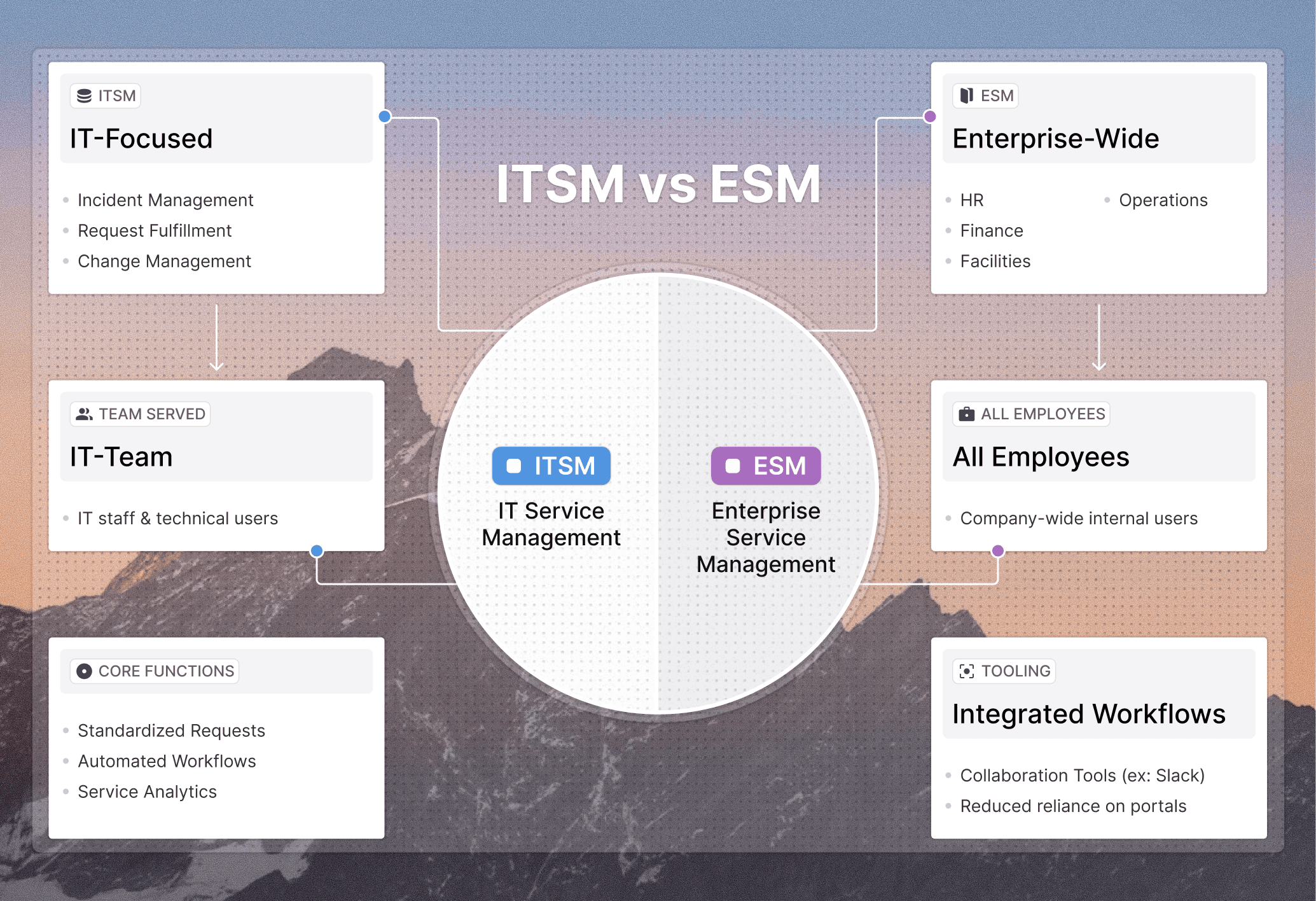
At the heart of the ITSM vs ESM conversation is scope. ITSM is purpose-built for IT teams, with processes optimized around infrastructure, applications, and access. ESM expands that scope to include every internal service function across the company.
The users change as well. ITSM primarily serves IT staff and technical stakeholders. ESM serves the entire workforce, including employees who may never log into a traditional ticketing portal. Tooling reflects this difference. ITSM platforms often rely on dedicated portals, while ESM increasingly favors embedded workflows inside collaboration tools.
This distinction matters because adoption drives value. Research on digital workflow adoption shows that tools embedded in daily work environments see significantly higher usage than standalone systems. In practice, ESM succeeds when it reduces the effort required to ask for help, not when it adds another destination.
Real-World ESM Use Cases Beyond IT
The most effective enterprise service management programs start with common, high-volume requests. HR teams often lead the way, using ESM workflows for onboarding, offboarding, and policy questions. Structured intake ensures nothing falls through the cracks while automation reduces manual follow-ups.
Finance teams apply similar patterns to approvals and expense inquiries. Facilities and operations teams use ESM to manage access requests, equipment issues, and office maintenance. In each case, the model is consistent: a clear entry point, defined ownership, and visibility into status.
What changes is not the process, but the context. When employees can initiate requests without leaving their primary workspace, completion rates improve and response times drop. This consistency is what allows service management to scale beyond IT without reinventing the wheel.
Does ESM Replace ITSM?
A common misconception is that adopting ESM means abandoning ITSM. In practice, the opposite is true. Strong enterprise service management depends on a mature ITSM foundation. ITSM remains the system of record for IT-related services, compliance, and reporting.
ESM acts as an extension layer. It brings other teams into the same service-oriented mindset while respecting existing systems and processes. This layered approach reduces risk and avoids the disruption that comes with replacing core platforms.
Organizations that succeed with ESM treat it as an evolution, not a rip-and-replace initiative. With that clarity, teams can focus on improving experience rather than debating ownership.
How Ravenna Enables ESM Directly in Slack
Modern work happens in collaboration tools, and service management is no exception. Ravenna approaches enterprise service management by turning Slack into a universal entry point for requests. Employees ask for help where they already communicate, without navigating portals or learning new systems.
Behind the scenes, Ravenna connects those requests to existing ITSM, CRM, and ERP platforms. This preserves systems of record while improving accessibility and adoption. Service teams gain structure and visibility, while employees get faster responses with less effort.
This model supports true service management beyond IT. It respects established tooling while removing the friction that often prevents ESM initiatives from gaining traction.
When to Choose ITSM, ESM, or Both
Early-stage organizations often start with ITSM alone. As request volumes grow and non-IT teams become service providers, ESM becomes increasingly relevant. Larger enterprises typically benefit from using both together, with ITSM anchoring technical workflows and ESM extending reach.
The decision depends on scale, complexity, and employee expectations. Centralized IT teams may prioritize ITSM maturity first. Distributed organizations with multiple service functions often see faster returns by layering ESM on top.
With this maturity-based approach, service management evolves naturally alongside the business.
Final Thoughts on ITSM vs ESM
The conversation around ITSM vs ESM reflects a broader shift in how organizations think about internal services. IT service management remains essential, but it no longer tells the whole story. As more teams take on service responsibilities, the need for a shared, scalable approach becomes clear.
Enterprise service management provides that bridge. By extending proven ITSM principles beyond IT and delivering them where work already happens, organizations can improve efficiency without adding complexity. When done well, ESM strengthens the foundations that ITSM put in place.
FAQs
What are the key differences between ITSM and ESM?
The key difference between ITSM vs ESM lies in scope and audience. IT service management (ITSM) focuses on managing IT services such as incident management, change management, and IT support within the IT department. Enterprise service management (ESM) extends those same ITSM principles across non-IT departments like HR, Finance, Facilities, and Operations to support enterprise-wide service delivery.
Why are organizations moving from ITSM to enterprise service management?
Organizations adopt enterprise service management as request volumes grow beyond IT and manual processes create silos. ESM helps streamline internal services, automate workflows, and improve employee experience by standardizing how service requests are handled across business units. This shift supports digital transformation while reducing reliance on email, spreadsheets, and disconnected ticketing systems.
What business functions can benefit most from ESM?
Enterprise service management is commonly used by human resources, finance, facilities management, procurement, and operations teams. Typical ESM use cases include employee onboarding, expense approvals, access requests, and facilities issues. By applying ITSM frameworks like ITIL outside IT, organizations improve service quality and response times across the entire organization.
Do you need ITSM in place before implementing ESM?
Yes, most successful ESM strategies build on a mature ITSM foundation. ITSM remains the system of record for IT operations, service desks, and compliance. ESM tools integrate with existing ITSM platforms rather than replacing them, allowing organizations to scale service management without disrupting established IT workflows.
Can enterprise service management work without a self-service portal?
Yes. Modern ESM solutions increasingly operate without traditional self-service portals. Instead, they embed service workflows directly into collaboration tools like Slack or Microsoft Teams. This approach improves adoption, reduces friction for end-users, and ensures service requests are created and routed without employees leaving their daily work environment.
Is enterprise service management only for large enterprises?
No. While large enterprises often see the fastest ROI from ESM, growing organizations also benefit as internal service demands increase. Companies experiencing cross-team dependencies, rapid hiring, or operational complexity can use ESM to optimize workflows, reduce service delivery disruptions, and improve employee satisfaction earlier in their growth cycle.