

The ITSM service desk is where IT theory meets Monday morning reality: tickets pile up, and your team is triaging the same requests it was triaging last quarter. The gap worth closing is between AI that surfaces an answer for a human to act on and AI that executes the resolution without anyone touching it.
TLDR:
The service desk is IT's single point of contact for incidents and requests; the help desk only handles break-fix.
Most self-service portals fail on adoption because employees won't leave Slack or email to log into a separate system.
Fully AI-automated tickets resolved in 2.4 to 6.3 hours vs. 49 to 102 hours for partially automated ones, per Fixify's 2026 benchmark.
Most AI in service desks today is advisory: it routes work back to a human instead of executing the resolution end-to-end.
Ravenna is a Slack and Teams-native workflow automation platform whose AI agents execute requests across Okta, Jamf, and Workday without a manual step in between.
What Is an ITSM Service Desk?
The ITSM service desk is the single point of contact between IT and the rest of the organization. When an employee can't access a system, needs software provisioned, or runs into a hardware issue, the service desk is where that request lands. It handles incidents, service requests, and ongoing communication across the request lifecycle.
Under ITIL, the service desk is a distinct practice within the broader IT Service Management framework, not a synonym for it. ITSM governs how IT works; the service desk is where employees experience it directly.
Service Desk vs. Help Desk: Understanding the Difference
Help Desk | Service Desk | |
|---|---|---|
Primary focus | Break-fix resolution | Full IT service delivery |
Scope | Incidents and outages | Incidents, requests, changes, communication |
Orientation | Reactive | Proactive and reactive |
ITIL alignment | Informal | Formal practice |
The help desk fixes things. The service desk manages the entire relationship between IT and the business. A help desk agent closes the ticket when the printer works again. A service desk owns the process from request intake through fulfillment, including communicating planned changes, managing service requests, and tracking the user experience across every touchpoint.
For most small and mid-sized organizations, the distinction is a question of scope. A help desk vs service desk distinction matters: a help desk fits when the priority is keeping things running. A service desk makes sense when IT is expected to deliver services predictably, handle provisioning and onboarding, and give leadership visibility into how those services perform.
Service Desk vs. ITSM: How They Relate
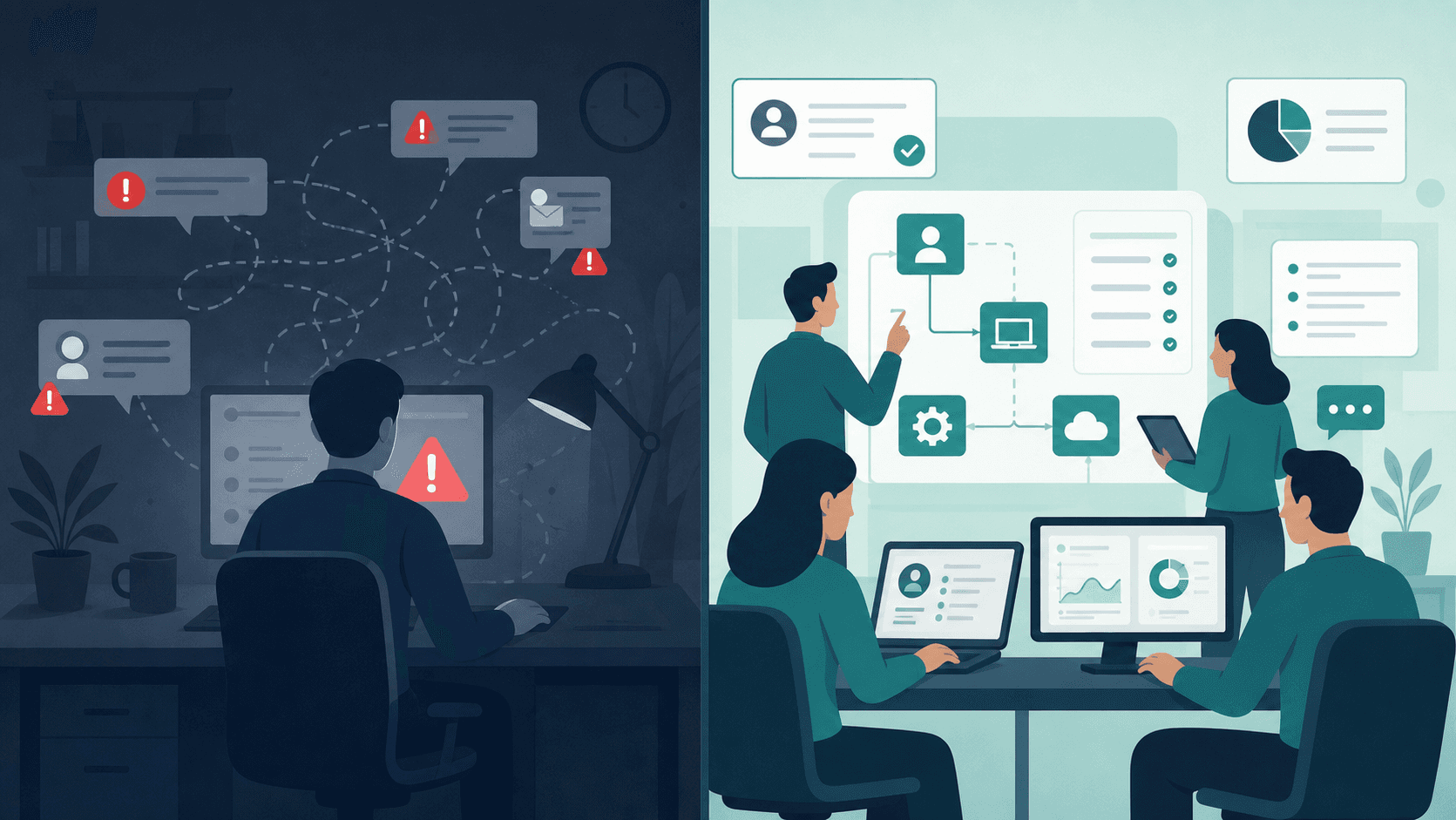
ITSM is the discipline; the service desk is where employees feel it. ITSM covers how IT designs, delivers, and continuously improves services across the organization, while the service desk is the active practice employees interact with day to day. ServiceNow, Jira Service Management, and similar tools implement ITSM processes. The framework is the system, and the service desk is where you check in.
This distinction matters when choosing software. A platform can claim ITSM compliance while delivering a poor service desk experience, which is why understanding AI-native ITSM matters. A lean service desk can resolve requests well without touching half of what ITSM covers. Know which gap you're filling before you choose a tool.
IT Service Desk Roles and Responsibilities
A ticket stalls when no one owns the next step. These are the roles that decide whether work moves or sits.
Tier 1 Analyst
Handles inbound requests and resolves password resets, access issues, and basic questions without escalation.
Tier 2 Specialist
Owns complex issues requiring deeper system access that Tier 1 cannot resolve independently.
Service Desk Manager
Keeps the queue moving, holds SLA ownership, and reports desk performance to leadership.
Knowledge Manager
Owns documentation accuracy and identifies knowledge gaps driving repeat tickets across the desk.
Key ITSM Service Desk Processes
Six processes run underneath every service desk, and together they determine whether the desk is reactive or structured.
Incident management: Restore service as fast as possible when unplanned interruptions hit, prioritizing speed over root cause.
Service request management: Handle expected, repeatable asks like access provisioning and hardware setup through predefined fulfillment paths.
Change management/enablement: Control how IT service changes get reviewed, approved, rolled out, and communicated to end users.
Problem management: Find and fix the underlying cause of recurring incidents so the same tickets stop returning.
Knowledge management: Turn resolved work into reusable documentation so repeat questions find answers without reaching the queue.
Event management: Monitor system signals and act on alerts before an outage ever reaches the ticket queue.
The Self-Service Portal and Its Role in Modern Service Desks
A self-service portal gives employees one place to submit requests, track ticket status, and search a knowledge base without reaching out to an agent. The promise is fewer inbound contacts and faster resolution for simple asks. In practice, most portals underdeliver on adoption. Employees don't log in. They message IT on Slack, send an email, or walk to someone's desk, and the service desk ends up handling the same volume through informal channels while also maintaining a portal nobody visits.
The root cause is friction. Leaving your current tool to log into a separate system, remember a URL, and fill out a form is a higher bar than sending a quick message. That gap is what most service desk teams call shadow support: requests arrive outside the formal channel, get resolved informally, and leave no record. The knowledge base never grows from those interactions, and the team never gets credit for the work.
Portals that live inside Slack or Teams see meaningfully higher submission rates because the intake step doesn't require a context switch, which is how self-service IT support in Slack reduces ticket time. The portal stops being a destination and becomes part of the workflow employees already use.
Service Desk Metrics That Actually Matter
Most teams track ticket volume and call it measurement. The metrics worth watching are the ones that tell you where resolution breaks down and why.
First-contact resolution rate: The share of tickets resolved without escalation; a persistent dip surfaces as Tier 2 backlog quickly.
Mean time to resolve (MTTR): Fixify's 2026 IT Help Desk Benchmark Report found AI-automated tickets resolved in 2.4 to 6.3 hours versus 49 to 102 hours for partially automated ones.
SLA compliance rate: Chronic misses signal understaffing, poor prioritization, or SLAs set without reference to actual capacity.
Ticket reopen rate: High reopen numbers mean the desk is closing tickets before the user's actual problem is resolved.
Customer satisfaction score (CSAT): CSAT can hold steady even with slow resolution, as long as communication stays consistent.
ITSM Service Desk Best Practices
Structure pulls work back into the queue when escalation, intake, and documentation aren't defined. These five practices close those gaps.
Define escalation paths before you configure anything. Document which request types escalate, who owns them at Tier 2, and what context transfers with the ticket.
Standardize intake across every channel. Phone, email, Slack, and portal each need to produce the same structured fields: category, requester, affected system, priority.
Build your knowledge base from resolved tickets, not planned documentation sessions. Let the queue drive the content.
Set SLAs against business schedules, not continuous clock time. Pause timers outside working hours and resume when your team is staffed.
Run post-incident reviews on recurring ticket patterns. If the same request type appears weekly, that's a problem management trigger.
How AI Is Changing ITSM Service Desk Execution
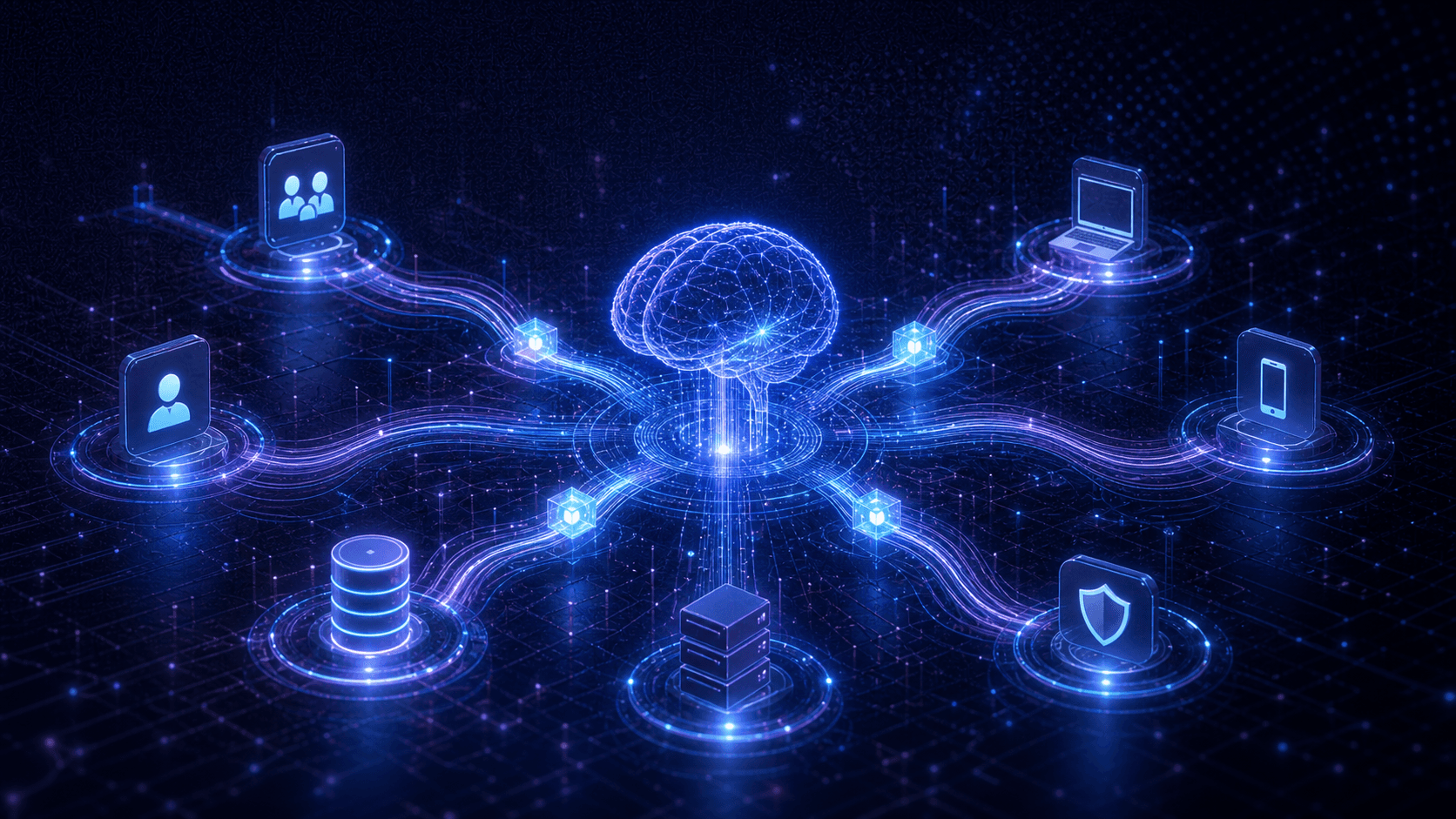
Most AI in service desks today is advisory. It reads the ticket, suggests a category, surfaces a knowledge article, and hands the work back to a human. That's a whole lot of merry-go-round just to get to a human agent in the end.
The shift happening now is from routing to resolution with AI in ITSM. An agentic system doesn't suggest the password reset. It triggers it in Okta, confirms the action, and closes the ticket, without a human clicking anything. Advisory AI reduces the time an agent spends looking for context; agentic AI removes the agent from the resolution path entirely.
That cost is measurable. Fixify's 2026 IT Help Desk Benchmark Report, drawn from 50,000+ tickets, found fully AI-automated tickets resolved in 2.4 to 6.3 hours. Partially automated tickets requiring human intervention took 49 to 102 hours. Every manual handoff is where resolution time compounds.
As itsm.tools notes, agentic AI ITSM is moving the service desk toward autonomous operation: connecting signals, executing across systems, and validating outcomes without waiting for a human to push each step. The ticket stops being the unit of work; the resolved outcome is.
What to Look for When Choosing ITSM Service Desk Software
Most software selection goes wrong before a single demo is booked. Teams evaluate platforms on feature checklists instead of asking whether the tool resolves work or just routes it. Here are the criteria that actually separate a good fit from a regrettable contract.
Deployment model: Standalone keeps your stack simpler. An enhancement layer works if you have compliance reasons to preserve a legacy system.
Channel nativeness: Portal-first tools require employees to leave Slack or Teams. Conversation-first intake drives higher submission rates and fewer informal workarounds.
Automation depth: The meaningful question is whether the tool executes multi-step workflows across connected systems without a human completing each step manually.
Workflow builder model: No-code visual builders produce auditable, maintainable automation. Code-generation approaches produce scripts your team owns and debugs whenever your stack changes.
Integration breadth: A service desk that can't reach your IAM, HRIS, and MDM systems can't resolve the requests those systems generate.
Analytics: Automation ROI metrics (requests resolved without human intervention, hours saved per workflow) show whether the platform reduces manual work or just logs it more neatly.
How Ravenna Built Agentic Workflow Automation for the Service Desk
An employee types a password reset request in Slack. The IT Agent interprets the intent, pulls the requester's context, triggers the reset directly in Okta, and posts confirmation back in the same thread. An offboarding request arrives: the PeopleOps Agent suspends the account, reclaims licenses, removes Google Group memberships, and closes the loop without a human clicking anything. The request never becomes work someone has to pick up.
Ravenna is a Slack and Teams-native workflow automation platform built for IT, HR, and Operations teams. Where traditional service desks log a request and route it to a human queue, Ravenna's AI agents interpret intent, gather context, and execute the resolution across connected systems, covering Okta, Jamf, Workday, BambooHR, Google Workspace, and more.
The Visual Workflow Builder produces stable, auditable no-code automations. When something breaks, you see exactly which node failed. There is no generated code to debug and no scripts that need updating every time your stack changes. Ravenna is purpose-built for Slack-native and Teams-native organizations; teams that need deep ITIL process compliance or formal change advisory board structures are a different fit.
Final Thoughts on What Makes an ITSM Service Desk Work Well
Service desk problems rarely come from a lack of effort. They come from structural gaps between how requests arrive and how the desk is set up to handle them. Getting intake consistent, escalation documented, and knowledge captured from real tickets will do more than any new tool on its own. Once those fundamentals are in place, agentic automation can take a meaningful share of the remaining manual work off your team's plate entirely. Reach out to the Ravenna team to see how that works in a Slack or Teams environment.
FAQ
What is the difference between a service desk and a help desk?
A help desk handles break-fix incidents: a login fails, a service goes down. A service desk owns the full IT service delivery relationship, covering incidents, service requests, change communication, and knowledge sharing. The service desk model fits when IT must deliver services predictably and give leadership visibility into performance.
What ITSM tools let me keep Jira Service Management but add AI automation on top in 2026?
Ravenna integrates bidirectionally with Jira Service Management, keeping tickets, status updates, and resolution data in sync while Ravenna's AI agents handle execution. You keep JSM as your system of record and add autonomous resolution on top without rebuilding your service catalog. Platforms like Moveworks take a similar overlay approach, though execution depth varies by architecture.
What are the risks of using AI-generated or vibe-coded workflows in enterprise IT automation?
When a workflow is generated as code, your team owns and maintains that code every time your stack changes. A new API version or field rename can break a generated script with no visible indication of which step failed. No-code visual builders produce auditable, node-by-node execution paths a non-technical admin can fix without a developer.
How do AI service desks handle software access request approvals with multi-stage approval routing?
A rule-based system routes requests to an approval queue and waits; if the approver does not respond, the SLA clock runs and the ticket stalls. Ravenna's AI agents build approval logic directly into the workflow, calculating risk scores and routing through sequential approval rounds with escalation timeouts. Automated reminders re-notify approvers on a configurable cadence until each round completes.
How should IT teams approach a proof of concept for an AI-powered service desk?
Start with high-volume, low-variance requests such as password resets and software access, where the resolution path is identical every time and success is easy to measure. These build visible ROI quickly and stress-test integration reliability before you tackle complex workflows like onboarding. The deflection rate and AI-versus-human resolution breakdown then give you the data to support expanding scope.