

If your IT team is spending a meaningful chunk of each day on requests that follow identical resolution paths every time, that's not a staffing problem. It's an architecture problem. Agentic AI in ITSM takes those requests off the queue entirely by doing the work itself, not suggesting it, not routing it faster, but finishing it. Here's what that actually looks like.
TLDR:
Most ITSM queues are clogged because every step after routing still requires a person, not because requests are hard.
Agentic AI in ITSM resolves requests end-to-end without human touchpoints; assistive AI only suggests next steps for a person to execute.
Password resets, access provisioning, and onboarding workflows are the right starting points because their resolution paths are deterministic.
Before deploying agentic AI, scope agent permissions per workflow, build audit trails, and define which request types require human sign-off.
Ravenna is an agentic ITSM platform that executes end-to-end workflows in Slack and Teams, resolving requests before a human touches the ticket.
Why Traditional ITSM Automation Falls Short
Traditional ITSM automation was built around a ticket queue. A request comes in, a rule fires, the ticket gets routed to the right team. That handoff is where the automation stops and the human work begins.
Most IT requests don't need a human at all. Password resets, software access, VPN troubleshooting, and group membership changes all follow identical resolution paths every time. The queue isn't clogged because requests are hard. It's clogged because every step after routing still requires a person, leaving teams with an exception queue that's usually larger than anyone admits.
What Agentic AI in ITSM Means
Agentic AI in ITSM means the system receives a request, reasons through what needs to happen, takes action across one or more connected systems, and reports back when the work is done. No queue. No human handoff to execute the task. The agent owns the resolution path from intent to outcome.
But, most "AI" in ITSM today is only assistive: it helps a human do the work faster. Agentic AI, on the other hand, does the work itself. The table below maps the key differences across every dimension that matters for resolution accountability.
Dimension | Assistive AI | Agentic AI |
|---|---|---|
Role in resolution | Suggests next steps for a human to execute | Executes steps directly in the target system (Okta, Google Workspace, MDM) |
Human involvement | Required: a person must review and act | None for eligible requests; acts autonomously and posts confirmation when complete |
Impact on workload | Reduces clicks; the human touchpoint remains | Eliminates the human touchpoint from routine resolution entirely |
Accountability for execution | A person holds it | The AI agent holds it |
The architectural difference is who holds accountability for execution. In an assistive model, a person does. In an agentic model, the AI agent does.
How Agentic AI Works in a Service Desk
When a request arrives in Slack or Teams, an agentic AI system in an ITSM context does something most service desk tools never attempt: it finishes the job. The sequence looks like this:
An employee types a request
First, the AI agent reads the intent
Then, it pulls context from connected systems like your identity provider or HRIS
Next, the AI agent checks whether the request meets the criteria for automated resolution
Finally, it executes the required action across the relevant tools, and posts confirmation back in the same thread
No queue, no handoff, no ticket waiting for someone to act. What separates agentic AI from a chatbot or knowledge base search is that final step: it takes the action and closes the loop, without a person in the path for eligible requests.
Core Use Cases for Agentic AI in ITSM
Access and Provisioning Requests
An employee requests access to a new tool. An AI agent reads the request in Slack or Teams, checks the employee's role and permissions, provisions the account, and posts confirmation in the same thread. No queue, no manual lookup.
Password Resets and Account Unlocks
These requests follow identical resolution paths every time. An AI agent intercepts them, verifies identity, executes the reset, and closes the loop without human touchpoints. For most IT teams, this category alone accounts for a disproportionate share of incoming volume.
Employee Onboarding and Offboarding
When an HRIS status change fires, an AI agent reads it, triggers the downstream workflow across identity providers, communication tools, license assignments, and group memberships (including steps to automate employee offboarding workflow), then posts a completed checklist back to the relevant Slack or Teams channel.
Incident Triage and Routing
When a request arrives that requires human judgment, an AI agent classifies intent, gathers context, and routes to the right person with everything attached. The analyst receives a structured handoff instead of a raw ticket.
The Business Impact of Agentic AI in ITSM
Resolution speed is where the difference shows up first. Ticket queues introduce wait time at every handoff: triage, assignment, action, confirmation. A meaningful share of routine tickets carry over to the next business day because no one was available to act. Agentic AI removes those handoffs, so password resets, software access, and onboarding tasks resolve the moment the request is read.
The downstream effects compound quickly:
Analyst capacity moves toward work that requires judgment. When routine requests resolve autonomously, analysts focus on escalations, root cause analysis, and complex multi-system failures instead of the IT team time spent on automatable work that drains capacity today.
MTTR drops on the requests that qualify. Requests that previously aged in a queue for hours now close in minutes. Across a full week of ticket volume, that compounds.
Employee experience improves measurably. A requester who gets a confirmation in Slack two minutes after asking has a fundamentally different experience than one waiting for a callback. That difference shows up in satisfaction scores.
IT backlogs shrink without adding headcount. Agentic resolution handles volume growth without a proportional increase in analyst hours, which matters as organizations scale.
None of this requires replacing the IT team. Agentic AI handles the work that shouldn't require a person in the loop; the team handles everything that does. IBM research signals that agentic execution is moving from pilot to standard operating model. A November 2025 MIT Sloan agentic enterprise study reaches the same conclusion, finding that agentic AI is redefining how organizations structure their IT operations instead of simply layering automation on top of existing processes.
How to Adopt Agentic AI in Your IT Service Management Practice
Getting started with agentic service management means mapping where manual work costs the most. A few principles help:
Start with high-volume, low-variance requests. Password resets, software access, account unlocks, and VPN troubleshooting follow the same path nearly every time. An AI agent classifies intent, verifies identity, executes the action, and confirms resolution in Slack or Teams without a human touching the ticket.
Connect your systems before agents go live. Agentic resolution only works when agents can read from and write to the right systems. Confirm your identity provider, HRIS, MDM, and relevant SaaS tools are connected and scoped correctly. Agents with read-only access will stall at the action step.
Define your escalation boundaries explicitly. Not every request should resolve autonomously. Set clear rules for what requires human review before execution: high-privilege access grants, bulk account changes, and anything touching sensitive data classes. Agents that know their own boundaries handle edge cases cleanly instead of guessing.
Measure deflection, not ticket volume alone. Ticket volume can drop for the wrong reasons. The metric worth tracking is autonomous resolution rate on eligible request types, alongside mean time to resolution for those same categories. That combination tells you whether agents are finishing work, or simply rerouting it.
How Ravenna Approaches Agentic ITSM
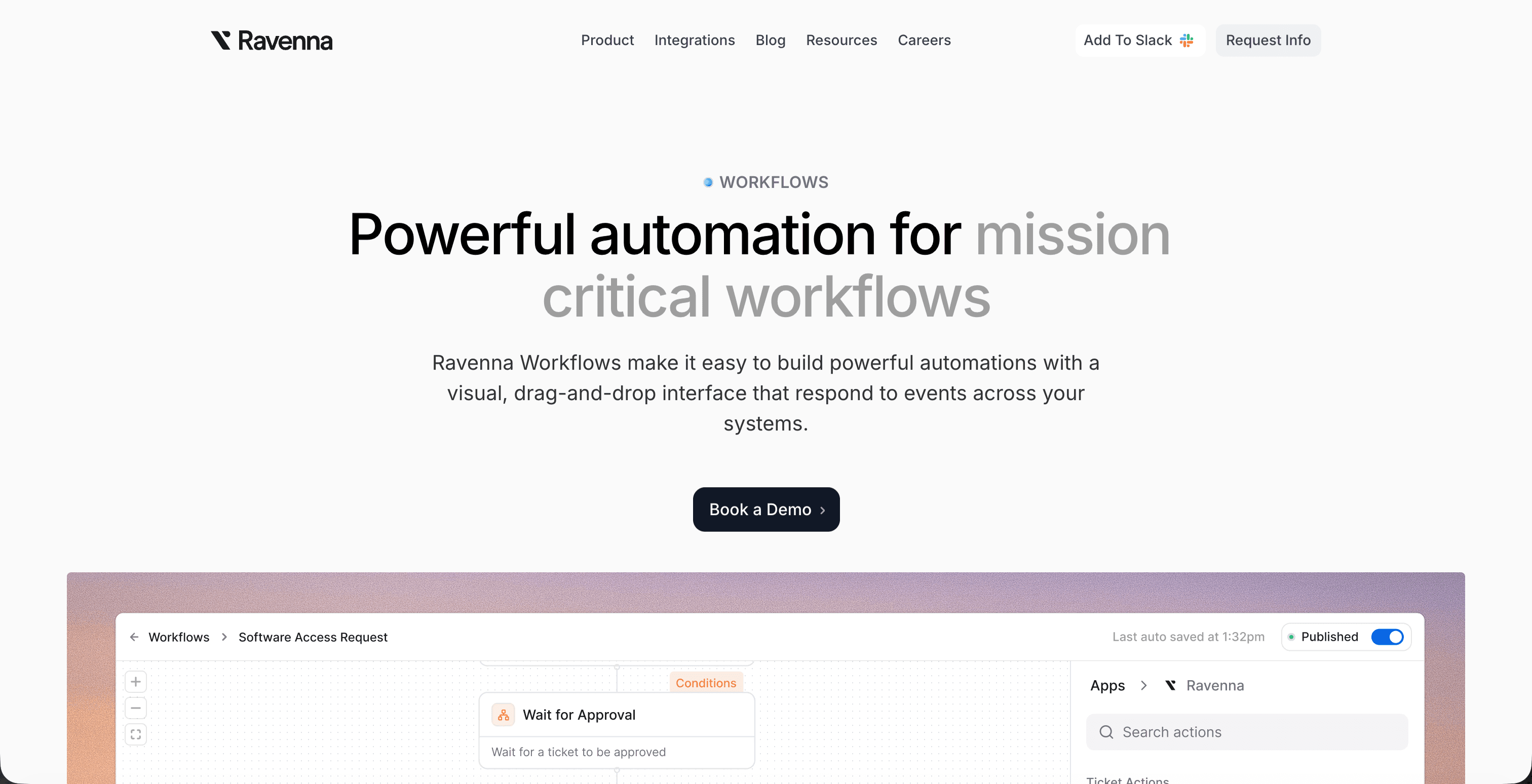
Ravenna is an agentic ITSM platform built for Slack and Teams-native IT teams. Where most service desk tools stop at routing, Ravenna's AI agents classify intent, gather context from connected systems, execute the action, and post confirmation back in the same thread.
What That Looks Like in Practice
An employee messages that they need access to a new tool. Ravenna's IT Agent reads the request, checks the employee's role against provisioning policies, triggers the access workflow in the relevant system, and closes the loop with a confirmation message before a human has touched the ticket. No queue. No handoff. No follow-up. The same architecture applies across the request types that consume the most IT time:
Password resets resolve autonomously against the connected identity provider, with no ticket opened and no analyst pulled in.
Onboarding workflows run in sequence across Okta, Google Workspace, Slack groups, and any other connected system the moment the HRIS status change fires.
Access requests that fall outside provisioning policy get escalated with full context already attached, so the analyst reviews a decision, not a raw request.
Ravenna deploys in minutes and connects to the tools IT teams already run. There is no new interface to adopt and no parallel ticket system to maintain alongside it.
Final Thoughts on Building an Agentic IT Service Desk
Getting from reactive ticket queues to autonomous resolution takes a deliberate sequence, but the starting point is simpler than most teams expect. Pick the requests that follow the same path every time, connect the systems your agents need to act on, and define the boundaries before you expand scope. Your team keeps the work that needs judgment; agentic AI in ITSM handles the rest. Reach out to the Ravenna team to see how that plays out in practice.
FAQ
What's the difference between agentic AI and assistive AI in ITSM?
Assistive AI helps a human do the work faster: it suggests next steps, drafts summaries, or surfaces a knowledge article, but a person still executes the resolution. Agentic AI in ITSM owns the full path: it classifies intent, pulls context from connected systems like your identity provider or HRIS, executes the action in the target system, and posts confirmation back in the same Slack or Teams thread without a human touchpoint for eligible requests.
How do I implement agentic AI in ITSM without automating everything at once and ending up with a brittle system?
Start with high-volume, low-variance request types where the resolution path is deterministic: password resets, software access provisioning, and account unlocks are the standard entry points. Confirm your identity provider, HRIS, and MDM are connected and correctly scoped before going live, then define explicit escalation gates for sensitive actions like high-privilege access grants or bulk deprovisioning before expanding scope.
Should I use Ravenna as a standalone ITSM replacement or layer it on top of Jira Service Management?
Both deployment models are supported, and the right choice depends on where your organization sits today. If you're dissatisfied with JSM's rules-based routing, portal adoption friction, or configuration overhead, Ravenna runs as a standalone agentic service desk. If you need to preserve existing JSM reporting and compliance workflows during a transition, Ravenna syncs bidirectionally with Jira Service Management in real time, so you can run agentic execution on top of your existing system of record without rebuilding from scratch.
What governance controls should I put in place before expanding agentic AI ITSM into sensitive request categories?
Four areas require attention before expanding scope: scope agent permissions to the minimum required per workflow type and enforce them at the integration layer; confirm every autonomous action writes a timestamped, immutable log entry your compliance team can access without opening an IT ticket; define which request categories require human sign-off before execution (high-privilege access, bulk deprovisioning, anything touching financial systems); and set a regular review cadence of what agents resolved in the prior period to catch scope creep before it compounds.
How does Ravenna's agentic AI for ITSM handle requests that fall outside automated resolution criteria?
When a request hits an exception (low classification confidence, an access tier above the auto-approval threshold, or a workflow that reaches its tool-call limit), Ravenna's IT Agent posts a summary of what was completed and where it stopped, then routes to the right human with full context already attached. The analyst receives a structured handoff instead of a raw ticket, so the escalation starts informed instead of from scratch.