
When you're shopping for SolarWinds alternatives, the core question isn't about feature lists or ITIL compliance. It's about whether your current tool manages tickets or resolves them. SolarWinds does the former well, with solid incident tracking and asset management that works for teams already in the SolarWinds ecosystem. But if your IT team is still manually handling 20 to 30% of repetitive requests after tickets get routed, you're not solving the bottleneck. You're just organizing it better.
TLDR:
SolarWinds manages tickets well but automation stays limited to routing, not resolving requests.
Organizations hit walls with reporting depth, automation field access gaps, and $39/agent pricing.
Jira SM, Ivanti, and BMC Helix require portals and admin overhead; ManageEngine adds cost per feature.
Ravenna automates workflows end-to-end in Slack, resolving requests across Okta, Workday, and Jamf autonomously.
What is SolarWinds Service Desk and How Does It Work?
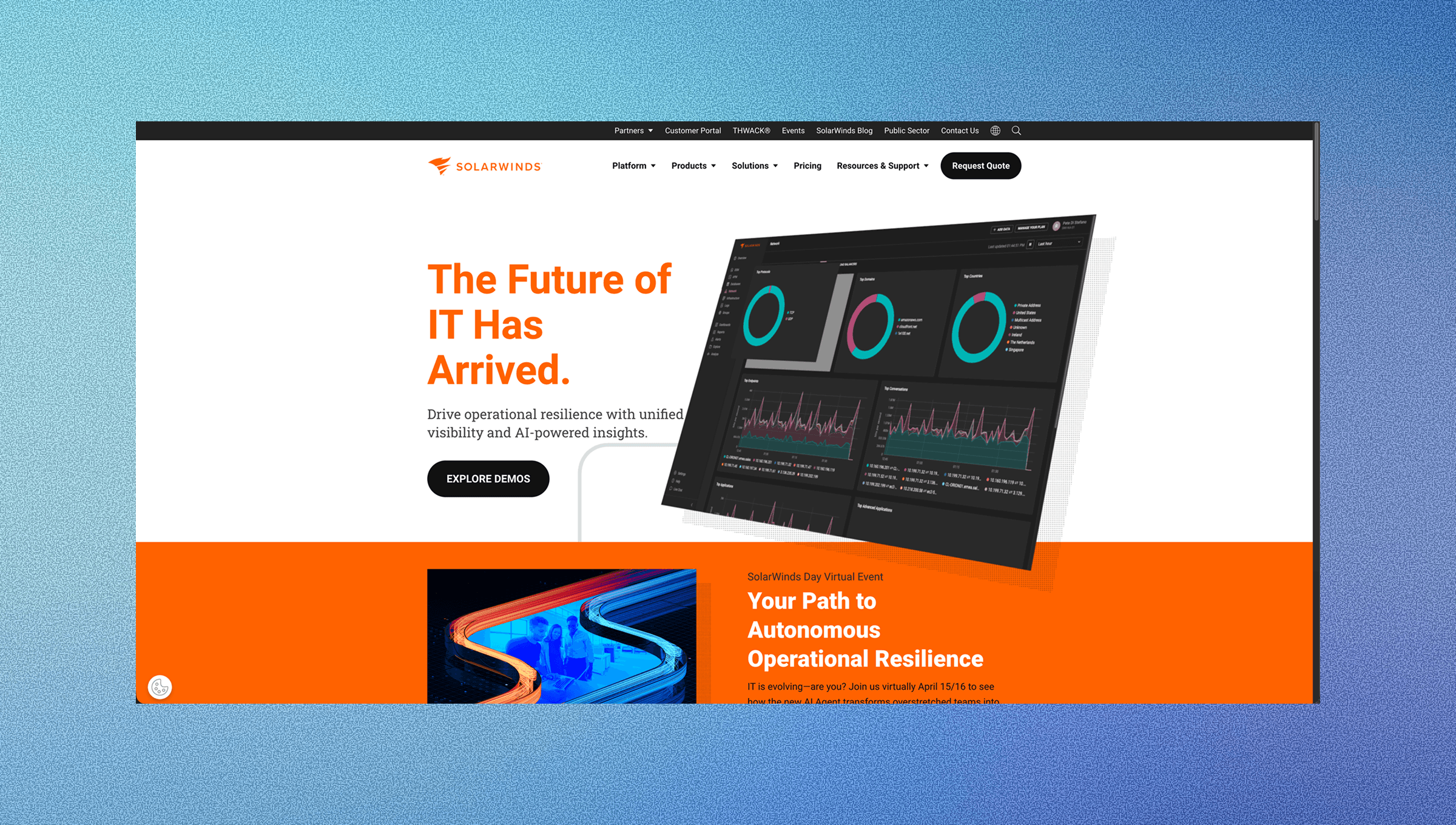
SolarWinds Service Desk is a cloud-based IT service management solution built for IT teams that need structured incident, problem, change, and asset management under one roof. It sits within the broader SolarWinds ecosystem, which many teams already use for network monitoring and observability, so part of the appeal is consolidation.
The core of the product is a web-based interface where agents handle tickets, track assets, and monitor service requests. End users get a self-service portal and service catalog to submit requests without going directly to IT. From there, SolarWinds applies AI and machine learning to categorize tickets, suggest solutions, and automate repetitive routing tasks. SolarWinds Service Desk earns its place in organizations that want process-heavy, ITIL-aligned workflows: change advisory boards, problem tracking tied to incident records, and structured approval chains. It handles these well.
The tradeoff is that it is a traditional ticketing system at heart. Automation exists, but it is largely confined to routing and categorization instead of resolving requests end-to-end. If your team spends time logging, triaging, and manually acting on tickets, that pattern mostly continues with SolarWinds. The system manages the queue; your team still does the work.
Why Consider SolarWinds Service Desk Alternatives?
SolarWinds Service Desk covers the basics well. Incident tracking, asset management, and service request workflows all function reliably, and teams already using SolarWinds for network monitoring get a natural consolidation point. For smaller IT teams that want a portal-based ITSM tool without heavy setup overhead, it gets the job done.
Teams running into growth or complexity start hitting walls quickly, though. Reporting is a recurring frustration, with limited depth and poor flexibility out of the box. Automation rules have gaps too, since certain fields simply cannot be accessed when building automation logic, which forces manual workarounds. There is no built-in remote support, and more advanced asset management capabilities require paying extra on top of an already steep base price.
At $39 per technician per month just to start, the cost-to-capability ratio doesn't add up when workflows still feel rigid. Users consistently flag that UI configuration, reporting, and automation customization lag behind comparable tools at similar price points.
The deeper issue, though, is structural. SolarWinds manages tickets well, but the work of resolving them stays with your team. For organizations where IT spends 20 to 30% of their time on high-volume, repetitive requests, a tool that organizes the queue without closing it autonomously is only part of a solution. Teams that need end-to-end automation executing tasks across their SaaS stack will find SolarWinds falls short of what they actually need.
Ravenna: Best SolarWinds Service Desk Alternative in May 2026
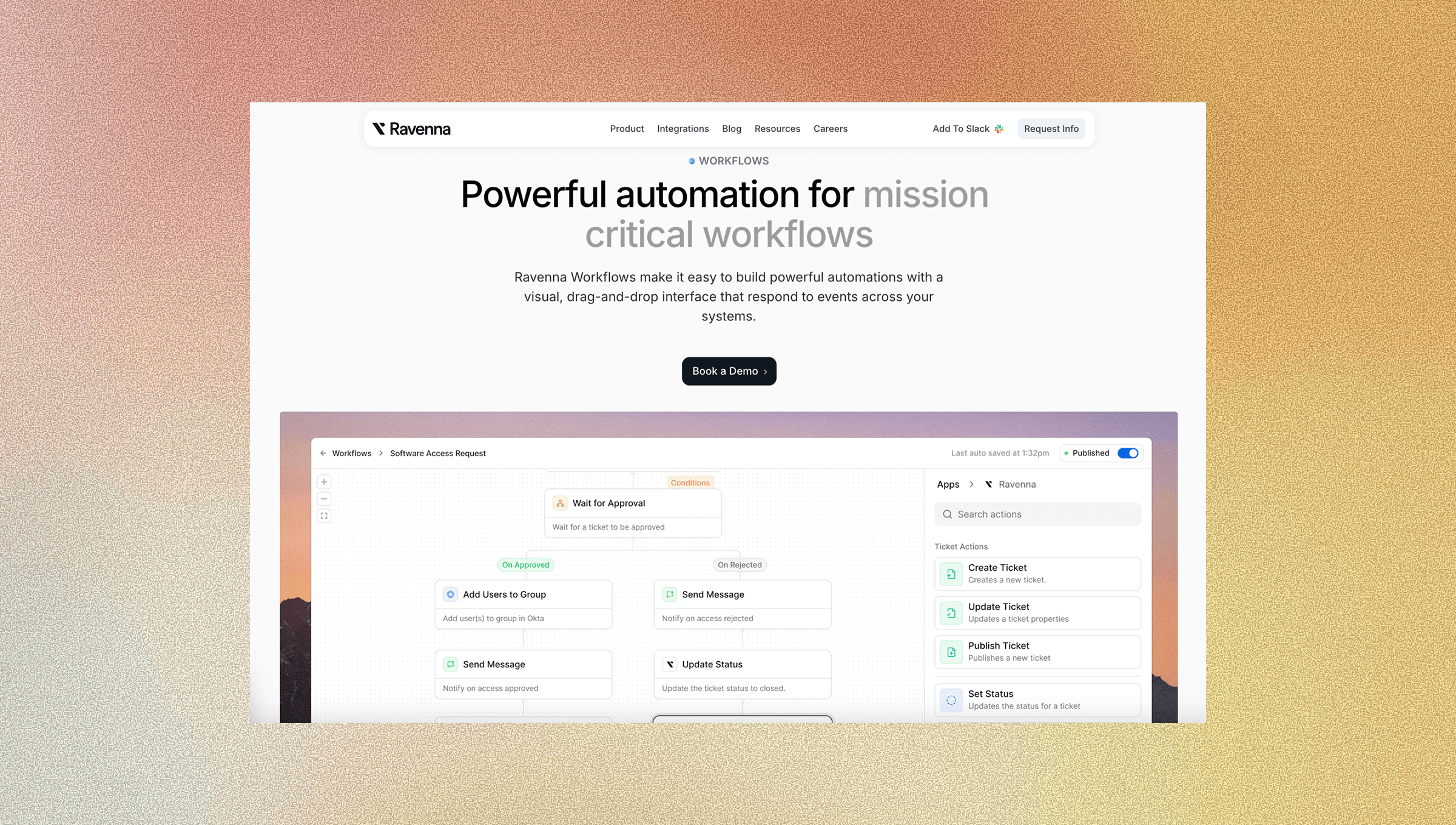
Ravenna is a Slack-native workflow automation platform that automates end-to-end IT, HR, and Operations workflows where employees already work.
On the features side, a Visual Workflow Builder lets teams design automations with drag-and-drop logic, conditional routing, and natural language generation without any scripting knowledge. AI Agents classify every incoming request, gather context through natural conversation in Slack, and execute tasks directly across connected systems instead of simply routing tickets to a human. Bidirectional integrations with Jira Service Management, Freshservice, and Linear let Ravenna work standalone or alongside existing ITSM solutions, syncing tickets in real time so teams can adopt Ravenna without disrupting their current systems of record. Analytics classify every ticket as automated, automatable, or non-automatable, giving IT leaders clear visibility into ROI and where to focus automation efforts next. Pre-built workflow templates covering common IT, HR, and Operations scenarios accelerate time to value, letting teams deploy standard automations in minutes instead of building from scratch.
The limitations worth acknowledging are primarily about fit instead of capability gaps. Ravenna is purpose-built for Slack-native environments, so organizations that have not standardized on Slack will not get the full benefit of the solution. Teams that require deep ITIL process compliance, formal change advisory board structures, or on-premises deployment options will find Ravenna focused toward a different set of priorities than traditional enterprise ITSM solutions.
Ravenna works best for IT, HR, and Operations teams that want to automate request resolution autonomously instead of just manage tickets more efficiently. Organizations already operating in Slack that spend a lot of time on repetitive, high-volume requests like access provisioning, onboarding sequences, password resets, and device management will see the fastest and most measurable ROI. Teams looking to augment their IT operations with agentic AI without ripping out existing tooling will find Ravenna a strong fit as both a standalone solution and an automation layer on top of current systems.
Jira Service Management
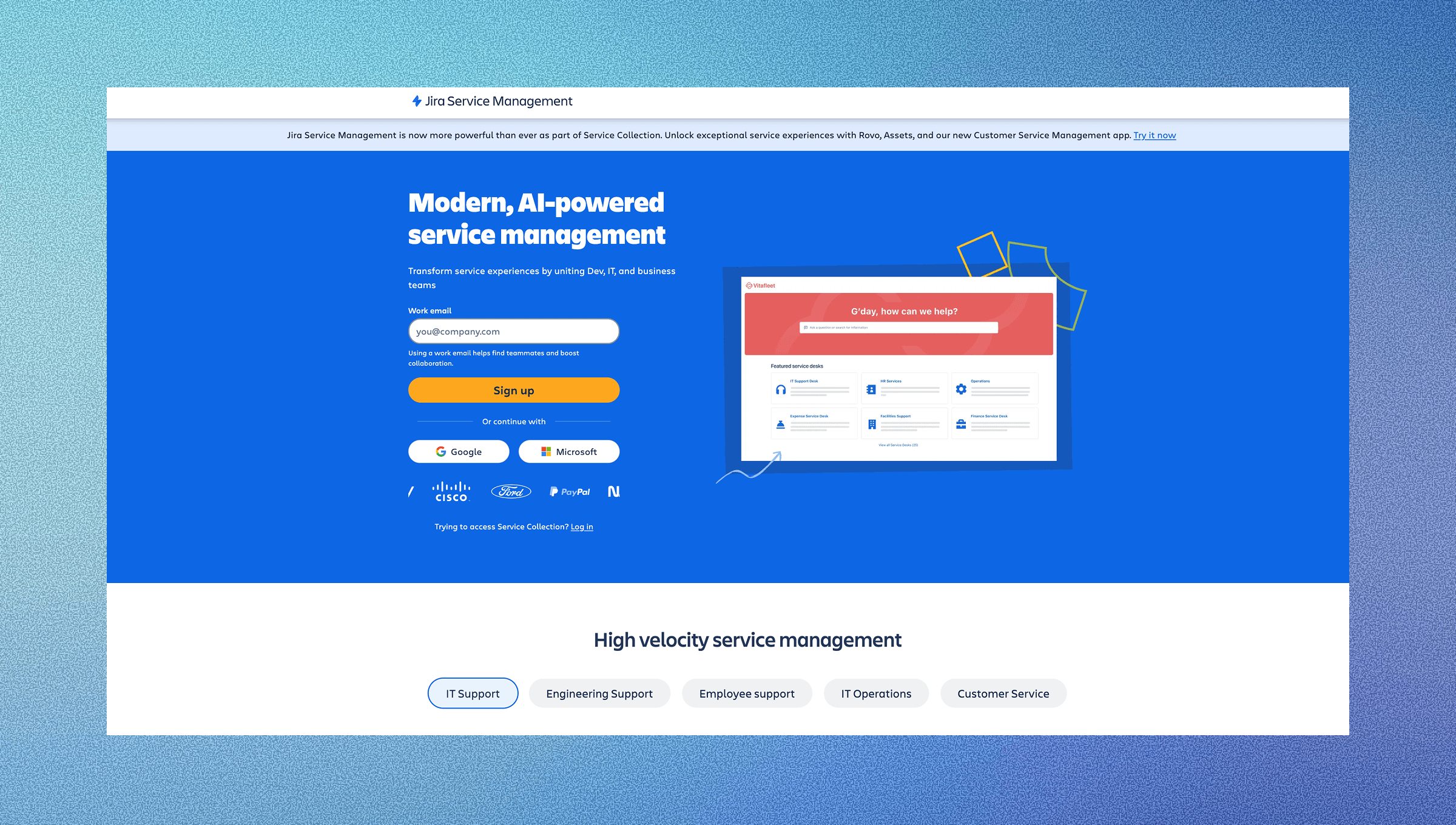
Jira Service Management is an ITIL-aligned service desk built within the Atlassian ecosystem, making it a strong fit for organizations that already rely on Jira Software and Confluence. It handles incident, change, and problem management with structured SLA tracking, and its deep integration with developer tooling makes it appealing to engineering-heavy organizations. Employees submit requests through a web portal, and agents manage queues, approvals, and escalations from a familiar Atlassian interface.
On the features side, native integration with Jira Software links service requests directly to engineering sprints and bug tracking, while ITIL-aligned workflows cover incident, problem, change, and asset management out of the box. SLA tracking and breach alerting give IT teams visibility into response and resolution commitments, and automation rules handle ticket routing, notifications, and basic conditional logic across queues. A self-service portal and service catalog round out the employee-facing experience, letting staff submit and track requests without contacting IT directly.
The limitations are worth noting for teams assessing it against more modern options. Employees must go through a portal to submit requests, which creates friction and reduces adoption compared to chat-native tools. Automation stays mostly at the routing and notification level and does not execute tasks across external systems. Configuration and ongoing maintenance require dedicated Jira admin bandwidth, especially at scale, and teams outside the Atlassian ecosystem often find the tool over-engineered for their actual support needs. AI capabilities are also basic relative to tools purpose-built for autonomous request resolution.
Jira Service Management excels at structured ticket operations for organizations already embedded in the Atlassian ecosystem, particularly where IT and engineering teams need to connect service requests to development workflows. Teams focused on SLA compliance and ITIL process adherence will find it well-suited to their needs. It is less appropriate for organizations focusing on autonomous task execution, high employee adoption, or Slack-native request handling.
Ivanti Neurons for ITSM
Ivanti Neurons for ITSM targets enterprises that need deep ITIL coverage with the flexibility to deploy in cloud, on-premises, or hybrid environments. The customization depth is substantial, though it comes with a steep learning curve and often requires scripting or middleware to connect third-party tools. Organizations relying on Google Workspace lose access to several features entirely, which is a meaningful limitation for modern cloud-first companies.
On the features side, flexible deployment options support cloud, on-premises, and hybrid environments to match enterprise infrastructure requirements. Deep ITIL process coverage includes incident, problem, change, and service request management with structured workflow support, and strong asset discovery and configuration management capabilities give IT teams visibility across their hardware and software inventory. Role-based automation and approval routing handle complex organizational hierarchies and multi-tier escalation chains, while reporting and analytics dashboards provide IT leaders with metrics across service delivery performance.
The limitations are significant for teams assessing it against more modern options. The learning curve is steep, and most organizations need dedicated ITSM administrators to configure and maintain the solution. Connecting third-party tools often requires custom scripting or middleware instead of native integrations, and Google Workspace users lose access to several features, making it a poor fit for organizations standardized on Google. The interface feels dated compared to modern service desk tools, contributing to lower end-user adoption, and time to value is slow, with long implementation cycles that delay return on investment.
Ivanti Neurons for ITSM delivers the process depth and deployment flexibility that large enterprises with dedicated ITSM administrators need to manage complex infrastructure at scale. IT organizations running mature service management programs across regulated industries or hybrid infrastructure environments will find it capable of meeting their requirements. Teams seeking fast time to value, modern employee experiences, or deep SaaS integrations without heavy configuration overhead will find it a difficult fit.
BMC Helix ITSM
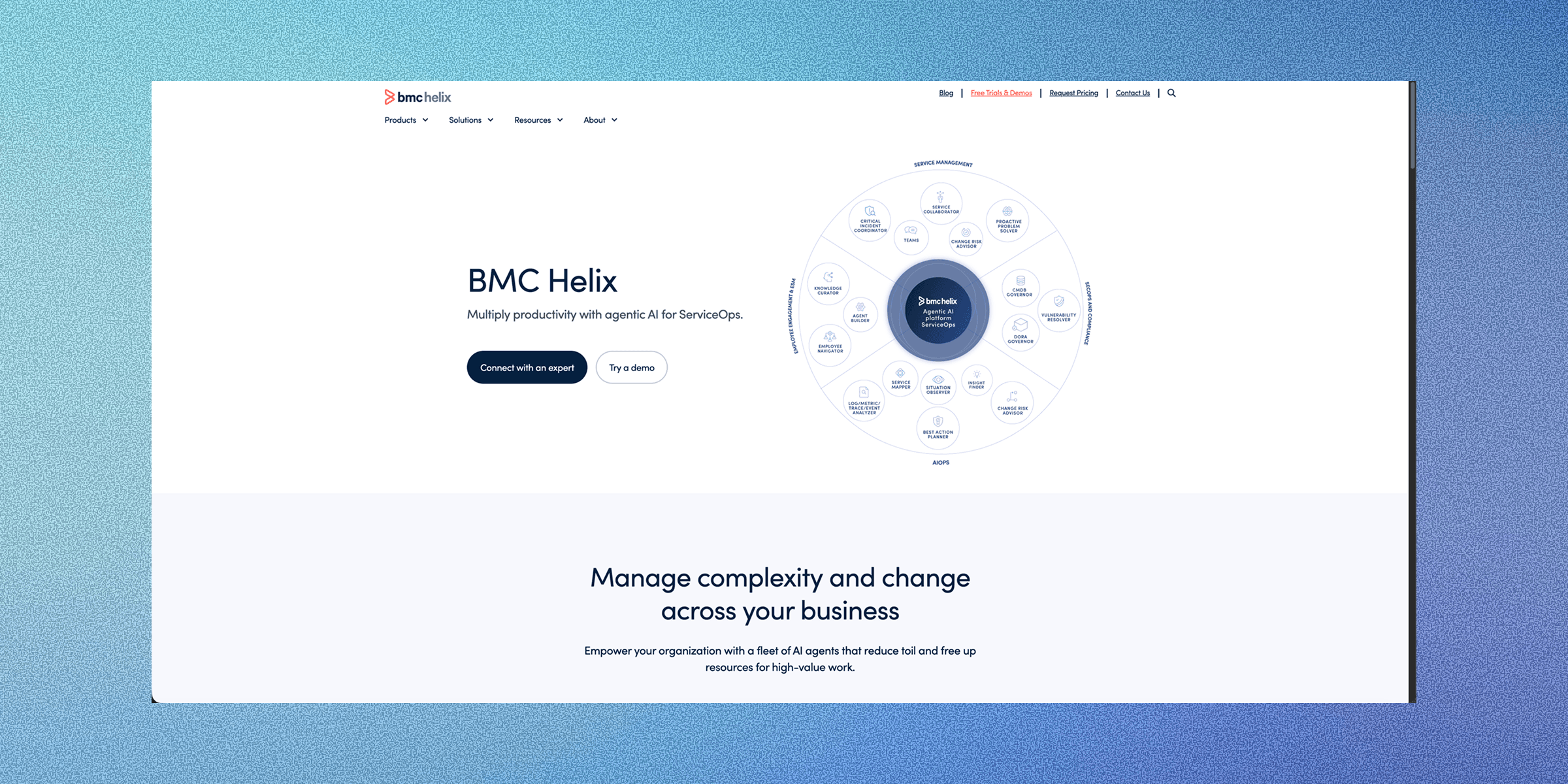
BMC Helix ITSM serves enterprises running complex, multi-cloud environments where scalability and observability integration are the primary drivers. It offers broad process coverage across incident, change, and problem management, and its AI-assisted features are designed to surface insights at enterprise scale. The tradeoff is that the solution carries a lot of implementation overhead, a dated interface, and a cost structure that escalates quickly with customization needs.
On the features side, BMC Helix provides complete ITIL process coverage across incident, change, problem, and release management, giving large IT organizations a structured framework for managing complex service delivery. Multi-cloud and hybrid infrastructure support lets enterprises manage assets and services across distributed environments from a single solution. AI-assisted features help with ticket classification, predictive service management, and anomaly detection at scale, and deep configuration management database capabilities give IT teams detailed visibility into infrastructure dependencies and change impact.
The limitations surface quickly for teams outside the enterprise tier. The interface feels dated and requires a lot of training before agents and administrators can work productively within it. Customization frequently adds licensing cost on top of an already steep base investment, and the admin-side configuration experience feels disconnected from the front-end user experience. Implementation cycles are long, which delays time to value for organizations with pressing automation needs, and the overall complexity makes it a poor fit for teams without a dedicated ITSM practice and the budget to support it.
BMC Helix handles industrial-scale infrastructure management for enterprises with mature ITSM programs, dedicated administrators, and the budget to support a complex deployment. Large IT organizations in regulated industries managing multi-cloud or hybrid environments will find the depth of process coverage and infrastructure visibility worthwhile. Teams that do not need enterprise-grade complexity, or those focusing on modern employee experiences and fast time to value, will find the investment difficult to make a case for.
ManageEngine ServiceDesk Plus
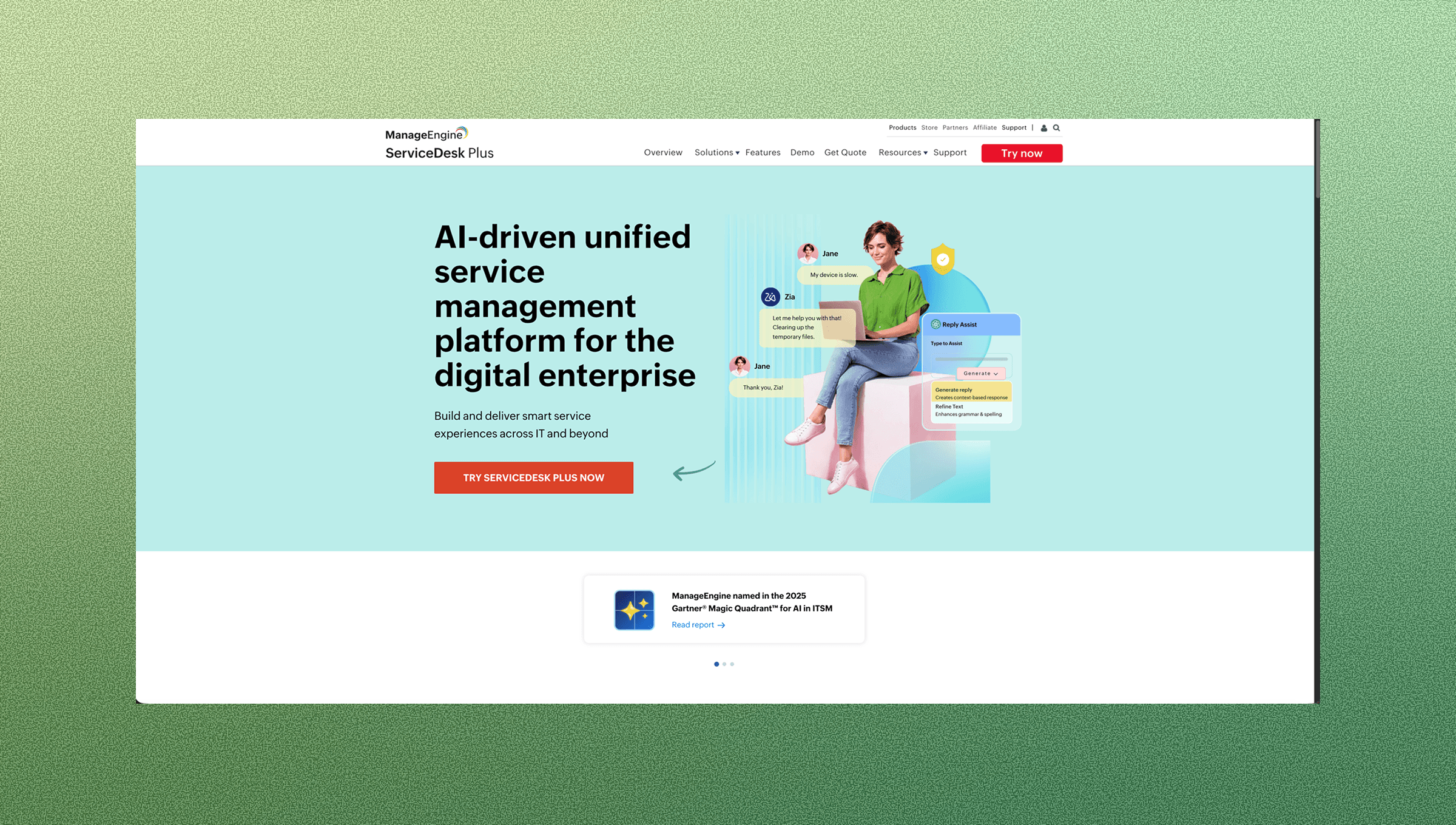
ManageEngine ServiceDesk Plus combines help desk functionality, asset management, and ITIL process coverage in a single package that competes on price, including a free tier that makes it accessible for smaller teams assessing their options. The solution covers the core bases well enough for small to mid-sized businesses, offering structured request handling and solid asset tracking without the enterprise overhead of tools like BMC Helix or Ivanti. The tradeoff is that the depth behind the pricing requires close attention, since add-ons and plan upgrades can significantly shift the cost.
On the features side, ManageEngine offers ITIL-aligned workflows covering incident, problem, change, and service request management within a single solution. Asset management capabilities give IT teams visibility into hardware and software inventory, and the tiered pricing structure including a free entry point makes it one of the more accessible options for budget-conscious teams. A self-service portal and service catalog let employees submit and track requests without direct IT contact, and built-in reporting provides metrics for team leads managing day-to-day service delivery.
The limitations surface as teams grow or their needs become more complex. The Standard plan is restricted in capability, and live chat support runs an additional $65 per agent per month on top of the base price. Change management capabilities add thousands annually, and asset management performance has room for improvement relative to dedicated asset tracking tools. The per-feature pricing model means costs escalate quickly as needs expand beyond the baseline, making the total cost of ownership harder to predict than the entry price suggests.
ManageEngine ServiceDesk Plus works best for small to mid-sized businesses that need affordable ITSM with reasonable asset tracking and ITIL structure without committing to enterprise-tier complexity or pricing. Teams with straightforward support needs and limited budgets will find the entry-level tiers serviceable, though organizations anticipating growth or requiring deeper automation, modern employee experiences, or predictable pricing as needs scale will likely find themselves limited sooner than expected.
Feature Comparison: SolarWinds Service Desk vs Top Alternatives
Picking the right tool comes down to where your actual gaps are. The table below cuts through the positioning and shows how each option stacks up across the features that matter most.
Feature | SolarWinds | Ravenna | Jira SM | Ivanti | BMC Helix | ManageEngine |
Slack-Native Experience | No | Yes | No | No | No | No |
End-to-End Workflow Automation | Limited | Yes | Limited | Yes | Yes | Yes |
Autonomous Task Execution | No | Yes | No | Limited | Limited | Limited |
Visual Workflow Builder | Yes | Yes | Yes | Yes | Yes | Yes |
HRIS Integration for Employee Context | No | Yes | Limited | No | No | No |
Bidirectional ITSM Integration | No | Yes | No | Yes | Yes | Limited |
AI-Powered Automation | Basic | Advanced | Basic | Advanced | Advanced | Basic |
Portal-Free Employee Experience | No | Yes | No | No | No | No |
Deployment Complexity | Low | Low | Medium | High | High | Medium |
Time to Value | Moderate | Fast | Moderate | Slow | Slow | Moderate |
Advanced Reporting | Limited | Yes | Yes | Yes | Yes | Moderate |
A few patterns stand out here. SolarWinds scores well on deployment simplicity, but its automation depth and AI capabilities lag behind most of the field. Ivanti and BMC Helix offer strong automation, but both carry high deployment complexity and slower time to value. Ravenna is the only option that combines a Slack-native experience with autonomous task execution, portal-free employee support, and HRIS integration for employee context, all with a fast time to value and low deployment overhead.
Why Ravenna is the Best SolarWinds Service Desk Alternative
SolarWinds manages the queue. Ravenna closes it.
That distinction matters more than any feature comparison. Organizations shopping for alternatives are not usually frustrated with how tickets get logged. They are frustrated that logging them is still the job. Ravenna's AI Agents resolve requests autonomously by executing tasks directly across Okta, Google Workspace, Workday, Jamf, and the rest of your SaaS stack. No portal routing, no manual follow-up. Because Ravenna lives inside Slack, adoption is not a project. Employees submit requests where they already work, and the AI Agent handles intake, clarification, routing, and resolution without disrupting their workflow. For IT teams spending 20 to 30% of their time on repetitive requests, that is recoverable time.
The Visual Workflow Builder lets your team build and maintain automations without scripting knowledge, and the analytics surface tells you exactly where your remaining automation opportunity sits. When every ticket is classified as automated, automatable, or non-automatable, the ROI conversation becomes concrete.
If SolarWinds is where your team tracks work, Ravenna is where your team stops doing it manually.
Final Thoughts on SolarWinds and Its Alternatives
Your ITSM tool should close tickets, not categorize them. That's where most SolarWinds alternatives still fall short, and it's where Ravenna takes a different approach. Instead of routing requests through a portal, Ravenna's AI Agents execute the work across Okta, Google Workspace, Workday, and your other tools, completing tasks autonomously in Slack. Let's talk if you're ready to see what real automation looks like for your team.
FAQ
When should you consider moving away from SolarWinds Service Desk?
If your IT team spends most of their time manually executing requests instead of resolving them autonomously, or if you need workflows that execute tasks across your SaaS stack without portal friction, SolarWinds' ticket-centric model will keep you stuck in that pattern.
What features matter most when comparing SolarWinds alternatives?
Look for tools that execute tasks autonomously instead of just routing tickets, offer a Slack-native experience to meet employees where they work, and provide clear analytics on automation ROI so you can identify which workflows to build next.
How does workflow automation differ from traditional ticket management?
Traditional ticket management organizes your queue and tracks work through completion, but your team still performs every action manually. Workflow automation executes the work itself by integrating directly with tools like Okta, Google Workspace, and your HRIS to resolve requests end-to-end.
Can you use Ravenna alongside your existing ITSM system?
Yes, Ravenna offers bidirectional integrations with Jira Service Management, Freshservice, and Linear that sync tickets in real time, letting you add autonomous workflow automation without ripping out your current system of record.
What types of requests work best for autonomous automation?
High-volume, repetitive tasks that follow predictable patterns see the fastest ROI: password resets, access provisioning, software license requests, onboarding sequences, and device management workflows that consume 20-30% of IT team time.