

Your employees get instant answers to IT questions, but still wait hours for account access, software licenses, or device configuration. That gap exists because RAG and agentic workflows for enterprise IT handle fundamentally different request types. RAG retrieves information from your knowledge base and generates answers. Agentic workflows check policies, route approvals, provision accounts, and complete multi-system tasks without manual handoffs. Most teams implement one or the other, then wonder why half their workload hasn't changed.
TLDR:
RAG answers questions from your docs while agentic workflows execute tasks across systems.
IT teams waste 20-30% of capacity on repetitive requests that agents can fully automate.
Agentic workflows cut resolution time from hours to minutes for access provisioning and offboarding.
Code-based automation breaks when APIs change; visual workflow builders stay maintainable long-term.
Ravenna automates IT workflows in Slack, routing requests to either knowledge retrieval or execution.
What RAG Actually Solves for Enterprise IT
RAG pulls relevant information from your existing knowledge base and feeds it to a large language model (LLM) to generate contextually accurate answers. Instead of pointing you to documents, it synthesizes relevant information from multiple data sources to answer specific questions. For enterprise IT teams, this solves a real problem: your documentation lives scattered across Confluence pages, SharePoint folders, and other internal data sources. When an employee asks "How do I reset my VPN?" or "What's our software approval process?", RAG surfaces the answer instantly instead of making someone dig through outdated documentation or wait for a support agent. Enterprises report a 30 to 70% gain in knowledge-heavy workflows after RAG deployment. The reason is simple: IT teams spend hours answering the same questions repeatedly.
RAG excels at informational queries where the answer already exists within your documentation, making it highly scalable for knowledge-heavy tasks. It's fast, accurate when the underlying knowledge base is current, and scales infinitely without adding headcount.
The Core Technical Difference Between RAG and Agentic Approaches
Retrieval-augmented generation (RAG) systems retrieve information and generate text responses. You query the system, it searches vector embeddings for relevant documentation chunks, then passes that context to an LLM to synthesize an answer. The output is always a written response grounded in retrieved documents. The tech stack relies on vector databases, embedding models, and context window management.
Agentic workflows, powered by agentic AI, decompose requests into executable tasks. You ask the agent to provision access, and it identifies required steps (verify license availability, check policy compliance, create account, assign permissions, send notification), then executes each step through API calls. The output is completed work across your systems. The tech stack uses workflow orchestration, decision-making logic, authentication management, and error recovery.
RAG answers questions. Agentic workflows complete actions. When an employee asks "What's our password policy?" RAG retrieves the relevant policy doc and generates an answer. When they request "Reset my password," an agentic workflow executes the reset, generates temporary credentials, updates security logs, and delivers the new password directly to the user.
Dimension | RAG Approach | Agentic Workflow Approach |
Primary Function | Retrieves information from documentation and generates synthesized answers based on knowledge base content | Executes multi-step tasks across systems with decision-making logic and API orchestration |
Ideal Use Cases | Policy lookups, troubleshooting guides, help documentation queries, VPN configuration steps, security incident reporting procedures | Access provisioning, password resets, device onboarding/offboarding, license management, multi-system approval chains |
Output Type | Text-based answers synthesized from retrieved document chunks | Completed actions across integrated systems with confirmation notifications |
Technical Requirements | Vector databases, embedding models, context window management, document indexing infrastructure | Workflow orchestration, API authentication, decision logic engines, error recovery mechanisms |
Accuracy Model | Probabilistic text generation grounded in retrieved context | Deterministic execution with guaranteed audit trails and compliance tracking |
Data Dependency | Relies on documentation currency and knowledge base updates | Operates on real-time system state: current access levels, available licenses, device assignments |
Maintenance Approach | Update knowledge base documents and retrain embeddings as content changes | Visual workflow builders for adjusting logic when APIs change or system integrations update |
How Agentic Workflows Actually Execute IT Tasks
Agentic workflows execute tasks instead of retrieving information. An agent receives a request, determines what needs to happen, plans the sequence of steps, then acts across your SaaS stack to complete the work. For example, when an employee requests GitHub access, an agentic workflow checks their role against your access policies, routes the request to the right approver if needed, provisions the account once approved, adds them to the correct teams, and confirms completion. No human touches the request.
The difference is reasoning, problem-solving, and tool use. Agentic systems analyze context, make decisions based on rules you've set, and call APIs to execute actions in tools like Okta, Google Workspace, or your MDM platform. This works for repetitive, high-volume requests: password resets that actually reset the password, device lockouts that trigger the unlock sequence, offboarding workflows that suspend accounts and reclaim licenses across 15 different systems. The agent handles all of it while you handle exceptions.
When RAG Falls Short in IT Operations
Traditional RAG breaks down when IT workflows demand more than retrieval and synthesis. The core issue: RAG systems can't reason through conditional logic or execute sequences of dependent actions. Consider access provisioning. An employee requests Salesforce access. RAG can tell them the approval process, but it can't check license availability, route to their manager, wait for approval, create the account, assign the correct permission sets based on role, then notify both parties. That requires decision-making across multiple systems with real-time data.
Traditional RAG also struggles with deterministic accuracy requirements. When compliance mandates exact audit trails or regulatory policies require specific approval chains, probabilistic text generation introduces risk. You need guarantees that the workflow executed correctly, not a statistically likely answer.
The gap widens with stale data. RAG retrieves what's in your documentation, but IT operations run on the current system state: who has access now, which licenses are available today, what device is assigned to whom right this second.
Why Enterprise IT is Shifting to Agentic Workflows
The shift to agentic workflows reflects a fundamental change in what IT teams need from enterprise AI systems. Request volume is growing faster than headcount, and answering questions doesn't reduce workload when employees still need someone to execute the actual task. Forty percent of enterprise applications will include task-specific AI agents by the end of 2026, up from less than 5% today. That acceleration happens because IT leaders see direct ROI: agents reduce resolution time from hours to minutes while eliminating the manual overhead of routing, triaging, and executing repetitive requests.
The business case is clear for enterprise AI adoption. RAG deflects informational tickets, but the bulk of IT workload lives in provisioning access, managing devices, and managing lifecycle events. Those workflows consume 20-30% of IT capacity despite being highly standardized. Agentic workflows automate that work entirely. You define the logic once, then the agent handles every instance going forward. No queue backlog for password resets. No manual provisioning delays for new hire onboarding. The work happens autonomously while your team focuses on requests that require human judgment.
Real IT Use Cases Where Each Approach Wins
In real-world IT environments, RAG wins when you need instant answers to informational requests. Your help documentation, IT policy lookups, and troubleshooting guides all fit here. An employee asks about VPN configuration steps, password requirements, or how to report a security incident. RAG surfaces the answer from your knowledge base without creating a ticket. Troubleshooting scenarios work well too: "My Slack notifications aren't working" pulls relevant diagnostic steps from your runbooks.
Agentic workflows, on the other hand, own execution-based requests and complex tasks across systems. Access provisioning is the clearest example: granting GitHub, Jira, or AWS access requires checking entitlements, routing approvals, creating accounts, and assigning permissions across systems. Software license management follows the same pattern: checking license availability, tracking allocations, and provisioning access automatically. Device lifecycle operations like laptop onboarding (enrolling in MDM, installing required software, configuring security policies) and offboarding (wiping devices, reclaiming licenses, suspending accounts) demand orchestration across multiple tools.
Multi-system approval chains don't work with traditional RAG. When a procurement request needs finance approval, then IT provisioning, then manager notification, you need an agent coordinating each step based on real-time responses.
The Hidden Complexity of Maintaining Agentic IT Workflows
Building agentic workflows is one thing. Maintaining them over time is where most implementations fall apart. Here are some of the hidden complexities:
Some solutions generate code from text prompts to create automation. Describe what you want, and the system writes scripts that execute the workflow. This sounds convenient until the code breaks. An API change, a system update ships, or a dependency change. Now you're debugging AI-generated code that no one on your team wrote or fully understands.
This is what happens with "vibe coding" approaches. The initial setup feels fast, but every change requires regenerating code and hoping it works. IT teams end up spending more time fixing automations than they save by running them.
Visual workflow builders solve this by replacing code with structured logic. You define steps, conditions, and integrations through a canvas interface. When something breaks, you see exactly which step failed and why. No debugging obscure scripts or reverse-engineering AI output. You adjust the workflow and move on.
The trade-off is upfront structure for long-term stability. Agentic workflows still require thought around logic, error handling, and integration points. But that complexity stays manageable when the system is built for humans to maintain.
How Ravenna Combines Both Approaches for IT Workflows
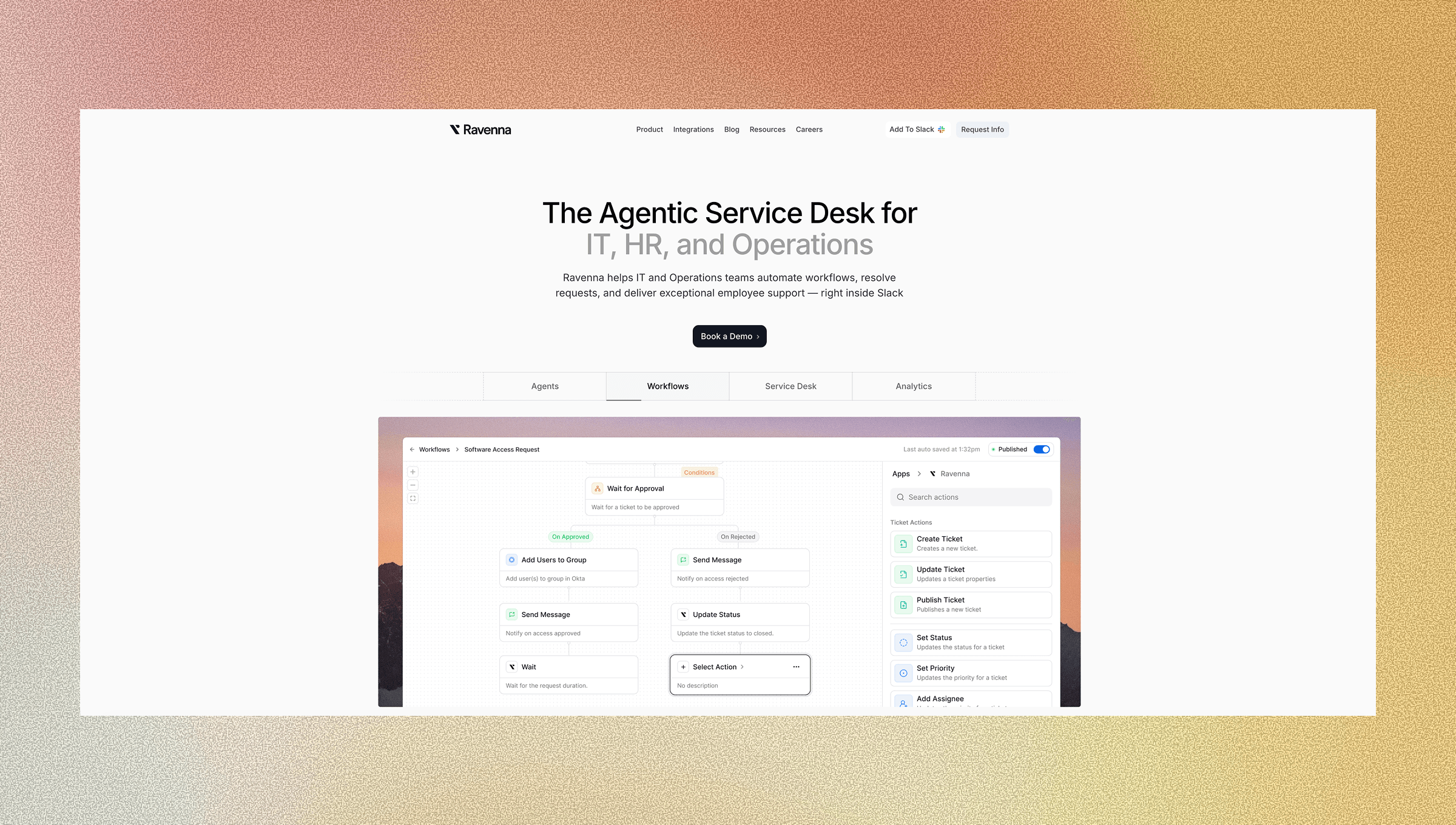
Ravenna doesn't force you to pick between RAG and agentic workflows. The system analyzes each request through Slack to identify intent, then routes it to either knowledge retrieval or multi-step execution automatically. Ask "What's our password policy?" and you get an instant answer pulled from your docs. Request "Provision Salesforce access for Sarah" and Ravenna triggers approval routing, account creation, permission assignment, and completion confirmation across your SaaS tools without manual handoffs. Your employees never see the distinction. They type requests in Slack and get results. Your IT team sees fewer tickets, faster resolutions, and work that finishes without intervention.
This hybrid approach matters because real IT workflows don't stay in one lane. Onboarding requires both policy explanations and account provisioning. Offboarding needs documentation retrieval and multi-system access revocation. Ravenna automates both sides while giving you full visibility into what's happening.
Final Thoughts on RAG and Agentic Approaches for Enterprise IT
You don't need to architect the perfect AI system before seeing results. RAG for enterprise IT and agentic execution work together to handle both the questions and the actual work your team deals with daily. Pick the highest-volume requests your IT team handles, automate those workflows first, and optimize as you build confidence. The technology exists, the question is how fast you want to free up your team's time.
FAQ
How do I know when to use RAG versus an agentic workflow for a specific IT request?
If the request needs information retrieval (like policy explanations or troubleshooting steps), RAG handles it instantly. If the request requires executing actions across systems (like provisioning access or resetting passwords), agentic workflows complete the work automatically without creating tickets.
What happens when an agentic workflow breaks after an API update?
Visual workflow builders let you see exactly which step failed and adjust the configuration through a canvas interface. This avoids the maintenance nightmare of debugging AI-generated code where no one on your team understands what broke or how to fix it.
Can Ravenna handle both simple questions and complex multi-step provisioning requests?
Yes. Ravenna analyzes each request in Slack to identify the intent, then automatically routes it to either knowledge retrieval for informational queries or multi-step execution for actionable workflows. Your employees get results without seeing the technical distinction.
How long does it typically take to see ROI from implementing agentic workflows?
Most teams see immediate impact on high-volume requests like password resets and access provisioning, with measurable time savings appearing within the first few weeks as the agent handles repetitive work that previously consumed 20-30% of IT capacity.