
Sales Asking About Attribution Logic: The Quarterly Question RevOps Shouldn't Have to Answer Live

Quarter-end pipeline reviews always surface the same attribution logic question from sales. A rep sees their deal credited to "Partner" instead of "Direct" and wants to know why. You explain the sales attribution model lookup, walk through which touchpoints qualified and how the weighting worked, and the conversation ends. Three months later, it happens again with a different deal and a different rep. The revops attribution explanation becomes a recurring agenda item because the logic behind the model never made it into a place the team can reference without asking you live.
TLDR:
RevOps fields the same attribution questions every quarter because the model logic lives in someone's head, not in documentation reps can reference independently.
CRM migrations and data cleanup break attribution memory by overwriting touch history, leaving deals without credited sources even after months of rep activity.
Sales and marketing interpret attribution differently: marketing tracks influence across touchpoints, sales reads it as a scorecard of effort and ownership.
Document which model is active, how credit assigns across touchpoints, and where to route follow-up questions so the answer exists before the question gets asked.
Ravenna's RevOps Agent pulls attribution documentation alongside deal-specific touch history in Slack, answering model questions without RevOps intervention.
Why RevOps Teams Field the Same Attribution Questions Every Quarter
The attribution logic question keeps coming back because the answer isn't stored anywhere a rep can find on their own. Quarter-end reviews surface it, someone asks, and RevOps walks through the reasoning verbally. Next quarter, same question, same walkthrough.
The core issue is that attribution models get built in meetings and adjusted in Slack threads. The decisions never land in a format someone else can read without asking. According to Visionary Marketing, 79% of B2B marketers are making budget decisions on incomplete or inaccurate attribution data, and companies with inaccurate attribution waste an estimated 23% of their marketing budget on low-performing channels. So when a new sales hire questions why a deal shows as marketing-sourced after three months of rep activity, the only path to an answer runs through whoever built the model.
What Attribution Logic Actually Means in Revenue Operations
Attribution logic is how your company decides which marketing touchpoints get credit for a closed deal. At its core, it's a set of rules (first touch, last touch, linear, time decay, or custom multi-touch) that assign fractional or full revenue credit across the buyer journey. But the attribution logic question that lands in RevOps every quarter goes deeper than model selection. Sales reps want to know why a specific deal credited one source over another, why a campaign they ran shows zero influenced revenue, or why their number looks different in the CRM versus the finance report.
Those questions require knowing which model is active, which touchpoints qualify, what the lookback window is, and whether manual overrides exist in the data.
The Four Questions RevOps Gets Asked Most About Attribution
Four questions come up on repeat. They show up in QBRs, in pipeline reviews, in Slack threads the night before a board meeting. Each one sounds simple. None of them are.
"Which model are we using right now?"
Sales asks this because they want to know whether the deal they just closed is going to show up as their win. RevOps hears it as: go find the documentation, verify it against what's actually configured in the CRM, and explain why first-touch and last-touch give different numbers for the same deal. The attribution logic question sounds like a lookup. It almost never is.
"Why does my number look different in Salesforce than in the dashboard?"
This is the attribution model lookup question that turns into a 45-minute archaeology project without self-service CRM data access. The answer usually lives across three systems, two date filters, and one pipeline stage definition that was quietly updated six months ago.
"Did marketing actually influence this deal?"
Multi-touch attribution was built to answer exactly this. But when a rep asks it live, what they often want is validation, not methodology. Explaining weighted influence scoring in a Thursday standup is a losing position for everyone involved.
"What changed since last quarter?"
Sometimes the model changed. Sometimes the data did. Sometimes the fiscal quarter boundary was adjusted and nobody updated the attribution window to match. RevOps attribution explanation becomes a root-cause exercise with no clean starting point.
Why Deals Show Multiple Attribution Sources
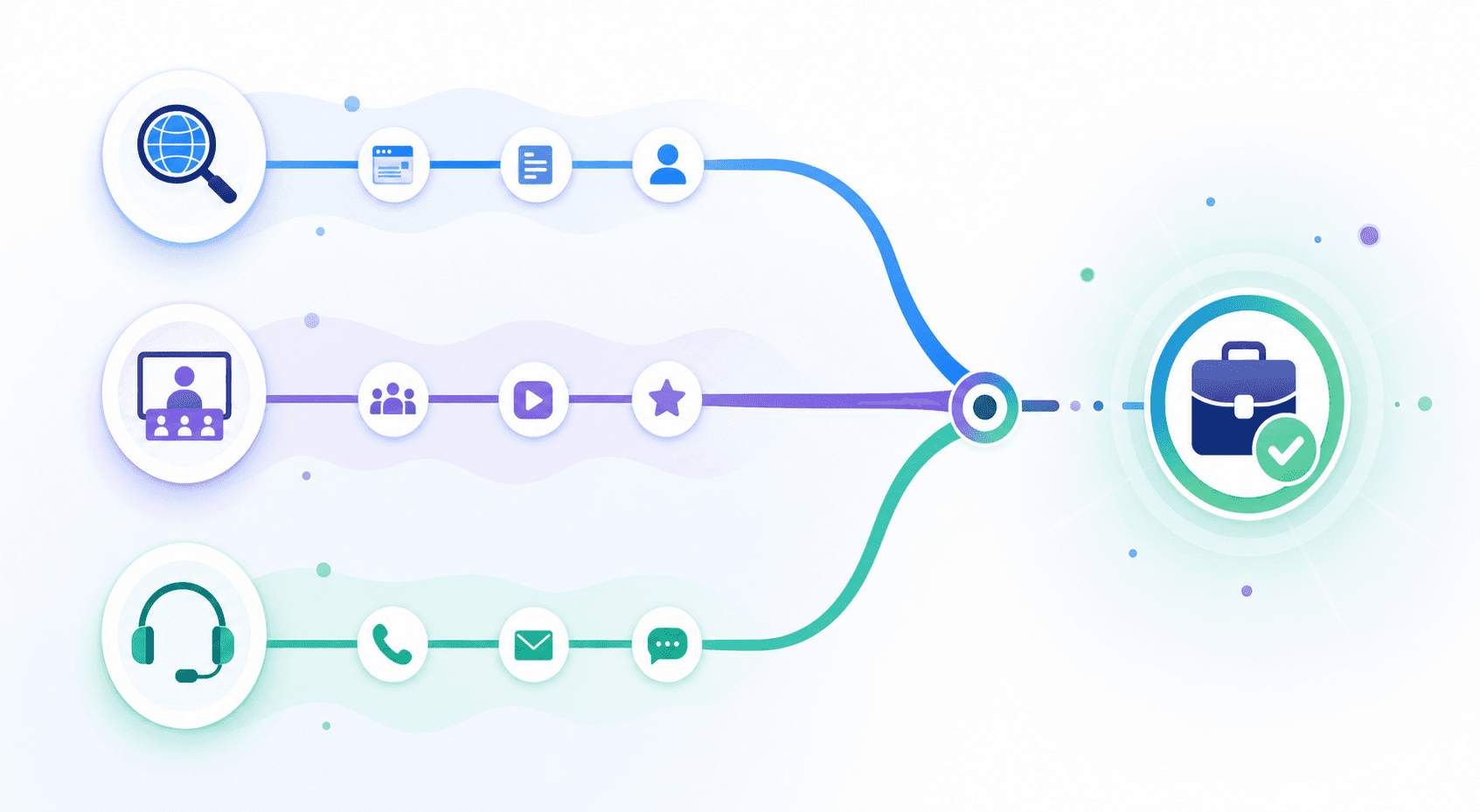
Most deals touch more than one channel before they close. A prospect reads a case study through organic search, attends a webinar two weeks later, and then responds to a rep's outbound sequence. Each of those interactions shows up somewhere in your attribution data, and none of them tells the complete story on its own.
The attribution logic question sales asks usually sounds like: "Why does this deal show both organic and outbound?" The honest answer is that both probably contributed. The harder answer is that how much credit each channel gets depends entirely on which attribution model your RevOps team chose to run.
The Models Behind the Credit Split
There are a few common approaches, and each produces a genuinely different answer to the same question. Understanding revenue attribution models helps clarify why the same deal can show completely different credit assignments depending on which framework your team runs.
First-touch attribution gives all credit to the channel that brought the prospect in initially. If organic search was the entry point, it owns the deal, regardless of what happened after.
Last-touch attribution flips that logic, crediting whoever closed the loop. The outbound rep who booked the final call gets the win, even if the prospect had been warming for months.
Multi-touch attribution distributes credit across interactions according to a weighting rule, which is where the "why does this deal show both" question gets its answer. Linear models split evenly; U-shaped models weight the first and last touch more heavily; W-shaped models add a third weight at the opportunity creation point.
The model your team runs shapes every number in the attribution report. Sales asking about a specific deal attribution question rarely want a lecture on modeling theory, though. They want to know why the number looks the way it does, and they want that answer quickly through Ravenna's Request Agent.
Side-by-Side Comparison of Attribution Models and Credit Assignment
Attribution Model | How Credit Gets Assigned | What Sales Sees in Practice |
|---|---|---|
First-Touch | All credit goes to the channel that brought the prospect in initially, regardless of subsequent activity | Organic search owns the deal completely if it was the entry point, even after months of rep outreach |
Last-Touch | Full credit goes to whoever closed the loop, ignoring earlier warming activity | The outbound rep who booked the final call gets the win, even if the prospect had been engaging for months |
Linear Multi-Touch | Credit splits evenly across every qualifying touchpoint in the buyer journey | Both organic search and the outbound sequence show equal percentage credit on the same deal |
U-Shaped Multi-Touch | First and last touch receive higher weight, with remaining credit distributed across middle interactions | Initial webinar and final sales call each get 40% credit, with the middle three touches splitting the remaining 20% |
W-Shaped Multi-Touch | Three moments get emphasis: first touch, opportunity creation, and deal close, with other touches weighted lower | Organic entry, the demo that created the opp, and the pricing call that closed it each show higher credit than nurture emails |
How Data Cleanup and CRM Migrations Break Attribution Memory

When a company rebrands, restructures territories, or migrates from one CRM to another, historical attribution data rarely survives intact. Opportunity records get reassigned. Contact ownership changes hands. Stage timestamps get overwritten during data normalization. And when that happens, the attribution model loses its memory of who touched what and when.
Sales reps notice this first. A deal they worked for months suddenly shows no credited touches. A sourced opportunity appears orphaned. The attribution logic question that surfaces in the next pipeline review has a genuinely complicated answer because the underlying data changed, not the model.
Why CRM Migrations Are Particularly Disruptive
Three specific failure points tend to compound during a migration:
Historical activity records frequently don't migrate with full fidelity. Call logs, email sequences, and meeting records attached to old contact IDs may not map cleanly to new object structures, which means the attribution model reads those touches as missing instead of present.
Field mappings between the old and new CRM often don't preserve the custom fields that attribution rules depend on. If your model keys off a "Lead Source Detail" field that gets renamed or consolidated, every rule referencing it silently fails.
Merge and deduplication logic during cleanup can collapse multiple contact records into one, stripping out the individual touch history that multi-touch attribution needs to assign credit across the funnel.
The result is that RevOps inherits a model that looks structurally intact but is quietly returning incomplete credit assignments on any deal that touched the CRM before the migration cutover date.
Why Attribution Models Change Without Warning
Most attribution models weren't designed. They were inherited. Someone configured first-touch tracking when the CRM launched, it produced numbers, and the team moved on. When buying journeys grew more complex and new tools joined the stack, nobody stopped to ask what each addition meant for how credit gets assigned.
That drift is quiet until it isn't. Poor governance and taxonomy changes are among the most common sources of attribution disputes. A wrong model is at least stable. One that shifted without notice leaves RevOps unable to explain why credit moved, which erodes trust faster than any methodology debate ever could.
The Sales and Marketing Alignment Gap That Fuels Attribution Disputes
The attribution logic question lands differently depending on which side of the table you sit on. Sales reps asking it usually want one thing: confirmation that their deals are being counted correctly. RevOps hearing it usually knows the answer involves a fifteen-minute explanation of touch windows, model weights, and why the numbers in Salesforce don't match the numbers in the attribution report.
That gap exists because sales and marketing teams rarely share a working definition of what attribution is supposed to measure. Each team comes to the same data with a genuinely different frame:
Marketing reads attribution as an influence map. Every touchpoint that preceded a closed deal counts. The goal is understanding which channels moved the prospect forward, regardless of who gets formal credit.
Sales reads attribution as a scorecard. The expectation is that the model reflects effort and ownership, and more so, their effort and their ownership. When it doesn't, the model looks broken.
Neither reading is wrong. But they produce completely different expectations from the same underlying data. The result is a recurring cycle: a rep flags a discrepancy, RevOps investigates, and the explanation requires context that isn't visible in any dashboard the rep can access. The attribution logic question keeps surfacing not because the model is broken, but because no one outside RevOps has a clear way to look it up themselves through self-service support.
That gap exists because sales and marketing teams rarely share a working definition of what attribution is supposed to measure. Marketing tends to build attribution models around influence, tracking every touchpoint that preceded a closed deal. Sales tends to read attribution as a scorecard, expecting it to reflect effort and ownership. Neither interpretation is wrong, but they produce completely different expectations from the same underlying data.
The result is a recurring cycle: a rep flags a discrepancy, RevOps investigates, and the explanation requires context that isn't visible in any dashboard the rep can access. The attribution logic question keeps surfacing not because the model is broken, but because no one outside RevOps has a clear way to look it up themselves through self-service support.
How to Document Attribution Logic So It Stops Being a Live Question
The attribution logic question keeps surfacing in QBRs and pipeline reviews because the answer lives in someone's head, not in a document anyone can find. Fixing that is less about writing a wiki page and more about building a small reference system that answers the question before it gets asked.
Three things need to be written down: which model is active and when it last changed, how credit gets assigned across touchpoints as concrete rules, and where sales reps go with follow-up questions. Each one removes a different reason RevOps gets pulled into the conversation.
What model is currently active and when it changed, including a plain-language summary of why the change was made, so anyone reading it later has context without needing to track down the person who made the call.
How credit is assigned across touchpoints, written out as concrete rules instead of abstract principles, so a sales rep can read it and immediately understand why a specific deal credited the way it did.
Where to go with follow-up questions, so the answer to "who do I ask?" is also documented and doesn't default to whoever happens to be online.
Keeping It Current Without Making It a Project
A static doc goes stale fast. The more useful approach is attaching a short update trigger to the model itself using IT knowledge management systems: any time attribution logic changes, the documentation updates in the same workflow. That means whoever approves the change also owns the record. Separating those two things is how documentation falls behind. The format matters less than the location. If the sales team lives in Slack and the doc lives in Confluence, the doc effectively doesn't exist using traditional systems. Put the reference where the question gets asked.
What Good Attribution Documentation Actually Includes
Good attribution documentation captures decision rationale alongside field definitions. The most useful attribution resources explain the why behind model choices alongside the what. That means a complete attribution reference covers four things at once: which model is active and when it was last updated, what counts as a qualifying touchpoint, how edge cases are handled, and where sales reps can go with follow-up questions without pulling someone into a meeting. Each one does different work.
Model status and change history. This entry should name the model type currently in use (first-touch, last-touch, linear, U-shaped, W-shaped), the date it was last changed, and a plain-language note on why the change was made. Without the rationale, someone reading it six months later has no way to know whether the current model reflects a deliberate strategic choice or a leftover from a tool migration.
Qualifying touchpoint definitions. Not every interaction counts. The documentation should spell out which activity types qualify (web visits, email opens, calls, demo requests, campaign responses), what the lookback window is, and the minimum criteria a touchpoint must meet to appear in attribution data. If your CRM requires a specific field to be populated before a touch logs, that belongs here too.
Edge case handling. Edge cases are where attribution disputes actually originate. Document what happens when a prospect re-enters the funnel after going dark, how partner-sourced deals interact with outbound sequences, and whether manual overrides exist and who can apply them. These are the scenarios RevOps gets asked about every quarter. Writing them down once removes the need to reconstruct the answer each time.
Escalation and follow-up routing. The documentation should name a specific owner or channel for attribution questions, not simply say "contact RevOps." A deal-level attribution question from a sales rep and a model configuration question from marketing analytics need different destinations. Making that routing explicit means the documentation resolves the question or points to the right person without RevOps having to intercept every thread.
Without that context, even a well-maintained data dictionary leaves RevOps fielding the same questions every quarter.
How Ravenna Turns Attribution Logic into Self-Service Knowledge
Ravenna integrates with Notion, Confluence, and Google Drive, so the attribution documentation your team writes once becomes retrievable through Slack. When a sales rep asks why an opportunity credited to Partner over Direct, Ravenna's RevOps Agent pulls the documented attribution hierarchy alongside that deal's specific touch history, then responds with both the general rule and the deal-level application following self-service adoption best practices without needing RevOps to loop in.
The knowledge base auto-generates searchable content from resolved attribution conversations, so the explanation given once becomes reusable across future questions. Conditional routing via agent rules surfaces different documentation by role using knowledge management folders, so sales, marketing, and finance each see the context relevant to their specific question instead of the full model spec.
Final Thoughts on Ending the Attribution Question Cycle
The attribution logic question repeats because the documentation doesn't live where sales asks it. Writing it down once solves nothing if the answer stays buried in a Confluence page nobody reads. Ravenna surfaces your attribution model rules automatically in Slack when a rep asks why a deal credited the way it did. Let's talk about making your attribution logic self-service instead of a standing RevOps meeting topic.
FAQ
Can I build a self-service attribution lookup without RevOps having to answer every question live?
Yes. The most effective approach is documenting which model is active, how credit gets assigned across touchpoints, and where to look for deal-level attribution data, then storing that reference where sales already works, like Slack or your CRM. Ravenna's RevOps Agent pulls documented attribution logic alongside specific deal touch history, responding with both the general rule and the deal-level application directly in Slack.
Why does my deal show both marketing and sales attribution sources?
Most deals touch multiple channels before closing, and multi-touch attribution distributes credit across those interactions according to a weighting rule. If a prospect came in through organic search and later responded to outbound, both channels contributed; the percentage each receives depends on whether your team runs first-touch, last-touch, linear, or weighted attribution models. The specific split lives in your attribution model documentation.
What's the difference between first touch and multi-touch attribution models?
First-touch gives all revenue credit to the initial channel that brought the prospect in, regardless of subsequent activity. Multi-touch distributes credit across every qualifying touchpoint based on a weighting rule: linear splits evenly, U-shaped weights first and last touch more heavily, and W-shaped adds emphasis at opportunity creation. Your model choice determines whether a single channel owns the deal or whether credit gets shared.
How do CRM migrations break attribution tracking?
Three specific points typically fail during migration: historical activity records often don't map cleanly to new object structures, custom fields that attribution rules depend on get renamed or consolidated, and merge logic during deduplication can strip individual touch history from contact records. The result is that deals touched before the migration cutover date return incomplete credit assignments even though the model itself looks intact.
What should attribution documentation actually include?
Good attribution documentation captures which model is active and when it changed, what counts as a qualifying touchpoint with concrete rules instead of abstract principles, how edge cases are handled, and where to go with follow-up questions. The key is attaching documentation updates to model changes in the same workflow, so the reference never falls behind what's actually configured in your CRM.