

If your team is still manually picking up tickets after an AI tool "handles" the request, the tool is doing triage, not resolution. That distinction is what separates most of the options on this list from each other, and it's the lens we used to rank all seven.
TLDR:
Most AI helpdesks deflect or route; agentic platforms execute end-to-end without a human in the path.
The key evaluation question: where does automation stop, whether at deflection-only, routing, or full agentic execution?
Risotto and Freshservice require human follow-through after intake and triage.
Ravenna's IT and PeopleOps agents execute provisioning, onboarding, and access workflows autonomously in Slack or Teams, without a ticket.
What Is an AI Helpdesk?
An AI helpdesk is a support system that uses AI to receive, interpret, and act on employee requests, without requiring a human to touch every step of the process.
The category spans a wide range. Some stop at surfacing knowledge base articles. Others route tickets to the right queue. The most capable classify intent, reach into connected systems like Okta or Google Workspace, execute the requested action, and confirm resolution back to the requester without a ticket ever being filed. Each human touchpoint adds time that agentic execution avoids.
Where the real distinction lies
The clearest way to separate AI helpdesk options is to ask what happens after the request arrives:
Deflection-only tools respond with a suggested article and hand off to a human if that doesn't work. The queue still exists; it just has a filter in front of it.
Ticket-routing tools classify and assign automatically, but resolution still depends on someone picking up the ticket and doing the work.
Agentic platforms classify intent, gather context, execute across systems, and post confirmation back to the requester. The human queue shrinks because the work gets done, not merely sorted.
How We Ranked AI Helpdesk Platforms
Each platform in this list was assessed against six criteria that reflect how AI helpdesk tools actually perform in practice, not on a feature checklist.
Autonomous resolution depth: how far the platform goes before handing work back to a human, from answering a question to closing the loop across connected systems without a ticket filed.
Conversational interface quality: how well the tool handles requests inside Slack, Teams, or email rather than requiring a separate portal.
Integration breadth: whether connections to identity providers, HRIS, MDM, and SaaS tools support read-and-write execution or only lookups.
Setup and deployment speed: how quickly a team moves from signed contract to live workflows given configuration complexity.
Fit for team size and complexity: whether the platform is built for SMB agility, enterprise governance, or something in between.
Pricing transparency: whether costs are published, predictable, and proportional to usage, or gated behind sales conversations.
Best Overall AI Helpdesk: Ravenna
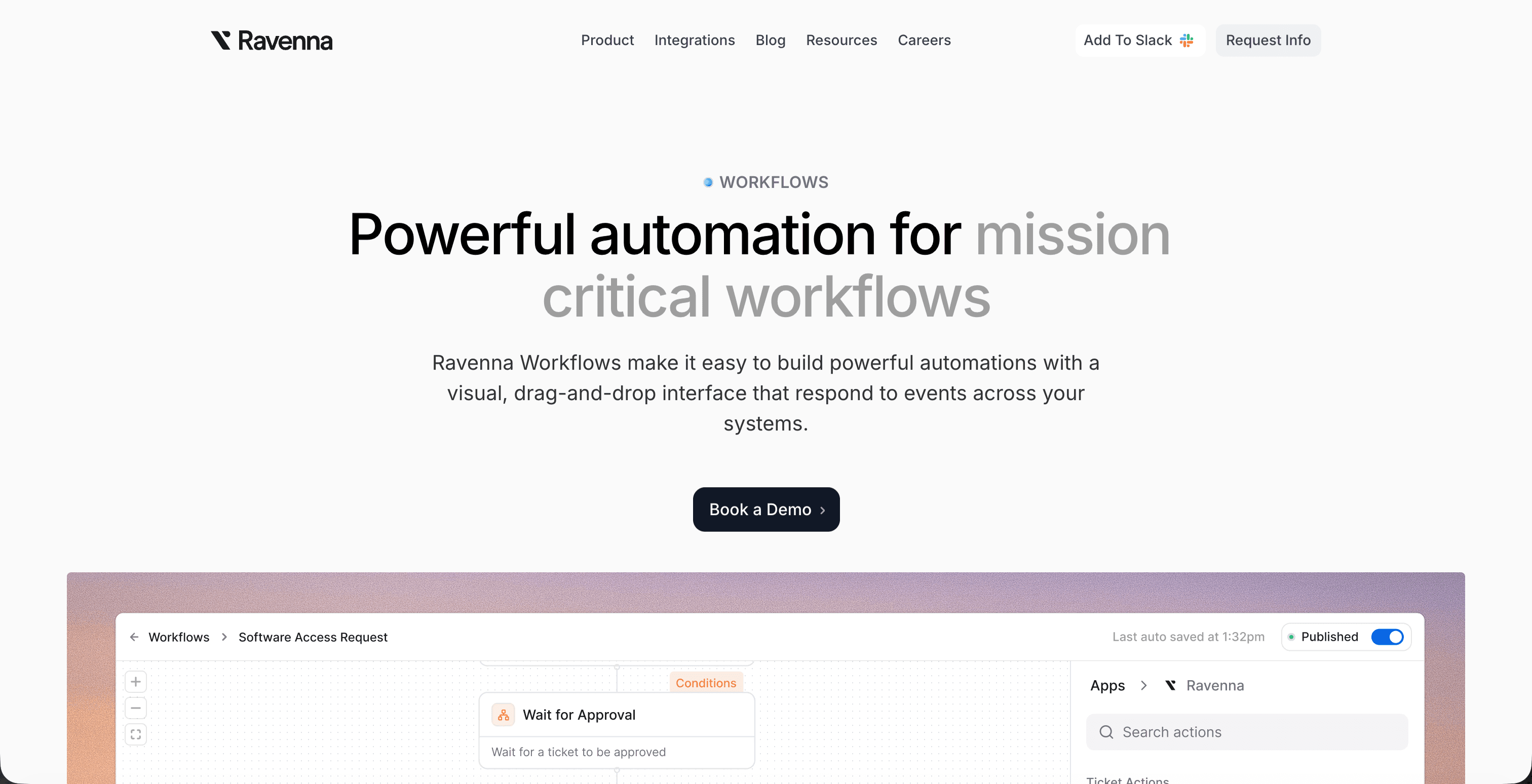
An employee messages Slack asking for access to a tool. Ravenna's IT Agent reads the request, checks entitlements, triggers provisioning, and posts confirmation back in the same thread. No ticket. No queue. Ravenna is a Slack and Teams-native platform built for IT, HR, and Operations teams, with AI agents that close the loop across provisioning, access management, onboarding, and offboarding.
Key Features
Slack-native and Teams-native request handling: requests, approvals, execution, and confirmation happen in the same thread with no separate portal
IT Agent resolves access requests, software provisioning, password resets, and device troubleshooting by reaching into Okta, Google Workspace, and other connected systems
PeopleOps Agent manages onboarding and offboarding end-to-end, reading HRIS status changes and triggering downstream actions across connected systems
Knowledge base syncs with Notion, Confluence, and Google Drive so agents resolve requests with current context
Approval Rounds route multi-step approvals without manual follow-up
Visual no-code workflow builder that deploys in minutes
Limitations
Purpose-built for Slack-native and Teams-native environments; organizations not standardized on either platform won't get full benefit from the interface layer
Teams that need deep ITIL process compliance, formal change advisory board structures, or on-premises deployment will find Ravenna aimed at different priorities
A single Microsoft Teams tenant cannot be linked to more than one Ravenna organization, which matters for multi-entity orgs sharing one Teams tenant
Bottom Line
Ravenna fits SMB to mid-market IT, HR, and Ops teams in Slack or Teams whose bottleneck is manual work after requests land. Requests get resolved, not sorted.
Risotto
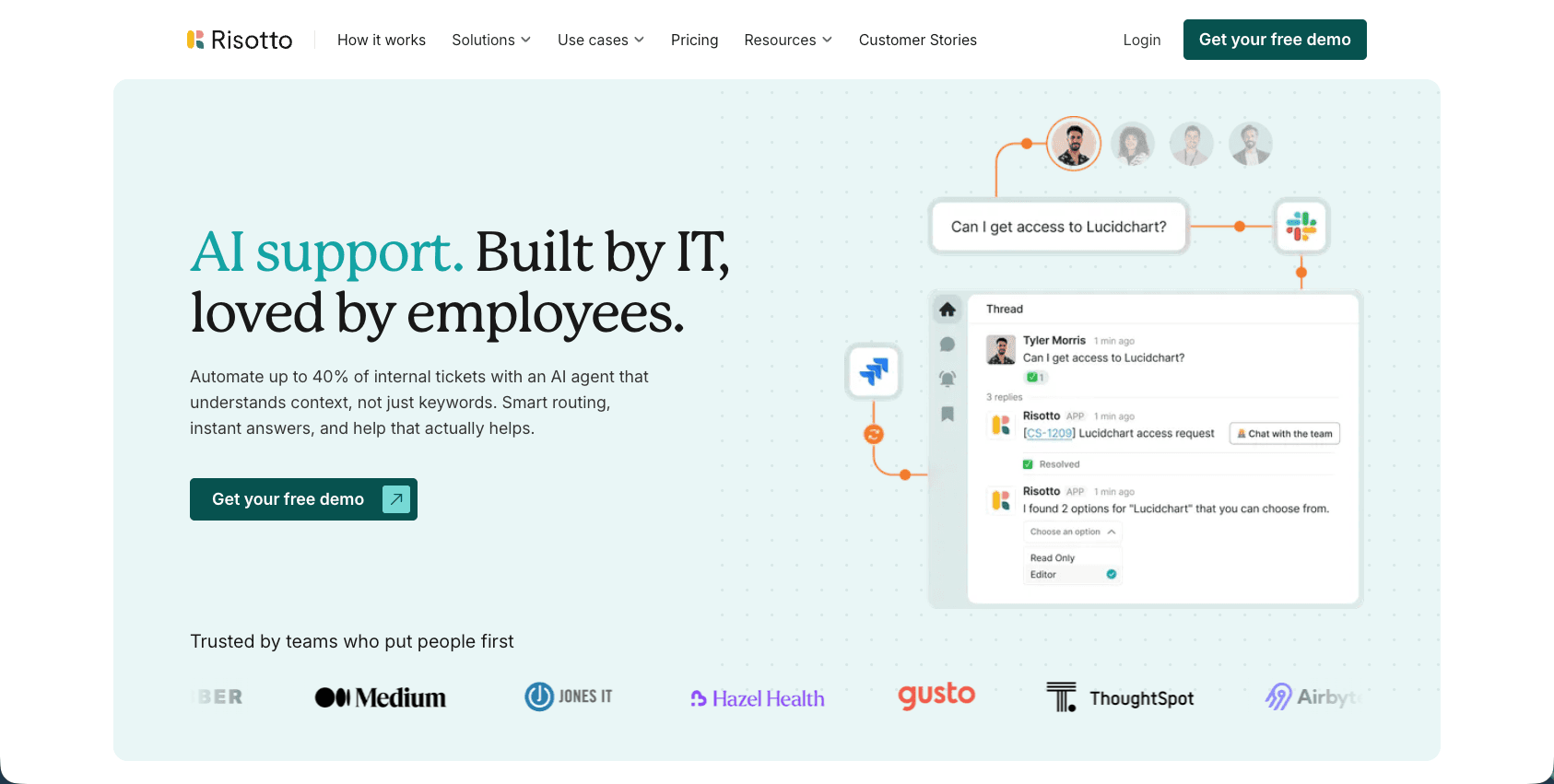
Risotto is a Slack-native helpdesk that keeps support conversations inside the channel where they start. An employee asks a question in Slack, Risotto reads the message, classifies the intent, and either pulls an answer from the connected knowledge base or routes the request to a human agent with context already attached. The loop closes in Slack without anyone opening a separate portal.
Key Features
Slack-first ticket management that converts messages into trackable requests
Knowledge base search that surfaces articles when a request is filed, reducing repeat questions
SLA tracking and reporting inside Slack, so IT leads can monitor response times without switching tools
Triage automation that assigns requests to the right team based on intent
Limitations
Execution stops at deflection and routing; workflow execution across connected systems requires human follow-through
Best suited for teams on Slack; organizations on Teams or split across both will find the experience uneven
Knowledge management depends on content your team creates manually; no adaptive layer captures resolution patterns automatically
Bottom Line
Risotto is a good fit for small to mid-market teams that want Slack-native ticket tracking and knowledge delivery without the overhead of a full ITSM rollout. Teams that need autonomous end-to-end execution across their identity, HR, and access systems will hit the ceiling of what Risotto resolves on its own, a gap covered in depth in Ravenna vs Risotto.
Freshservice
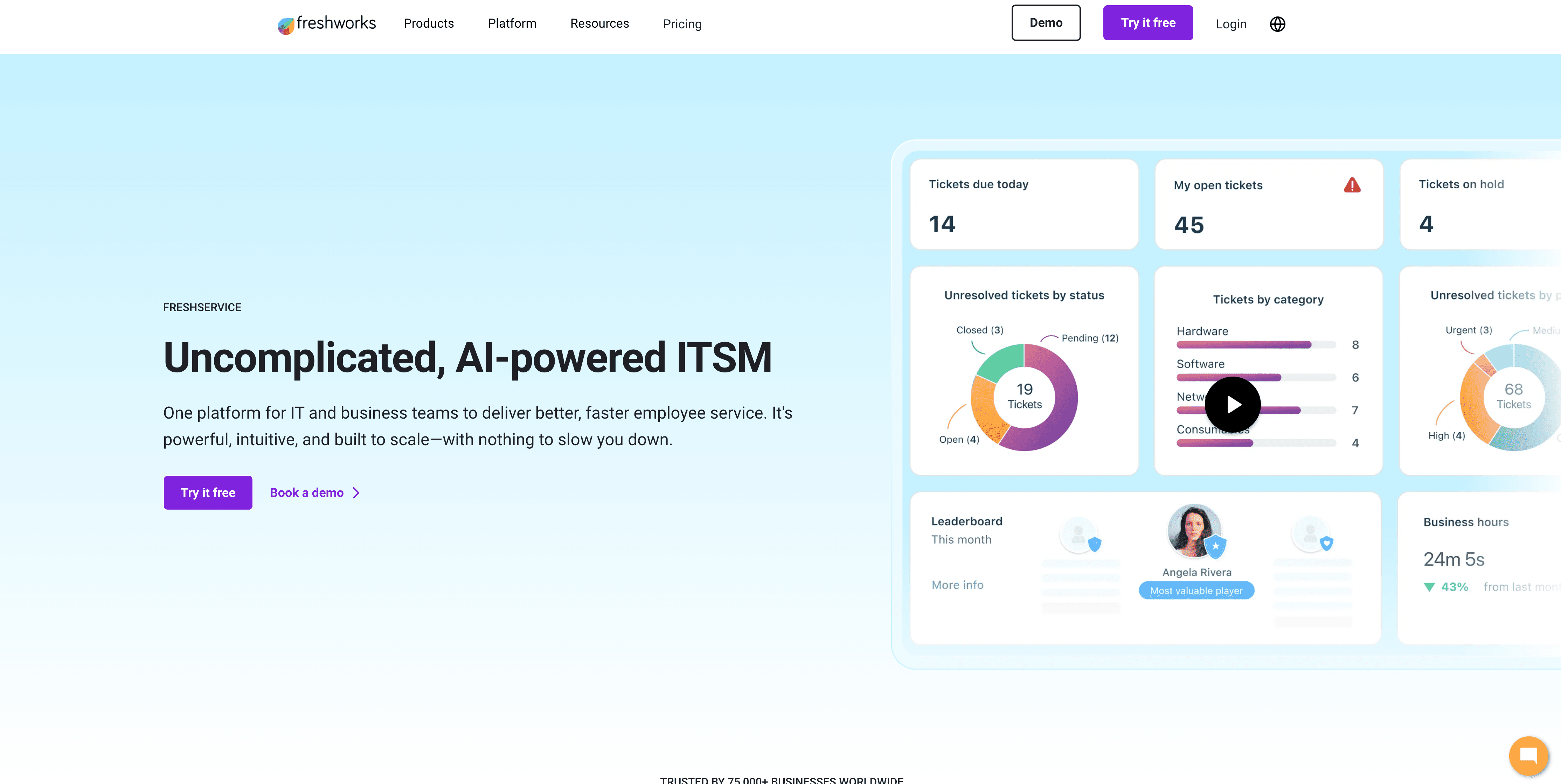
Freshservice is Freshworks' cloud-based IT service management product. An employee submits a request through the web portal or email, Freshservice creates a ticket, routes it to the queue, and waits for a human agent to act. For an independent view, TechRadar's Freshservice review covers its AI automation features and where the platform fits best.
Key Features
Incident and change management follow ITIL v3/v4 frameworks, making it a fit for organizations with formal compliance requirements
Asset management tracks hardware and software inventory with solid depth for mid-market IT teams
SLA tracking and reporting give managers visibility into ticket volume, SLA adherence, and agent workload without custom configuration
AI-assisted ticket categorization and suggested responses reduce manual triage at the intake stage
Limitations
AI assistance stops at categorization and routing; resolution still requires a human to pick up the ticket and act across Okta, HRIS, or Active Directory
Ticket-first architecture means every repetitive request depends on someone in the loop at each resolution step
Bottom Line
Freshservice suits IT teams that need structured ITIL governance, mature asset tracking, and SLA compliance documentation. Teams whose bottleneck is the volume of repetitive requests in queue will find the human-in-the-loop dependency at every resolution step hard to work around.
Jira Service Management
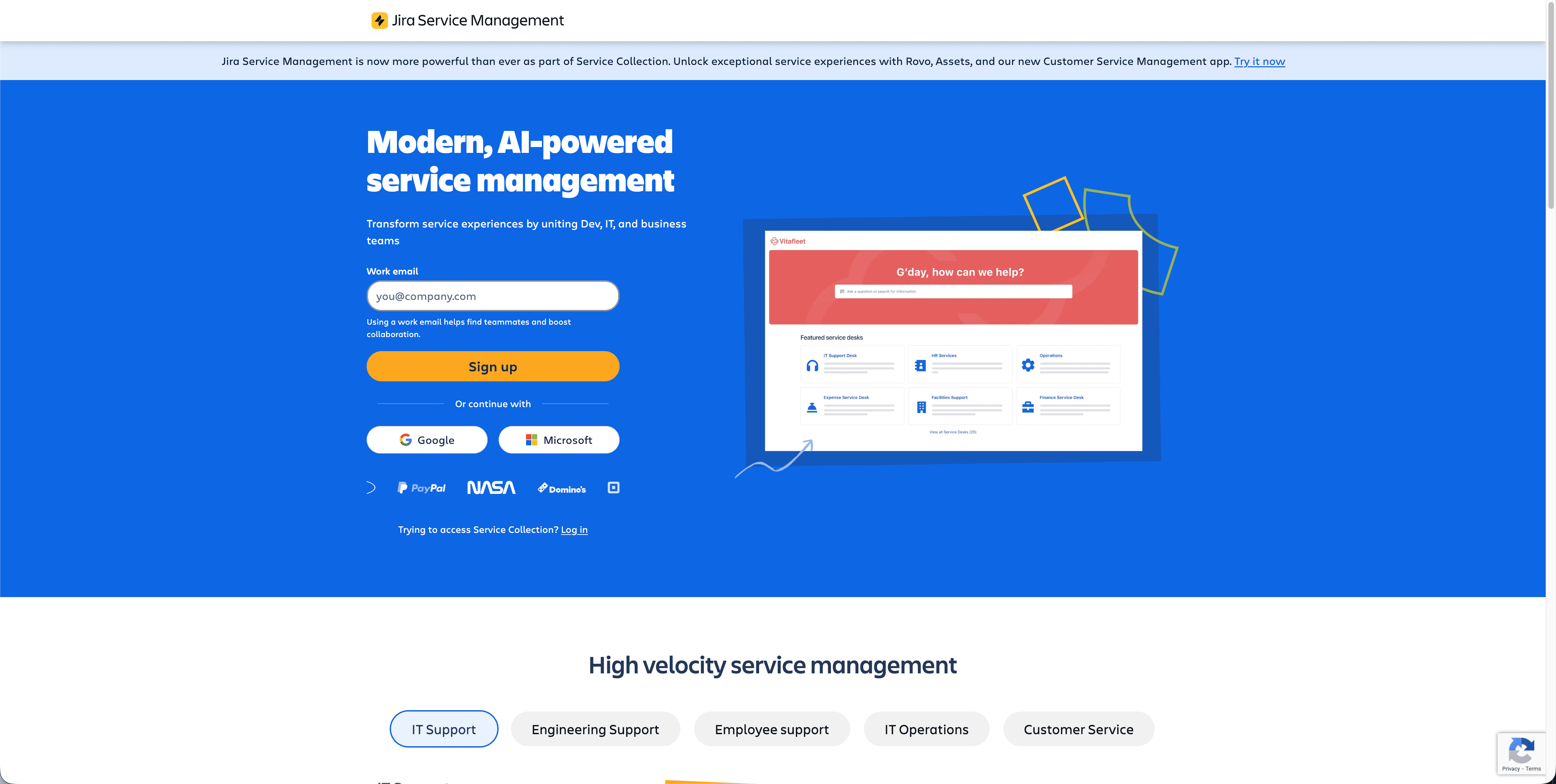
Jira Service Management (JSM) started as a developer tool and grew into a full IT service desk product. A request comes in through the portal, the system creates a ticket, routes it to a queue, and waits for an agent to open it, take action, and close it out. JSM has since added virtual agents that suggest knowledge articles and handle basic categorization, and for teams deep in the Atlassian ecosystem (Jira Software, Confluence, Bitbucket), the integration story is genuinely strong.
Key Features
Portal and email-based ticket intake with customizable request forms across service catalogs
Virtual agent for Slack and Microsoft Teams that can deflect common questions using Confluence knowledge base content
Native Jira integration lets IT teams link incidents directly to engineering work for faster root-cause tracking
Automation rules for routine ticket actions like assignment, priority escalation, and SLA breach alerts
Reporting and SLA dashboards built into the interface
Limitations
AI resolution stays at the suggestion layer; executing actions in downstream systems still requires a human agent
Pricing scales per agent seat, which grows expensive as team size increases
Teams outside the Atlassian ecosystem get less value from the integrations that make JSM most useful
Initial setup and ongoing administration take real time investment
Bottom Line
JSM fits engineering-led organizations on Atlassian products that want service desk capabilities in the same toolchain. For lighter Slack-native alternatives, the Console vs Risotto help desk showdown is a useful comparison. For peer ratings, G2's Jira Service Management reviews cover configuration complexity and per-seat pricing. Teams whose priority is autonomous resolution across Okta, Google Workspace, or Active Directory will find JSM hands that work back to a human agent.
ServiceNow ITSM
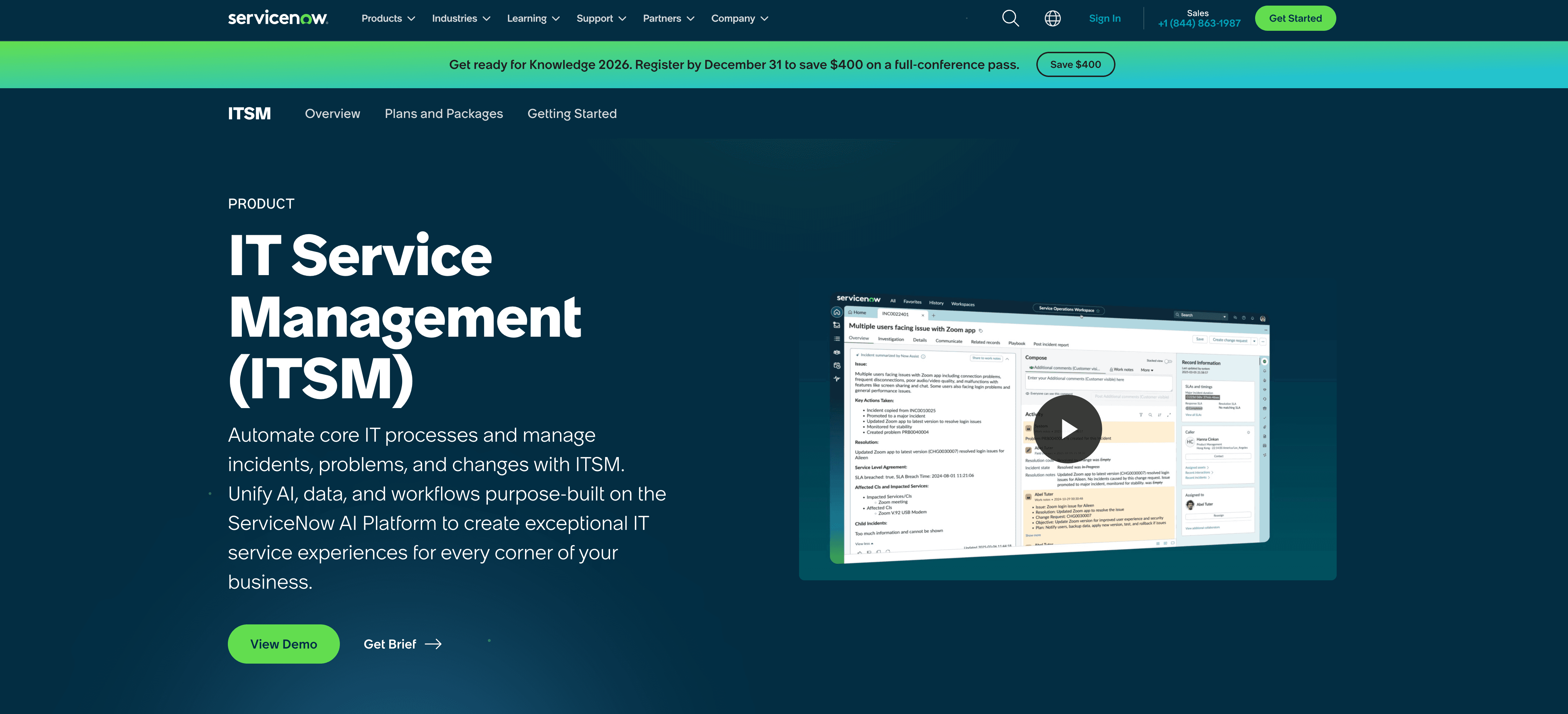
An employee submits a service request. ServiceNow creates a ticket, routes it through the appropriate workflow, tracks SLA status, and generates an audit trail before a human agent picks it up, takes action, and marks it resolved. It is the dominant enterprise ITSM system of record, built for governance and compliance rather than autonomous execution.
Key Features
ITIL-aligned incident, problem, change, and asset management for enterprise governance requirements
Enterprise service catalog with SLA and compliance tracking built into the ticket lifecycle
Now Assist AI for ticket routing and deflection, layered on the existing ticket architecture
Multi-department governance with formal change advisory board support at scale
Limitations
Automation stops at categorization and assignment; resolution still requires a human agent at every step
AI capabilities through Now Assist arrive as a separate layer on top of the ticket architecture, not native to the resolution path itself
Enterprise rollouts typically run months to over a year, requiring dedicated ITSM administration teams
Per-seat and module-based pricing adds up quickly as team size and deployment scope grow
Bottom Line
ServiceNow fits large enterprises with dedicated ITSM administration teams that need formal ITIL process compliance, change advisory board structures, and multi-department governance at scale. Teams whose bottleneck is repetitive manual work in queue will find the architecture hands that work back to a human agent at every resolution step.
Feature Comparison Table of AI Helpdesk Platforms
Here is a side-by-side look at how these seven AI helpdesk platforms compare across the capabilities that matter most to IT teams making a switch.
How the Seven Platforms Compare Across Core Capabilities
Capability | Ravenna | Risotto | Freshservice | Jira Service Management | ServiceNow |
|---|---|---|---|---|---|
Agentic execution | End-to-end | Deflection and routing | Limited | Limited | Rule-based |
Slack / Teams native | Both | Slack only | Integration | Integration | Integration |
Deployment speed | Minutes | Hours to days | Days to weeks | Days | Weeks to months |
Autonomous resolution | Yes | No | No | No | Partial |
HRIS / MDM integrations | Native | Limited | Limited | Limited | Native |
Best fit | IT, HR, Ops at SMB to mid-market | Slack-native ticket tracking, small to mid-market | ITIL governance and asset tracking | Dev and engineering teams on Atlassian | Enterprise ITIL governance |
Why Ravenna Is the Best AI Helpdesk
Ravenna is an AI-native workflow automation platform built for IT, HR, and Operations teams working inside Slack and Microsoft Teams. Most AI helpdesk tools stop at suggesting an article or routing a ticket to a queue. Ravenna's IT Agent, PeopleOps Agent, and RevOps Agent close the loop without a human in the path, executing across Okta, Google Workspace, your HRIS, and connected CRM systems end-to-end.
Final Thoughts on What Separates AI Helpdesk Tools
Most teams shopping for AI helpdesks are solving for the same thing: less manual work landing on IT every week. The architecture behind each tool determines whether you get a smarter filter or an actual resolution. Your best move is to identify where work gets stuck, then match the tool to that gap. Connect with Ravenna to see what autonomous resolution looks like in practice.
FAQ
How do I choose the right AI helpdesk from this list for my team's needs?
Start where work actually stalls. If requests pile up because answers aren't documented, a deflection tool like Risotto may be enough. If someone still has to open Okta after every ticket, you need agentic execution depth.
Is Ravenna or Jira Service Management a better fit for IT teams already in the Atlassian ecosystem?
JSM fits teams tightly coupled to Jira Software, Confluence, and Bitbucket that need incident management in the same toolchain. Ravenna fits teams whose priority is autonomous execution: provisioning access in Okta, triggering offboarding, or resetting MFA without a human picking up the ticket.
Is Freshservice or Ravenna better suited for teams with formal ITIL compliance requirements?
Freshservice fits teams that need ITIL workflows, asset management, and SLA tracking for compliance requirements. Ravenna fits teams whose bottleneck is the volume of repetitive requests that still require a human to close out.
Can Ravenna work alongside an existing ITSM platform like Jira Service Management or Freshservice, or does it require a full replacement?
Ravenna runs standalone as an AI-native service desk or layers on top of Jira Service Management, Freshservice, or Linear via bidirectional integration, syncing tickets and resolution data without disrupting existing workflows.