
When you're considering Freshservice vs Ravenna, you're choosing between portal-based ticketing and an agentic IT service management platform built around execution. Freshservice delivers structured ITSM capabilities through a familiar help desk model where employees submit tickets via a web interface. Ravenna takes a different path as a service management platform focused on execution inside Slack, where your team already works. The question isn't which tool has more features, but whether you want to process tickets or eliminate manual work across your stack.
TLDR:
Ravenna automates workflows in Slack, executing tasks across your SaaS stack without tickets.
Freshservice routes requests through a web portal that creates adoption friction for employees.
Workflow automation delivers 25-30% productivity gains by eliminating manual work, not simply routing tickets.
Ravenna handles IT, HR, and Ops requests through one interface versus separate service desks.
What is Freshservice?
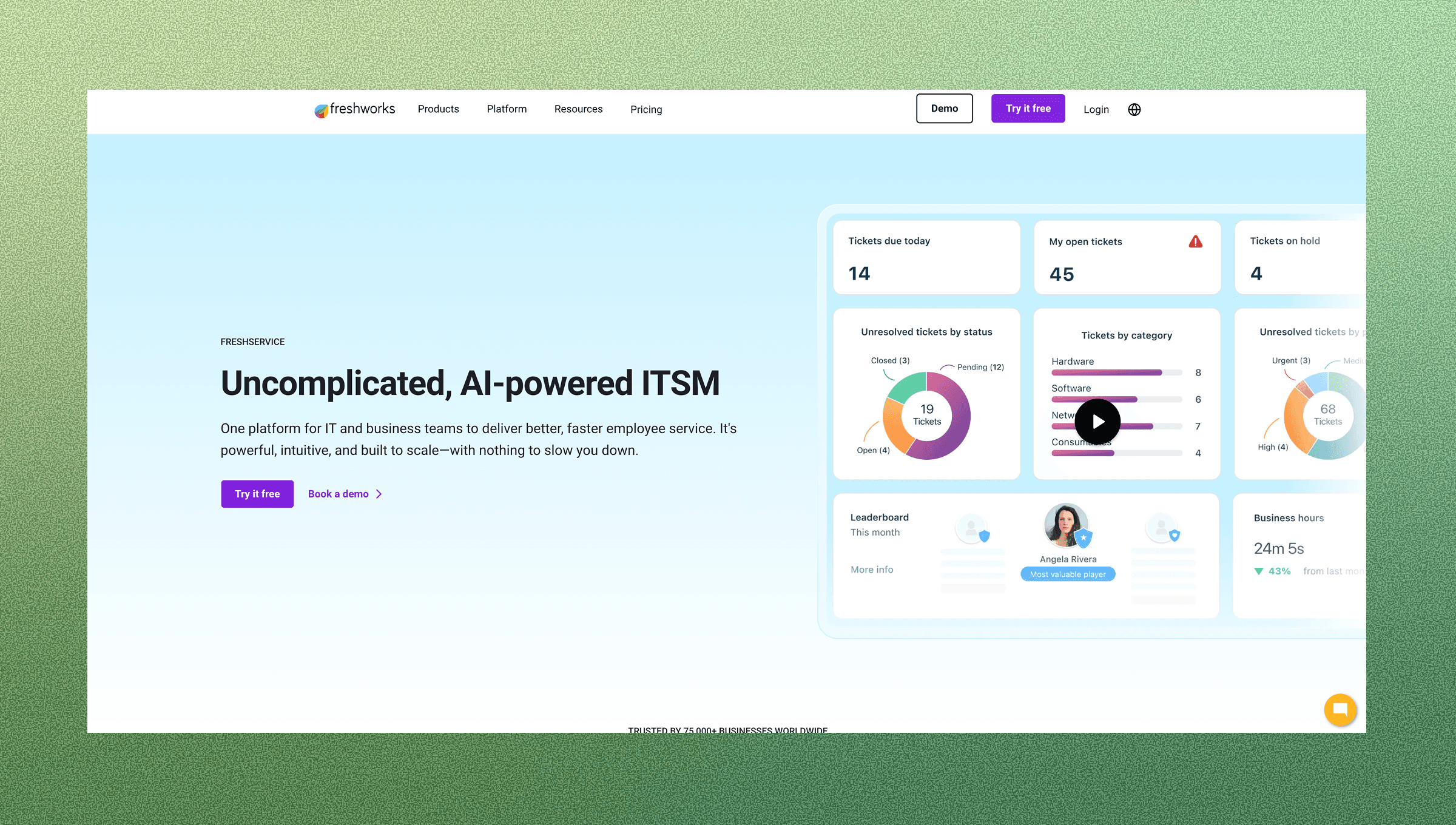
Freshservice is a cloud-based IT service management solution from Freshworks that helps organizations manage IT support operations through a traditional ticketing approach. The tool follows the classic helpdesk model where users submit tickets through a web portal or email, and IT teams work through queues to resolve issues.
Freshservice includes incident management, change management, IT asset management, SLA management, automated ticket routing, and knowledge base articles. The system adds AI-powered chatbot responses and ticket categorization, integrates with common enterprise tools via API connections, and provides reporting dashboards to track resolution time and ticket volume.
For organizations looking for a conventional ITSM solution with portal-based workflows, Freshservice delivers that familiar experience.
What is Ravenna?
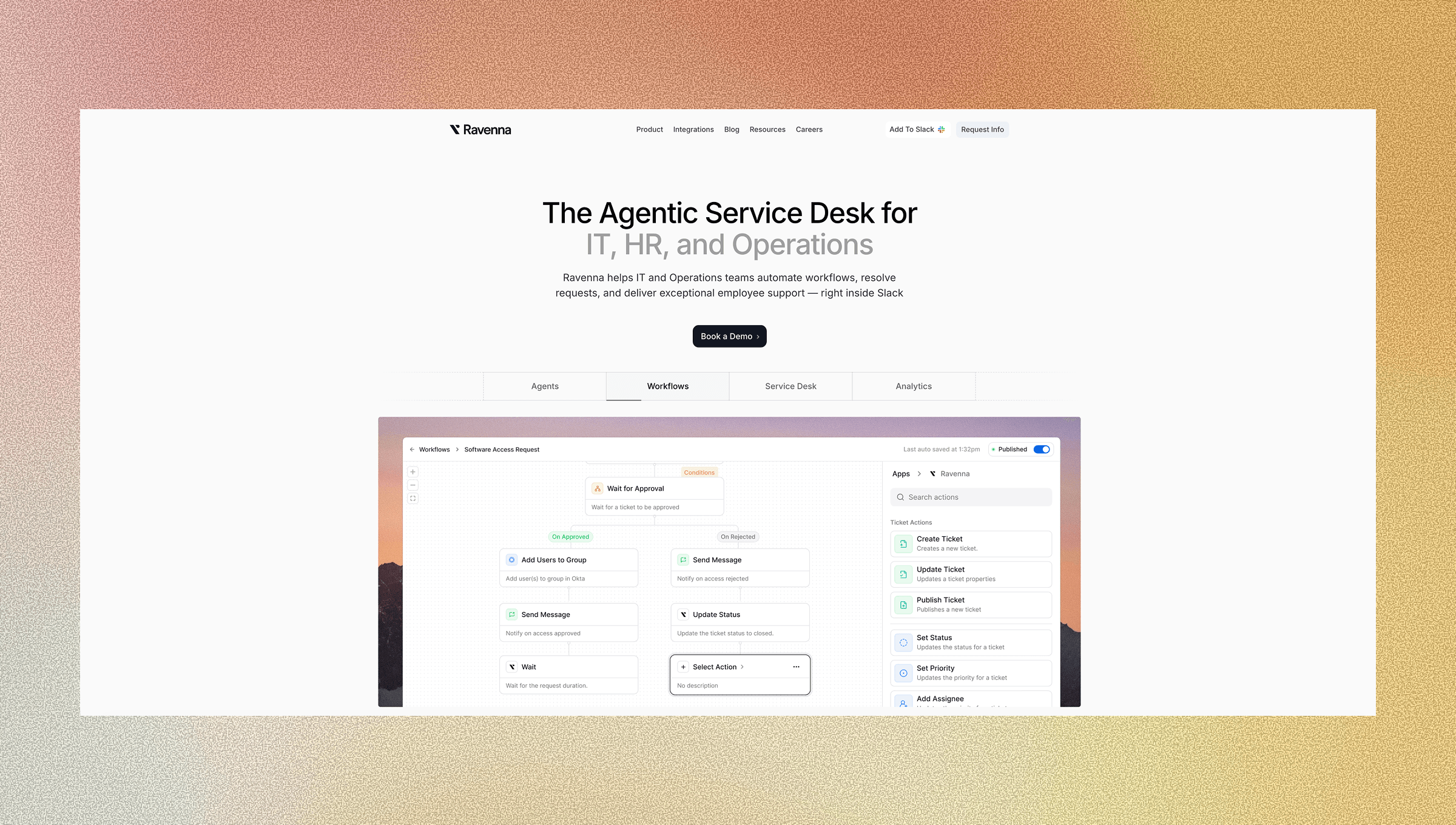
Ravenna is a Slack-native workflow automation platform and agentic ITSM solution built to handle IT, HR, and Operations requests without forcing end-users to navigate separate portals or ticketing systems. Instead of managing queues, Ravenna executes end-to-end processes across connected systems.
At the heart of the system are Ravenna Agents: autonomous AI workers designed to perform work, executing complex tasks across your SaaS stack without human intervention. When an employee messages Ravenna in Slack to request software access, reset a password, or report a device issue, Ravenna Agents classify the intent, gather any missing context, and execute the required actions across connected systems like Okta, Google Workspace, Vanta, Cloudflare, BambooHR, Rippling, or Jamf. The work gets done without creating a ticket that sits in a queue waiting for manual intervention.
The visual builder provides a no-code framework for designing customizable workflows. You can define conditional rules, approval chains, and multi-step logic that runs autonomously within Slack. Workflow management capabilities let you duplicate existing workflows to quickly create variations for different departments or request types, send emails directly within automation workflows to communicate with employees or stakeholders, and diagnose failures with detailed error messages that show exactly where automations break.
How We Compared the Two Solutions
We looked at a number of criteria in assessing Ravenna versus Freshworks:
User interface
Workflow automation
Cross-functionality
AI integration
Analytics
#1. User Interface: Slack-Native Workflow Execution vs Portal-Based Ticketing
The difference between these two approaches comes down to where work actually happens. Freshservice sends notifications to Slack and Microsoft Teams, but employees still need to open the self-service portal to submit detailed requests, respond to questions, or track progress. That context switch creates friction that kills adoption.
When employees have a choice, 70% of requests go through Slack instead of portals, and self-service IT support in Slack can reduce ticket time dramatically. Opening another tool, logging in, navigating unfamiliar menus, and filling out forms takes time and mental energy. When distributed teams live in Slack all day, asking them to visit a separate portal creates a barrier that many avoid by sending direct messages to IT staff instead.
Ravenna removes that friction. Employees ask questions, make requests, and receive updates through natural conversation in Slack. The AI agents handle disambiguation if details are missing, approvals happen inline with interactive buttons, and status updates appear in the same thread. The work coordinates across your entire stack while the employee simply chats in Slack.
#2. Workflow Automation and Execution Capabilities
Workflow automation saves employees 30% of their time, with organizations reporting 25-30% productivity increases in automated processes when following a self-service adoption approach. Those gains come from eliminating tickets through execution-first automation. How do these two solutions handle workflow automation?
Freshservice offers workflow automation within its ITSM suite, handling ticket routing, notifications, and status updates through configurable rules. The architectural limitation is clear: Freshservice automates ticket processing, but executing work across external systems like Okta, Google Groups, or HRIS tools requires custom integration work that most teams can't maintain long-term.
Ravenna coordinates execution across your SaaS tools and existing systems. The visual workflow builder lets you design multi-step sequences that run autonomously, connecting identity providers like Okta, HRIS systems like BambooHR and Rippling, and MDM tools like Jamf. Unlike AI-generated code that creates fragile automations, structured visual workflows stay transparent and easy to modify when requirements change.
#3. Cross-Functional Support Across IT, HR, and Ops
Freshservice focuses on IT service management use cases. While you can configure additional service catalogs to handle HR or operations requests, the tool is built as an IT service desk first. Extending it to support PeopleOps benefits questions, onboarding workflows, or RevOps approvals typically requires separate service desks or custom configuration work. For companies where IT, HR, and Operations each field their own requests, this creates fragmented service management processes or forces IT teams to become the bottleneck for internal support.
Ravenna handles multi-domain internal support right from the start. The same Slack interface processes IT access requests, HR benefits questions, device troubleshooting, and support requests through employee self-service software. Employees ask in Slack, and Ravenna Agents classify intent and either execute the workflow or route to the appropriate team. Specialized Ravenna Agents for IT, PeopleOps, and RevOps handle domain-specific workflows autonomously while maintaining one consistent employee experience. Workspace customization features include automatic SSO redirects that route users to the appropriate authentication provider based on email domain, collapsible Kanban columns for queue management, and flexible application provisioning with department-specific approval chains and license availability controls.
#4. AI-Powered Automation and Intelligent Agents
While both of the tools feature automation features, how they integrate and use AI is very different:
Freshservice integrates AI through Freddy AI, which provides automated ticket routing, knowledge base suggestions, and assistance with common queries. The AI functions as an intelligent assistant instead of an autonomous agent that executes complex multi-step workflows. Organizations looking for AI that performs work will find Freshservice's AI capabilities support their agents instead of replace manual tasks.
Ravenna operates as an agentic system where AI agents execute actions across connected SaaS systems. These autonomous AI workers understand context, disambiguate vague requests, and complete workflows across multiple systems without human intervention. Ravenna Agents don't simply tell a user how to reset a password, they integrate with Okta to perform the reset directly. The knowledge base generation capability creates documentation from natural language descriptions, identifies gaps based on recurring questions, and powers instant query resolution that deflects requests before they become tickets. For organizations measuring AI value by the percentage of requests fully resolved without human involvement, Ravenna's autonomous AI workers deliver measurable time savings.
#5. Analytics and Measurable Business Impact
Without analytics dashboards, it's difficult to measure the impact a service management platform has on the business. Both of these solutions, though, approach analytics differently.
Freshservice provides standard ITSM reporting focused on ticket metrics, SLA compliance, and service desk performance. The analytics track traditional help desk KPIs like ticket volume, time to resolution, and backlog, which measure how the service desk processes tickets. You can monitor agent productivity and identify bottlenecks in ticket handling, but the reporting doesn't quantify hours saved through automation or distinguish between tickets resolved by AI versus human agents. For teams needing to prove need for headcount or show ROI, the analytics focus on ticket throughput instead of work elimination.
Ravenna, on the other hand, tracks time saved, percentage of requests auto-resolved, and autonomous AI worker versus human resolution rates. The reporting quantifies automation impact in hours reclaimed and calculates ROI. Deflection insights identify which requests are fully automated versus which still require manual intervention, letting you focus on where to build additional workflows. Knowledge base analytics show which topics generate the most questions, guiding documentation efforts for maximum impact.
Side-by-Side Comparison
Coordinates end-to-end workflows that execute tasks across your entire SaaS stack through Ravenna Agents: autonomous AI workers that handle requests without human touchpoints. Visual workflow builder designs multi-step sequences connecting Okta, Vanta, Cloudflare, BambooHR, Rippling, Jamf, Slack groups, and Google Groups. Duplicate workflows for department variations, integrate email notifications directly into sequences, and diagnose failures with detailed error messages.
Handles IT, HR, and Operations requests through one interface from the start. Specialized Ravenna Agents for IT, PeopleOps, and RevOps process requests autonomously through the same Slack interface without requiring separate service desks. Workspace customization includes automatic SSO redirects, collapsible Kanban columns for queue views, and flexible application provisioning with department-specific approval chains.
An agentic system where Ravenna Agents, autonomous AI workers, execute actions across your SaaS stack. These domain-specific workers (IT Agent, PeopleOps Agent, RevOps Agent) understand context, disambiguate vague requests, and complete workflows across multiple systems without human intervention. Knowledge base generation creates documentation from natural language, identifies content gaps, and powers instant query resolution. Performs work instead of just suggesting solutions.
Tracks time saved, percentage of requests auto-resolved, and autonomous AI worker versus human resolution rates. Quantifies automation impact in hours reclaimed and calculates ROI. Deflection insights identify which requests are fully automated versus requiring manual intervention. Knowledge base analytics show which topics generate the most questions, guiding documentation efforts for maximum impact.
Feature | Freshservice | Ravenna |
User Interface | Portal-based ticketing system where employees submit requests through a web interface. Basic Slack and Teams notifications, but detailed requests require opening the service portal. Creates context-switching friction that reduces adoption. | Slack-native interface where employees make requests through natural conversation. AI agents handle disambiguation, approvals happen inline with interactive buttons, and status updates appear in the same thread. No portal required. |
Workflow Automation | Automates ticket routing, notifications, and status updates through configurable rules. Limited to ticket processing workflows. Executing work across external systems like Okta or Google Groups requires custom integration work. | Coordinates end-to-end workflows that execute tasks across your entire SaaS stack through Ravenna Agents: autonomous AI workers that handle requests without human touchpoints. Visual workflow builder designs multi-step sequences connecting Okta, Vanta, Cloudflare, BambooHR, Rippling, Jamf, Slack groups, and Google Groups. Duplicate workflows for department variations, integrate email notifications directly into sequences, and diagnose failures with detailed error messages. |
Cross-Functional Support | Built primarily as an IT service desk. Extending to HR or Operations requests requires separate service desks or custom configuration work. Creates fragmented systems or forces IT to become the bottleneck for all internal support. | Handles IT, HR, and Operations requests through one interface from the start. Specialized Ravenna Agents for IT, PeopleOps, and RevOps process requests autonomously through the same Slack interface without requiring separate service desks. Workspace customization includes automatic SSO redirects, collapsible Kanban columns for queue views, and flexible application provisioning with department-specific approval chains. |
AI Capabilities | Freddy AI provides automated ticket routing, knowledge base suggestions, and assistance with common queries. Functions as an intelligent assistant that supports agents instead of an autonomous agent that executes workflows. | Agentic system where Ravenna Agents, autonomous AI workers, execute actions across your SaaS stack. These domain-specific workers (IT Agent, PeopleOps Agent, RevOps Agent) understand context, disambiguate vague requests, and complete workflows across multiple systems without human intervention. Knowledge base generation creates documentation from natural language, identifies content gaps, and powers instant query resolution. Performs work instead of suggesting solutions. |
Analytics and Reporting | Standard ITSM reporting focused on ticket metrics, SLA compliance, and service desk performance. Tracks ticket volume, time to resolution, and backlog. Does not quantify hours saved through automation or distinguish AI versus human resolution rates. | Tracks time saved, percentage of requests auto-resolved, and autonomous AI worker versus human resolution rates. Quantifies automation impact in hours reclaimed and calculates ROI. Deflection insights identify which requests are fully automated versus requiring manual intervention. Knowledge base analytics show which topics generate the most questions, guiding documentation efforts for maximum impact. |
Best For | Organizations with existing ITSM practices seeking a cloud alternative to legacy systems. Teams comfortable with portal-based workflows and traditional IT service desk operations. | Slack-first organizations that measure success by work eliminated instead of tickets processed. Teams needing cross-functional support across IT, HR, and Operations with workflow-first architecture and execution-focused automation. |
Why Ravenna is the Better Choice
Freshservice works well for organizations needing a structured IT service desk with solid ticketing functionality and process management. Teams with existing ITSM practices seeking a cloud alternative to legacy systems will find Freshservice delivers core ITSM capabilities at a reasonable price point.
Ravenna is the better choice for Slack-first organizations that measure success by work eliminated instead of tickets processed. The workflow-first architecture, native Slack experience, and Ravenna Agents, autonomous AI workers that execute complex tasks without human intervention, deliver measurable time savings and higher adoption rates. For teams wanting to automate end-to-end workflows across IT, HR, and Operations, Ravenna's execution-focused approach provides faster ROI and a different employee experience. Organizations focusing on automation impact, cross-functional support, and maintainable workflows will find Ravenna offers capabilities that traditional ITSM solutions weren't designed to provide.
Final Thoughts on Freshservice Compared to Ravenna
Choosing between Freshservice and Ravenna depends on what you're optimizing for in your internal support operations. Freshservice delivers reliable ITSM functionality with portal-based workflows and solid reporting on ticket metrics. Ravenna, as a workflow automation platform and agentic ITSM solution, executes end-to-end processes across your SaaS stack through AI Agents that complete work instead of creating tickets. If you measure success by hours saved instead of tickets closed, the workflow-first approach with autonomous execution delivers different results than traditional service desk software.
To see how Ravenna fits into your workflows, schedule a demo with us.
FAQ
How do I decide between Freshservice and Ravenna for my team?
Start by assessing where your employees actually work and what you want to measure. If your team lives in Slack and you want to reduce manual work through automation, Ravenna delivers faster ROI by executing workflows where employees already are. If you need structured ITSM processes with portal-based ticketing, Freshservice provides those capabilities.
What's the main difference in how these two tools handle employee requests?
Freshservice routes requests through a ticketing system where IT teams work through queues manually, while Ravenna executes workflows autonomously across your SaaS stack through Ravenna Agents. When an employee requests software access in Freshservice, a ticket gets created for manual processing; in Ravenna, Ravenna Agents integrate with Okta, Vanta, or Cloudflare to complete the access provisioning without human intervention.
Who is Freshservice best for versus Ravenna?
Freshservice fits organizations with existing ITSM practices seeking a cloud alternative to legacy systems, particularly those comfortable with portal-based workflows. Ravenna is built for Slack-first teams that need cross-functional support across IT, HR, and Operations, where success means eliminating manual work instead of processing tickets faster.
Can Ravenna handle HR and Operations requests or just IT support?
Ravenna handles multi-domain support from the start, with specialized Ravenna Agents for IT, PeopleOps, and RevOps that process benefits questions, onboarding workflows, and approvals autonomously through the same Slack interface. You won't need separate service desks or custom configuration work to extend beyond IT use cases.
What happens to my existing workflows if I need to modify automation logic?
Ravenna's visual workflow builder keeps automations transparent and modifiable without requiring code changes. You can adjust conditional rules, approval chains, and multi-step sequences through the canvas-style editor, duplicate workflows to create variations for different departments, integrate email notifications directly into automation sequences, and troubleshoot issues with failure diagnostics that show exactly where workflows break. You avoid the maintenance problems that come from AI-generated code breaking when requirements change.