

You probably measure your IT service desk by how fast tickets close. But this misses something critical: your team spends a significant time on requests that require zero judgment, just execution across systems in IT support. Agentic service desks flip the metric. Instead of optimizing queue management, you measure how much work gets resolved without ever needing a queue. That’s the structural difference between recording work and actually doing it.
TLDR:
Agentic service desks execute work across systems autonomously instead of routing tickets to queues
Manual ticket handling consumes a significant volume of IT time on predictable work that follows the same pattern
Slack-native interfaces solve the portal adoption problem where the majority of users abandon traditional ITSM
Ravenna automates workflows end-to-end across Okta, BambooHR, and Jamf from Slack without code or manual routing
Why the Ticketing Model Was Never Built for Workflow Automation
Ticketing systems were built for a world where IT's job was to log a problem, route it, and wait. That was the entire workflow, and for that era, it worked. Legacy ITSM tools still follow that same logic: incident logging, queue management, and status tracking. Executing a request across Okta, BambooHR, and Jira was never part of the design. Instead of true automation, you get a very organized pile of manual tasks.
The gap has a real price. Legacy systems consume your IT budgets through maintenance, patching, and manual fixes. They were designed to record work, and that is exactly what they do.
What "Agentic" Actually Means for IT Operations
The word "agentic" gets used loosely, so it's worth being precise. An agentic AI service desk goes beyond responding to requests; it reasons through them using artificial intelligence. It interprets user intent, decides which systems to query, takes action across them, and confirms resolution without human routing at every step. This is structurally different from automation rules or chatbots. Those tools follow scripts, while agentic AI systems rely on AI agents to make decisions. Agentic systems use LLMs to handle ambiguity, context, and multi-step decisions. For IT operations, routine requests get resolved instead of being acknowledged and queued.
The Hidden Cost of Manual Ticket Handling in Traditional ITSM
Routine requests like password resets, access provisioning, and software installs consume a significant volume of IT time, creating hidden cost savings opportunities when automated. That is a quarter of your team's capacity tied up in predictable, repeatable work. The real cost is what does not get done. Every hour spent manually routing a support ticket is an hour not spent on security, infrastructure, or work that requires human agents and judgment. As backlogs grow, response times slow, employees route around the system, and the queue becomes the problem it was meant to solve.
From Reactive Routing to Autonomous Resolution
Traditional IT service management (ITSM) is a handoff machine. A request arrives, gets categorized through triage, and lands in someone's queue. The system's job ends there. What happens next depends entirely on whether someone picks it up.
Agentic resolution breaks that dependency. When a request hits an agentic service desk, it classifies intent, queries systems in real-time, executes the action, and confirms completion. A new hire needs software access, and it is provisioned through Okta before they finish reading the confirmation message.
The architectural difference is straightforward: routing systems transfer responsibility; agentic systems accept it. Tickets can still exist where needed, but the goal moves from managing the handoff to eliminating it entirely.
Capability | Traditional Ticketing Systems | Agentic Service Desks |
Primary Function | Log requests, categorize issues, route to appropriate queues, and track status through manual resolution | Interpret intent, query relevant systems, execute actions across multiple platforms, and confirm resolution autonomously |
Workflow Execution | Human technician picks up ticket, manually performs actions across systems, updates ticket status at each step | AI agent executes multi-step workflows across Okta, BambooHR, Workday, and other systems without human routing |
Integration Architecture | Periodic syncs and webhook calls with disconnected systems requiring manual coordination between platforms | Live bidirectional connections reading context from HRIS, identity providers, and SaaS apps simultaneously |
User Interface | Dedicated self-service portal requiring separate login, navigation, and form completion with 20-30% adoption rates | Slack-native interface where employees already work, eliminating context switching and portal friction |
Success Metrics | SLA compliance, ticket closure time, queue length, and response time to initial assignment | Resolution without escalation, deflection rate, time-to-resolution across request types, employee satisfaction by category |
IT Resource Allocation | Team capacity consumed by routine password resets, access provisioning, and software installs | Routine requests resolved autonomously, freeing IT teams to focus on security, infrastructure, and work requiring judgment |
The Portal Adoption Problem Nobody Talks About
Self-service portals look great in demos. In practice, adoption craters to 20-30% within three months. Employees open a new tab, remember a password, work through an unfamiliar interface, and fill out a form before they can even submit a request. At some point, they just DM the IT team directly.
That is shadow IT in its most common form. Not rogue software installations, but someone messaging "can you give me Figma access?" because the portal adds five steps to a two-sentence request. The friction is minor, which is exactly why it compounds so quietly.
Slack-native service desks sidestep this entirely. Requests happen where employees already work, with no context switch required. Adoption stops being a change management problem when the interface is already open on every screen.
When Workflow Orchestration Replaces Ticket Queues
A ticket queue answers "what needs to be done?" Workflow orchestration answers how it actually gets done, across every system involved.
Take a standard onboarding request. In a legacy system, one ticket becomes several: IT handles access, HR updates the record, Finance sorts software licenses. Each lives in a separate queue with no coordination between them. In an automated workflow, one trigger kicks off the entire sequence. Google Workspace accounts, HRIS records, software provisioning, and new hire notifications all happen in order, without anyone touching a queue.
The queue itself does not vanish overnight. What changes is the measure of success. Queue length becomes less relevant than how much work moves through the system without human routing. That is where the difference between a ticketing system and a workflow orchestration engine becomes impossible to ignore.
The Role of AI Agents in Eliminating Busywork
AI agents don't just reduce ticket volume in customer support and IT support. They remove the category of work that ticketing systems were built to manage in the first place. Think about what busywork actually looks like for your IT team: a user submits a password reset request, a technician picks it up, looks up the account, resets it, closes the ticket. Dozens of times a day. That's not support work. That's workflow execution that a well-configured agent handles start to finish without human involvement. The shift matters because it augments your team's capacity, freeing them to work on problems that genuinely require judgment.
Measuring What Actually Matters: Beyond SLA Compliance
Ticketing systems gave IT teams one clear metric to optimize: did the ticket close on time? SLA compliance became the north star, even when it had little connection to whether employees actually got help.
Agentic service desks open up a different set of metrics worth tracking, including faster resolution and improved resolution times.
Resolution without escalation tells you how often AI handled requests end-to-end, without a human ever stepping in.
Time-to-resolution across request types shows where automation is working and where workflows still stall.
Employee satisfaction scores tied to specific request categories reveal friction that SLA reports never surface.
Deflection rate measures the share of requests fully resolved before reaching the queue.
These metrics reflect outcomes, not activity.
Integration Architecture: The Full Stack vs. The Wrapper
Legacy ticketing systems were built in an era when integrations relied on APIs, periodic syncs, and webhook calls. Agentic service desks require something architecturally different: a real-time, bidirectional connection to your existing tool stack for better scalability. The distinction matters because an AI layer bolted onto a ticketing system still routes work through that system's logic. An agentic service desk reads context from your HRIS, your identity provider, your monitoring tools, and your SaaS apps simultaneously, then acts across all of them without waiting for a human to stitch the steps together. That is the gap separating a wrapper from a full integration architecture.
Why Ravenna Is Built for Workflow Automation Beyond Ticketing
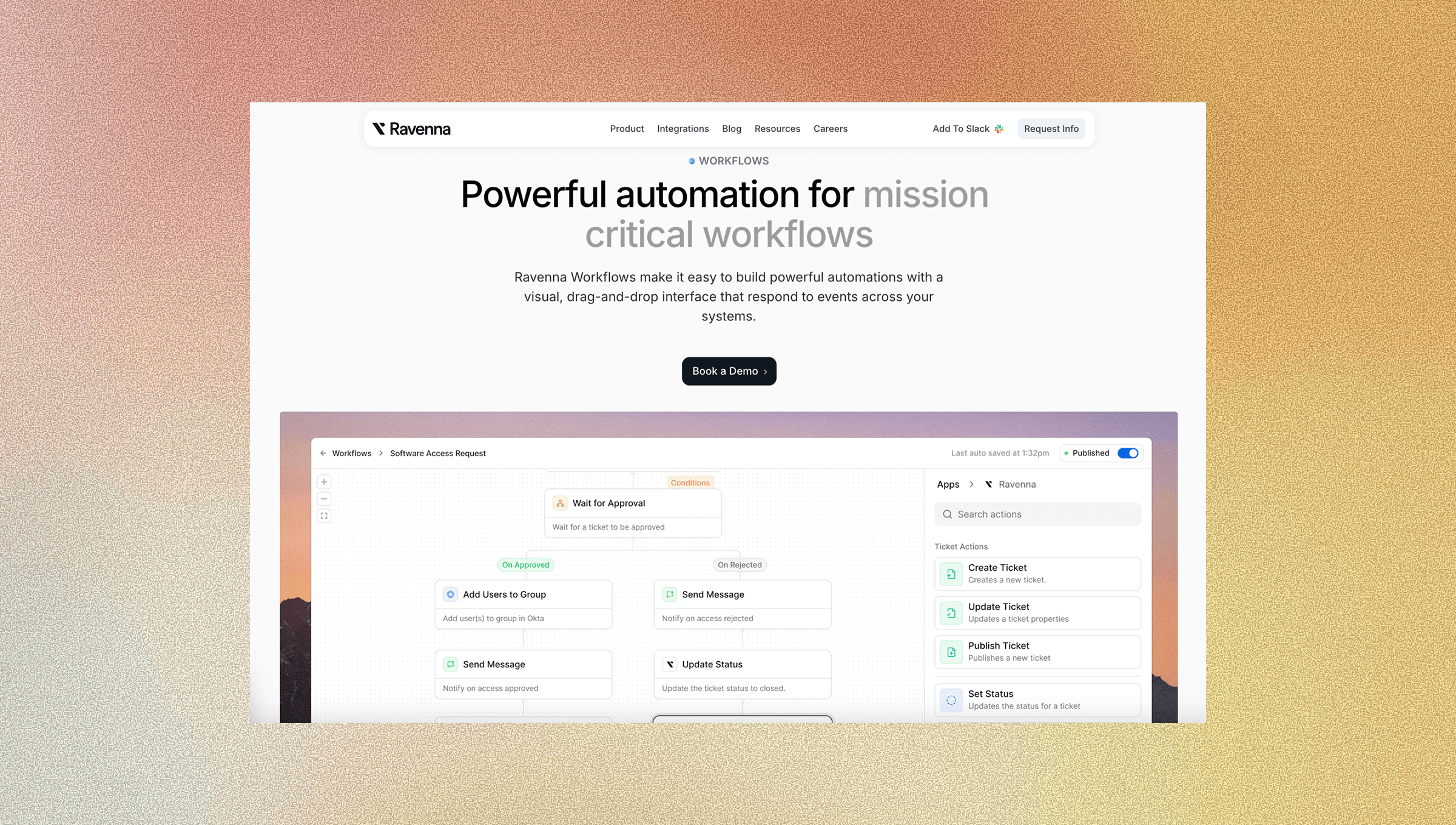
Ravenna is a workflow automation platform built to execute workflows across your entire tool stack, going beyond ticket tracking with scalable functionality. Its Visual Workflow Builder lets IT teams construct multi-step automations across Okta, BambooHR, Workday, and Jamf without writing a line of code, all triggered from Slack where employees already work. HRIS context flows automatically into every request, so routing, approvals, and provisioning adapt to who is asking without manual lookup. For teams not ready to leave existing tools behind, bidirectional integrations with Jira Service Management, Freshservice, and Linear mean you can keep current systems of record while layering Slack-native workflow automation on top. Tickets sync across both directions. Work closes out without anyone manually bridging the gap.
FAQ
What's the difference between a ticketing system and an agentic service desk?
A ticketing system logs and routes requests to queues where humans handle them. An agentic service desk interprets requests, decides which systems to query, executes actions across those systems, and confirms resolution without human routing at every step, resolving work end-to-end instead of tracking it.
Can I move from legacy ITSM to agentic without ripping out my current tools?
Yes. Bidirectional integrations with Jira Service Management, Freshservice, and Linear let you keep your existing ticketing system as the system of record while adding autonomous resolution on top. Tickets sync in both directions, so you gain automation without disrupting current workflows or reporting structures.
How much IT time do routine requests actually consume?
Routine requests like password resets, access provisioning, and software installs consume your IT team's capacity. That's a quarter of your team's time spent on predictable, repeatable work that follows the same pattern every time, work that workflow automation can handle without human involvement.
What's the difference between an agentic service desk and an AI chatbot for IT support?
AI chatbots follow scripts and answer questions. Agentic service desks use LLMs to reason through ambiguous requests, make multi-step decisions, and execute actions across your tool stack (Okta, BambooHR, Workday) without human routing. One answers; the other resolves.
What should I measure instead of SLA compliance when automating IT workflows?
Track resolution without escalation (how often AI handles requests end-to-end), time-to-resolution across request types, deflection rate (requests resolved before reaching the queue), and employee satisfaction by request category. These metrics reflect actual outcomes instead of whether tickets were closed on time.