

Most IT teams that say they’ve automated the service desk have actually automated the paperwork. The request gets categorized and routed in seconds, then sits in a queue until someone on your team opens Okta and does the work by hand. Autonomous IT ticket resolution is what happens after routing: the request is classified, the context is pulled, the action runs in the connected system, and the ticket closes without anyone touching it. Getting there takes four capabilities working together, and missing any one of them puts a human back in the loop.
TLDR:
Autonomous resolution means eligible requests get executed end to end and confirmed automatically, instead of landing in a human queue.
It takes four capabilities working together: intent classification, context awareness, system integration, and action execution.
Goal-following agents go find missing context and escalate when judgment is needed; rules-based workflows only handle the gaps someone configured a path for.
In Fixify’s 2026 benchmark, tickets with 75 to 100% of the work automated resolved in a median of 4.4 hours, against 71 hours for tickets with no automation.
Ravenna’s IT Agent classifies intent, pulls employee context, triggers provisioning in Okta or Google Workspace, and confirms in Slack without a human in the path.
Your IT team might run what looks like an automated workflow but still manually handles every request at the execution step. Routing and categorization don't solve the problem. Autonomous IT ticket resolution means the request gets classified, context gets pulled, action gets taken in the connected system, and the ticket closes automatically. That takes four capabilities, namely intent classification, context awareness, system integration, and action execution, working together.
What Autonomous Resolution Actually Means
“Autonomous resolution” gets stuck on plenty of things it doesn’t describe: chatbots that suggest an article, routing rules, and deflection flows that close the conversation without solving anything.
The real definition is narrower. An AI agent works out what the employee needs, gathers the context, runs the required steps across connected systems, and closes the loop without a human touching the work.
Why Isn’t Ticket Routing Enough?
The request still sits there, waiting for a human to open it, look up the relevant system, take the action, and close it out. Routing a ticket to the right queue is filing, not resolution.
The ticket-first ITSM model centers on documentation and routing: a request is logged, categorized, and assigned, then someone does the work.
Ticket routing answers "who should handle this?" Autonomous resolution answers "handled."
The Four Capabilities Autonomous Resolution Depends On
Accurate intent classification: The system reads what the employee typed and understands what they need, beyond the surface-level words.
Context awareness: It knows who is asking, their role, department, manager, and what systems they already have access to.
Integration with employee systems: It can reach into Okta, the HRIS, Google Workspace, or any system the request touches.
Autonomous action execution: It completes the task by provisioning the account, resetting MFA, removing access and more, without a human opening a second tool.
if the you deploy an AI agent that classifies intent perfectly but can't connect to any systems, it's just a glorified ticket routing system and the human agents still has to resolve. An agent with deep integrations but no context awareness provisions the wrong license tier because it can't match the request to the correct access level without knowing the requester's department. Moving from routing to autonomous resolution in ITSM takes all four capabilities working together.
Goal-Following Agents vs. Rules-Based Automation
Rules-based automation follows a fixed path that fires when conditions match. Take a provisioning request with a blank department field. If someone configured a fallback, the workflow applies a default or sends it to a human queue. If nobody did, it just stops.
A goal-following agent treats the blank field as a problem to solve. It checks the org chart, the manager record, or a prior onboarding entry to work out the department before deciding which license tier applies. Inferred context never overrides access policy, so when sources conflict or the context is still thin, the agent hands the request to a human before anything gets provisioned.
I believe this is the difference that matters most when you’re evaluating tools, because a demo with complete inputs looks the same either way. Ask what happens when the inputs aren’t complete. Forrester’s service management analysts see the same shift, writing that software provisioning, access management, and request fulfillment can now be assembled and executed autonomously.
What Autonomous Resolution Looks Like End-to-End
An employee messages IT from Slack: "I need access to Figma."
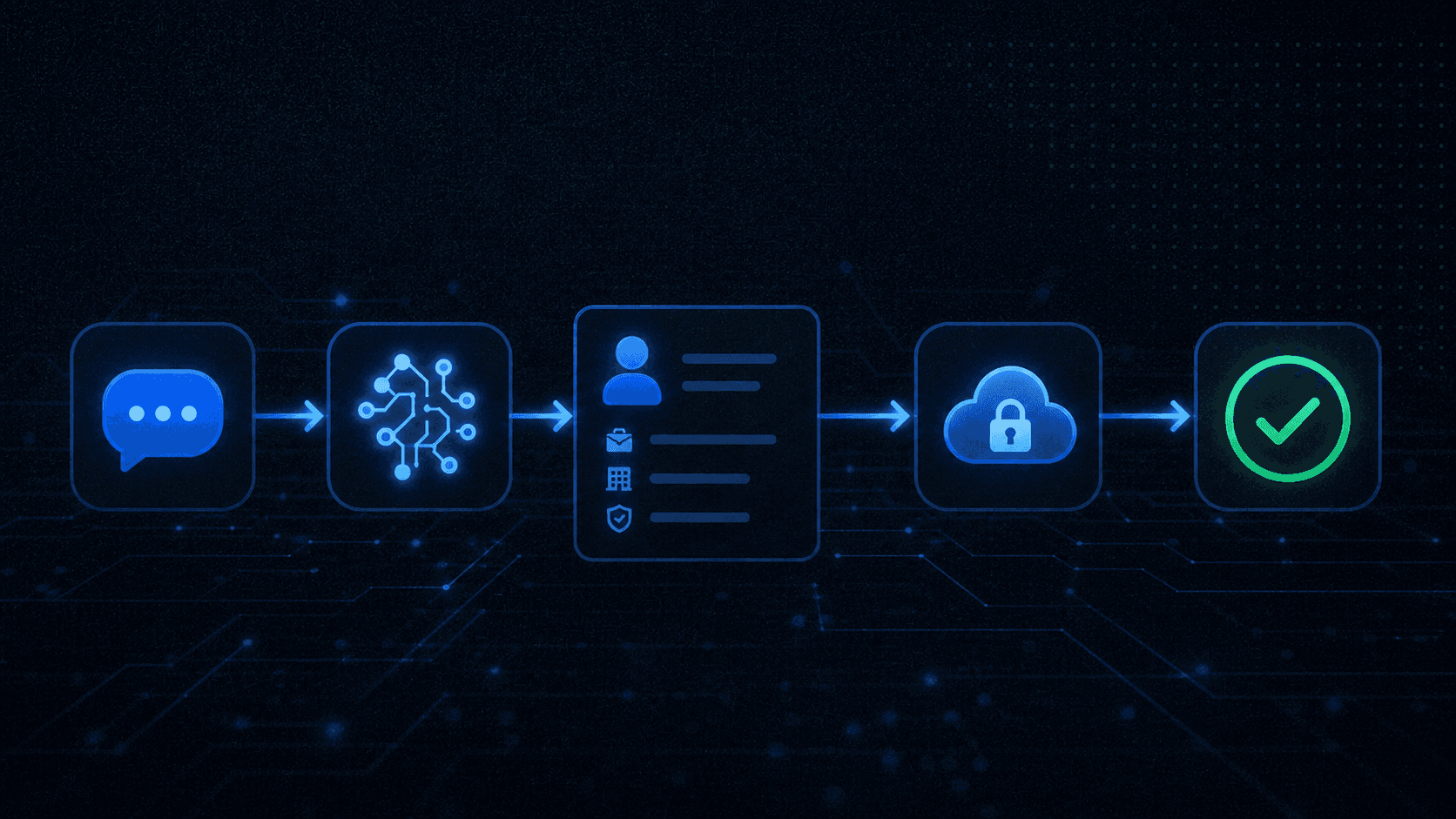
In an illustrative scenario where HRIS data is connected, and a configured integration supports Figma license checks and provisioning, the request hits Ravenna's IT Agent. Intent classification runs first: the agent reads the message and identifies this as a software access request. It pulls the employee's profile from the HRIS: design contractor, reports to the creative director. If a seat is available and the configured policy permits provisioning without approval, the agent proceeds.
In this illustrative scenario, with prerequisites met, the agent provisions the Figma seat, sends confirmation in the same Slack thread, and the ticket closes once provisioning completes. An automated MFA reset works on the same prerequisites: the organization's identity-verification and reset-policy checks must pass before the IT Agent executes the reset in Okta and confirms in Slack. A record lookup alone is not identity verification.
Where Human Escalation Still Belongs
resolution path, a privileged access request that touches production, a policy conflict where someone has to decide which rule wins: those are the requests where human judgment changes the outcome.
In those cases Ravenna’s IT Agent recognizes it isn’t sure enough to act and hands off to your team. The handoff carries the context already assembled, so whoever picks it up can see what was requested, what was checked, and exactly where the ambiguity is.
How Resolution Rate and Deflection Rate Are Measured
Metric | What It Measures | What It Tells You | Watch Out For |
|---|---|---|---|
AI vs. human resolution rate | Percentage of requests fully resolved by an AI agent versus those requiring human intervention at any point | The overall split between autonomous and human-touched work | A high AI rate can mask partial automation if "resolved" includes human approvals mid-workflow |
Deflection rate | Share of incoming requests that never entered a human-managed queue | How much volume bypasses the ticket queue entirely | Counts article suggestions that ended the thread without executing anything |
Auto-resolution rate | Requests that completed end-to-end without any human involvement, including approvals | The truest measure of autonomous execution: no human in the path at any step | A low number may reflect required approval steps, not a failing system. |
Resolution path attribution complements these aggregate metrics by classifying each resolved ticket individually (AI resolved, workflow only, human touched, or unclassified), showing where automation held and separating an agentic service desk from a help desk.
In Fixify's 2026 IT Help Desk Benchmark Report, which analyzed 50,000+ tickets, partially automated tickets resolved in 49 to 102 hours, while fully AI-automated tickets resolved in 2.4 to 6.3 hours. These figures reflect Fixify's dataset, not Ravenna results or a guarantee, and the comparison alone does not prove automation caused the time difference.
Common Failure Modes in Autonomous Resolution Systems
Intent misclassification: the agent misreads the request and triggers the wrong workflow, a common gap between a chatbot and an AI-native service desk. An access escalation gets routed as a new provisioning request, and the employee gets the wrong outcome.
Integration gaps at execution: classification works, context is gathered, then the agent hits a system it can't reach. The workflow hands off to a human queue at the exact step that should be autonomous.
Silent mid-run failures: the workflow stops partway through without alerting anyone. The employee waits, IT never knows, and no handoff signal or confirmation goes out.
Code-generation brittleness: automations built from AI-generated scripts can break when an upstream API changes. Without a maintenance owner, the failure may stay unnoticed until a request hits that path.
When Autonomous Resolution Is and Is Not the Right Fit
It works best for high-volume, repeatable requests with a clear policy behind them: password resets, MFA resets, and software access provisioning. Complex compliance reviews, exceptions that need sign-off from several teams, and anything without a prior resolution path need a person. There, the agent’s job is to gather context and escalate instead of guessing.
There’s one practical requirement: requests have to reach a configured intake path, like Slack, Teams, or a webhook trigger. If someone DMs a member of your IT team directly, the agent never sees it.
How Ravenna Approaches Autonomous Resolution
Ravenna is a Slack and Teams-native workflow automation platform for AI-native ITSM. Its IT Agent and PeopleOps Agent each use intent classification, context awareness, system integration, and action execution, reflecting the platform's core multi-agent orchestration. When a software access request arrives in Slack, the IT Agent classifies intent, pulls employee context from the HRIS, executes provisioning in Okta or Google Workspace, and confirms completion in the same thread.
Automation and ticketing share a single data layer, so each workflow step updates the ticket state immediately. The no-code visual workflow engine shows exactly which step failed, with no AI-generated TypeScript to maintain.
The Tickets dashboard's Resolution Path breakdown classifies every resolved ticket as AI-resolved, workflow-only, human-touched, or unclassified. IT leaders see per-ticket where agentic service management is working and where people remain in the path. Routine requests run end to end, and anything that needs judgment reaches your team with the context already gathered.
Final Thoughts on Autonomous Resolution and Where AI Agents Actually Fit in IT
Autonomous resolution means completing eligible requests end-to-end, not labeling work for someone else. AI agents execute routine, policy-defined workflows; IT teams set policies, oversee automation, and handle exceptions requiring judgment. Faster resolution does not remove the need for those safeguards. Get in touch with Ravenna to see how that split plays out in practice.
FAQ
What's the difference between autonomous IT ticket resolution and deflection?
Deflection keeps requests out of a human queue and can resolve questions through knowledge-based answers. It does not prove that a requested action was completed. Autonomous IT ticket resolution verifies end-to-end execution: intent classified, context gathered, action completed, and ticket closed automatically.
How does Ravenna handle ambiguous requests without triggering the wrong workflow?
Ravenna's IT Agent first classifies intent, routing every request to one of three paths: answer from the knowledge base, execute through a workflow, or escalate to a human agent. For ambiguous or overlapping requests, it uses employee context from the connected HRIS (role, department, manager, existing access) to choose the right path. When human judgment is required, it hands off with that context already gathered.
What ITSM platforms support both Workday and Microsoft Intune for IT teams in 2026?
Ravenna integrates with Workday for HRIS data and Microsoft Intune for device management, alongside Okta, BambooHR, Jamf, and Kandji. A configured workflow can use employee context to provision access through Okta, push a device profile via Intune, and confirm completion in Slack without manual coordination across tools.
How does AI autonomous ITSM handle requests that don't follow a clean, pre-formatted path?
Fixed workflows can stop cold when a request arrives with missing or unexpected inputs and no configured path covers the gap, such as a blank department field. AI ITSM systems that follow goals instead of rules handle many of these gaps by querying available state, such as the org chart or a manager record, to infer the missing context. Ravenna's IT Agent uses this goal-following approach, executing once context and policy are sufficient and escalating to a human when the gap requires judgment.
How do I automate employee onboarding and offboarding across Okta, BambooHR, and Google Workspace?
The reliable path is a webhook-triggered workflow that fires on an HRIS event, like a new hire record or a termination status change in BambooHR. Onboarding runs account creation in Okta, role assignment, and group membership in Google Workspace, confirmed in Slack. Offboarding suspends accounts, reclaims licenses, and removes group memberships across the same systems, also confirmed in Slack. Ravenna runs each sequence as one coordinated operation and logs each step, so a failed step shows up with a retry or escalation instead of staying hidden. Alternatively, you can build and maintain custom middleware, which puts the integration logic on your team to own and update whenever an API changes.