

The days of chasing legal for sales legal precedent retrieval on every non-standard request are a structural problem, not a bandwidth one. Your reps aren't asking the wrong questions. They're asking the right questions to the wrong place, because there's no custom deal term lookup layer between the rep and the person who used to have the answer. Building that layer is simpler than it sounds, and it changes where legal's time actually goes.
TLDR:
Custom deal term lookup is a queryable record of approved non-standard contract provisions reps can search before escalating to legal.
Build your term library from 3 sources: closed-won contracts, escalation logs, and legal approval records indexed by rep-friendly language.
RevOps owns ingestion and tagging; legal sets which term types require mandatory review regardless of precedent found.
A lookup system tells you what's been done before, not whether that precedent fits your current deal. Judgment stays with a person.
Ravenna's RevOps Agent runs custom deal term lookup as a self-service workflow in Slack or Teams, returning sourced answers without a ticket.
Why Sales Reps Keep Asking Legal the Same Questions
Sales teams and legal teams have always had a tense relationship with speed. A rep lands a promising deal and immediately hits a wall: can we offer extended payment terms? Has anyone done a multi-year SaaS agreement with a liability cap below our standard threshold? The question goes to legal, legal is busy, and the deal waits.
The problem repeats because there is no reference system that intercepts the question before it reaches a person.
What Custom Deal Term Lookup Means
A custom deal term lookup is a structured, queryable record of non-standard contract provisions your organization has previously approved. Sales reps can search it themselves before escalating to legal or deal desk.
What separates it from a document archive is retrieval specificity. You're not browsing old contracts hoping something relevant surfaces. You're querying by clause type, customer segment, deal size, or the approver who signed off, and getting a specific precedent back. The same principle applies to how self-service CRM reports surface deal data without an analyst ticket. "Has anyone approved 90-day payment terms for an enterprise customer?" should take seconds, not a Slack thread to legal.
The system's value is in making that answer available the moment a rep forms the question, without putting a human in the retrieval path.
The Institutional Memory Problem in Deal Terms
When a sales rep asks "have we ever done a 90-day payment term before?" the answer almost never lives somewhere findable. It often lives in a closed Salesforce opportunity, buried in a PDF attachment, or in the memory of a deal desk analyst who negotiated it. This is the core challenge that legal knowledge management frameworks aim to solve: making institutional expertise retrievable and not locked inside specific people.
That's the institutional memory problem with non-standard deal terms: the precedents exist, but retrieval requires either luck or the right person being available.
Defining the Non-Standard Term Policy
A non-standard term policy is the set of rules that governs when a sales rep can offer a deal structure that falls outside the standard contract template. Think extended payment schedules, liability caps that differ from the default, custom SLA tiers, or pricing exceptions that have cleared finance review before. The policy itself is rarely a single document. It lives across legal sign-off emails, past redline histories, finance approval threads, and the institutional memory of whoever closed a similar deal eighteen months ago.
That's the core problem. The policy exists, but it's not retrievable.
How to Build a Historical Deal Term Library
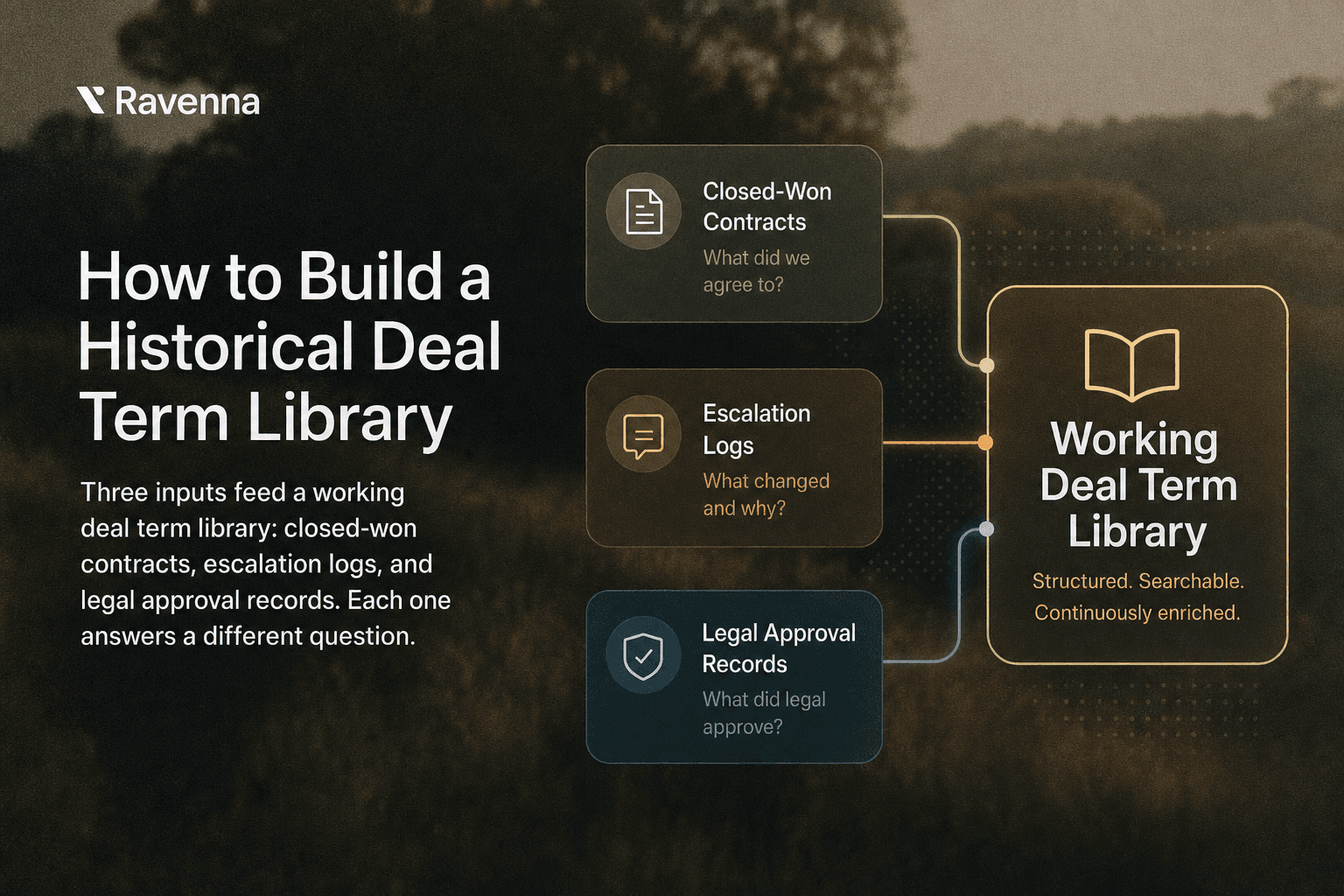
Three inputs feed a working deal term library: closed-won contracts, escalation logs, and legal approval records. Each one answers a different question a rep might ask.
Closed-won contracts show what terms actually cleared, beyond what legal approved in principle. Pull the final executed versions, not the redlines.
Escalation logs capture the judgment calls: who approved the exception, under what conditions, and whether it held up post-close.
Legal approval records fill the gap between "we've done this before" and "we have a policy on this," surfacing precedents that never made it into a formal playbook.
Once sourced, structure entries around the question a rep would actually type, not the clause name a lawyer would use. A rep asks "Can we cap liability at one times ARR?" not "What is our limitation of liability posture?" Index by that natural question, attach the precedent and the approval condition, and the library becomes searchable by intent instead of by contract taxonomy.
Review the library quarterly. Non standard term policy evolves as deal volume grows, and a precedent from two years ago may reflect risk tolerance the company no longer holds.
Making the Library Searchable, Not Simply Stored
Storing precedent is only half the problem. The other half is retrieval: making sure a rep who has never seen a particular clause can find the answer before the deal slows down waiting for someone who has.
The pattern that works here is treating approved precedent as a structured reference layer: every non standard term policy decision tagged by deal type, industry, contract value, and outcome, so a rep can query it the way they would a knowledge base instead of excavating an email chain. It's the same principle behind surfacing deal routing logic before the rep has to ask.
The Self-Service Pattern for Sales Reps
When a sales rep asks "can we do this deal term?", the answer is almost never in their inbox. It's in a contract from eighteen months ago that legal approved once, under specific conditions, for a specific customer segment. The rep doesn't know that deal exists. Legal doesn't know the rep is asking. And the question sits in a Slack thread until someone with institutional memory happens to see it.
A self-service reference layer breaks that dependency by building a structured layer between the question and the person who used to answer it.
How the Pattern Works
The core mechanism is straightforward. A rep types a question in natural language: "have we ever done net-90 payment terms for an enterprise deal?" The system searches indexed contract records, prior approval threads, and documented non standard term policy decisions, then returns the relevant precedent with the conditions under which it was approved.
Three components make this work:
A structured index of past deal terms and their approval context, so the system can retrieve against specific term types instead of scanning unstructured documents
A retrieval layer that matches the rep's query to the right precedent, including the deal size, segment, and conditions that governed the original approval
A response that tells the rep whether it's been done and what it would take to do it again
What This Replaces
Without this pattern, custom deal term lookup runs through people. The rep asks a colleague, who asks legal, who searches their own memory or a shared drive folder that may not be current. Sales legal precedent retrieval, done manually, is slow enough that it routinely outlasts the conversation that prompted it.
The self-service pattern doesn't remove legal from the process. It removes legal from the first fifteen minutes of every process, and routes them in only when a rep has already confirmed that a term has precedent and needs a formal approval path.
How RevOps and Legal Govern the System
RevOps and legal teams are the ones who actually decide what lives in a custom deal term lookup system and what gets flagged for review. Without clear ownership here, the system drifts.
A working governance model has two layers. RevOps controls the structure: which non standard term policy entries get added, how precedents are tagged, and when records get retired. Legal controls the boundaries: which term categories require mandatory review regardless of what a past approval shows.
The practical split looks like this:
Responsibility | Owner | What It Covers |
|---|---|---|
Ingestion and tagging | RevOps | Pulls approved deal terms from closed contracts; tags each entry with segment, deal size, and approving authority |
Review trigger definitions | Legal | Sets which term types a rep can self-serve and which always route to counsel regardless of precedent found |
Refresh cadence | RevOps + Legal | Quarterly review to retire stale precedents and add newly approved patterns before reps cite outdated deals |
The failure mode is letting the system run without that refresh cadence. A rep finds an old approval for a liability cap that legal has since walked back, cites it in a negotiation, and the deal closes on terms the company no longer stands behind.
When a Lookup System Is Not Enough
A lookup system answers one question well: has this been done before? It cannot answer whether what was done before should apply to the deal in front of you now.
Three situations call for escalation even when a precedent exists. When the prospect is materially different from the reference account, the prior approval may not carry. When a rep is combining multiple non-standard terms, each individually cleared, the combination can create risk that no single historical record surfaces. And when the original approval came from a business context that has since changed, citing it is citing a policy the company no longer holds. Understanding where legal approval bottlenecks originate helps set the right escalation triggers from the start.
The self-service pattern handles retrieval. Judgment about whether a retrieved precedent fits the current situation still belongs to a person.
The goal is to remove legal from the conversations where the answer is already documented and retrievable, so their time goes to the ones where it genuinely is not. The same logic applies to keeping attribution logic questions out of live RevOps meetings.
How Ravenna's RevOps Agent Handles Deal Term Retrieval
When a sales rep asks "can we do this deal?" the answer usually lives somewhere in a closed contract, a legal approval thread, or a Slack message from six months ago. Without a system to surface it, that question becomes a ticket, a meeting request, or an email chain that stalls the deal while legal gets looped in manually.
Ravenna's RevOps Agent handles custom deal term lookup as a self-service workflow. A rep asks the question in Slack or Teams. The RevOps Agent queries connected contract repositories, past approval records, and non-standard term policy documentation to return a direct answer with sourcing. No ticket. No waiting for legal to respond.
The retrieval logic covers three core scenarios:
When a rep asks whether a specific term has been approved before, the RevOps Agent pulls matching precedents from closed deals, surfaces the approval context, and returns the result in the same thread where the question was asked.
When a rep needs to know whether a proposed term falls inside or outside policy boundaries, the agent checks the non-standard term policy and flags whether the request requires escalation or can proceed.
When there is no existing precedent, the agent identifies that gap and routes to the appropriate legal or deal desk contact with the relevant context already attached, so the conversation starts informed instead of cold.
The pattern here is sales legal precedent retrieval as infrastructure, not as a reactive support function. It's the same distinction that separates an agentic service desk from a help desk. Reps get answers in the flow of work. Legal spends time on genuinely novel questions instead of re-explaining decisions that were already documented somewhere in the system.
Final Thoughts on Removing Legal From the First Fifteen Minutes of Every Deal Review
The precedents are there. The approvals happened. The terms got negotiated. What's missing is a retrieval layer that puts the answer in front of the rep before the question becomes a ticket. Structure your non-standard term policy as a queryable reference, and legal can spend their time on the deals that genuinely need them.
FAQ
What is a custom deal term lookup system, and how is it different from a contract archive?
A custom deal term lookup system is a structured, queryable index of non-standard contract provisions your organization has previously approved, built so sales reps can retrieve specific precedents by clause type, deal size, customer segment, or approving authority in seconds. A contract archive is just storage; a lookup system is retrieval by intent, so a rep asking "have we ever approved net-90 payment terms for an enterprise deal?" gets a direct answer with approval context, not a folder of PDFs to excavate.
What's the fastest way to give sales reps self-service access to non-standard term precedents without routing every question through legal?
Build a structured index from three sources (closed-won contracts, escalation logs, and legal approval records), then tag every entry by deal type, industry, contract value, and the conditions under which the term was approved. Index by the question a rep would actually ask, not the clause name a lawyer would use, and set a quarterly review cadence with RevOps owning ingestion and legal owning the escalation triggers. That structure is what separates a working self-service reference layer from a document dump that nobody consults.
How does Ravenna's RevOps Agent handle sales legal precedent retrieval from Slack?
A sales rep types a question in Slack or Teams, and the RevOps Agent queries connected contract repositories, past approval records, and non-standard term policy documentation, then returns a direct answer with sourcing in the same thread. No ticket, no waiting for legal to respond. If no precedent exists, the agent identifies that gap and routes to the appropriate legal or deal desk contact with the relevant context already attached, so the conversation starts informed and not cold.
When should a rep escalate to legal even if the custom deal term lookup returns a matching precedent?
Three situations call for escalation regardless of what the lookup returns: when the prospect differs materially from the reference account the prior approval was built around, when a rep is combining multiple individually cleared non-standard terms whose combination may create risk no single historical record captures, and when the original approval came from a business context (risk tolerance, pricing model, legal posture) the company no longer holds. The lookup handles retrieval; judgment about whether a retrieved precedent fits the deal in front of you still belongs to a person.
How do RevOps and legal teams govern a non-standard term policy system without letting it drift?
The governance split that works is RevOps owning ingestion and tagging (pulling approved terms from closed contracts and marking them with segment, deal size, and approving authority) while legal sets the review triggers that define which term types a rep can self-serve and which ones route to counsel regardless of what precedent shows. Both teams share a quarterly refresh cadence to retire stale precedents before reps start citing deals that reflect risk tolerance the company no longer holds.