

Most IT teams are paying for the same work twice. The full-stack service desk versus middleware debate comes down to this: you're either funding one system that handles conversational interface, workflow execution, and integrations, or you're paying for an AI wrapper on top of ServiceNow with custom connectors holding everything together. Every workflow touches multiple systems. Every vendor update breaks integrations. Every deployment takes eight weeks instead of days because you're configuring in parallel. You can't retire either system, so the dual overhead becomes permanent when one unified architecture could handle it all.
TLDR:
Middleware ITSM costs 3-5x your license fees in implementation and integration overhead.
Dual-stack architectures require managing two systems, duplicate licenses, and broken connectors.
Full-stack workflow automation cuts ticket costs 43% and resolution time 68% at scale.
Slack-native ITSM automation reaches 100% adoption without portal training or change management.
What the Middleware Tax Really Costs IT Teams
The middleware tax is what you pay when you buy an AI help desk that sits on top of your existing ITSM system. Instead of replacing the old infrastructure, you're adding another layer, which means you're now funding two systems: the legacy ITSM tool for ticketing and workflow management, plus the new AI wrapper for conversational interface and basic automation. This stacking creates compounding costs that extend far beyond the initial purchase. You're paying for dual licensing fees, custom integrations to connect the two systems, ongoing maintenance to keep those integrations functional, and the technical overhead of managing two separate architectures. When one system updates, the integration breaks, creating outages, operational disruptions, and unexpected downtime. When you need to modify a workflow, you're touching multiple systems.
The numbers tell the story. ServiceNow implementation costs range from $50,000 to $1 million depending on scope, integrations, and support requirements. Now layer an AI help desk on top of that, and you're adding another six-figure annual commitment without retiring any of the underlying expenses.
The promise of adding AI sounds appealing. But if the AI layer can't execute workflows end-to-end, you're not reducing costs or complexity. You're multiplying them.
The Three Hidden Layers of ITSM Middleware Costs
Let's break down what the costs really look like when you choose to layer an AI help desk on top of your existing ITSM. With an AI help desk on top of your ITSM, you can expect three layers of cost:
Layer one: the ITSM - When you look at IT service management pricing models, base ITSM licenses run $20 to $100 per user monthly, depending on modules and service providers involved. For 100 employees, that's $24,000 to $120,000 annually just for the foundation.
Layer two: the AI wrapper subscription - This now sits atop your existing ITSM system. You're paying for two interfaces handling identical work, duplicate user seats, and separate data models requiring constant synchronization.
Layer three: integration and orchestration - This is where costs compound. Disconnected systems need custom connectors, API management, maintenance cycles, and fragmented data integration to communicate. This introduces inefficiencies and cross-system dependencies. Each vendor update breaks connections. Every new workflow touches multiple systems, multiplying dev cycles and failure rates.
For a 100-person company, you're funding three separate software stacks when the work only needs one execution layer.
Why Implementation Timelines Reveal Architectural Complexity
Implementation timelines expose the hidden cost of architectural fragmentation. A deployment that stretches 4 to 8 weeks signals you're not simply configuring software; you're integrating two disconnected systems and building custom bridges between them. These are the hidden gotchas of layering middleware across separate platforms.
Middleware deployments drag because you're configuring in parallel: the AI layer for intent classification and conversational routing, the ITSM system for workflows and approvals, then the connectors that pass data between both. Each handoff point needs testing. Each integration introduces failure modes. Every week in deployment means another week your technical support team relies on manual processes to triage password resets and access requests that automation should handle, increasing queues and bottlenecks. The delayed ROI shows up in continued overtime, growing ticket backlogs, and employee frustration with slow resolutions.
Full-stack ITSM automation collapses this timeline. One system to configure. One workflow engine to connect. One data model to manage. Deploying workflows in days instead of months means your team starts recovering time immediately.
The Real Cost of "AI-First" ITSM That Still Requires Legacy Systems
"AI-first" ITSM that still depends on ServiceNow and other legacy systems underneath miscalculates the true bill offered by many legacy ITSM providers. Licensing fees represent roughly 25% of your total cost of ownership. Implementation, consultants, and training typically run 3 to 5 times your annual license spend. For a mid-sized deployment at $100,000 in annual licenses, you're looking at $300,000 to $500,000 in services before the system goes live. Now double that investment cycle. The AI layer needs its own implementation, its own consultants to configure intent classification, its own training program to teach agents how the dual system works. You're funding two parallel rollouts that both need ongoing support contracts.
The worst part is that this split never resolves. You can't sunset the legacy ITSM because the AI wrapper depends on it for workflow execution. You can't retire the wrapper because employees refuse to go back to the old portal. Both systems stay active indefinitely, each demanding annual maintenance, version upgrades, and compatibility testing.
You're left with permanent dual overhead where one system should have been enough.
The ROI of Eliminating the Middleware Layer
The middleware layer is rarely the most cost-effective approach. It increases long-term spend and operational complexity. The ROI calculus is straightforward. Consolidating to a single workflow automation system collapses costs across three vectors: automation coverage, resolution speed, and cost per ticket.
Consider a simple example. A multinational bank replaced its dual-stack architecture and saw automation coverage jump from 12% to 48% of all high-volume inbound requests, improving response times and key performance metrics tied to customer experience. MTTR dropped from 6.5 hours to 2.1 hours, a 68% reduction. Cost per ticket fell 43% as fewer requests required manual handling. CSAT climbed from 82% to 92%.
So how can you understand the costs for your business? Start by calculating your current ticket volume as a baseline, multiply by average handling time, then apply a conservative 40% automation rate to optimize IT resource allocation and free IT resources for higher levels of service delivery. A team processing 500 monthly tickets at 15 minutes each spends 125 hours on manual work. Automate 200 of those requests, and you've recovered 50 hours monthly. Multiply that time savings by your blended IT hourly rate. Add the licensing costs you'll stop paying when you retire the legacy ITSM stack. Subtract the cost of one unified system. That spread is your annual ROI.
Full Stack Service Desk Architecture vs The Wrapper Approach
In short, middleware takes longer to integrate and costs more over time. On the time-to-integrate side, there are ways to speed up integrations. For example, some middleware vendors generate automations from natural language descriptions. But don't be fooled. This sounds helpful until the auto-generated code fails. You're now debugging scripts you didn't write, reverse-engineering logic buried in hidden functions no one on your team understands, and increasing troubleshooting effort. An alternative to this is visual workflow builders, which skip the whole problem. Drag-and-drop nodes show exactly what happens at each step. When an automation fails, you see which condition triggered the error and fix it without touching code or hiring developers to patch AI-generated scripts.
The ideal solution is a full-stack system built on a scalable framework that includes the conversational interface, the workflow engine, and the integration layer within one architecture. You build automations once, manage them in a single interface, and troubleshoot from one place when something breaks. The wrapper approach, on the other hand, splits these layers. Your AI tool routes tickets. Your legacy ITSM handles approvals. Connectors sync data between them. Each automation touches multiple systems, each with its own configuration and maintenance overhead.
Ravenna's Approach to Eliminating the Middleware Tax
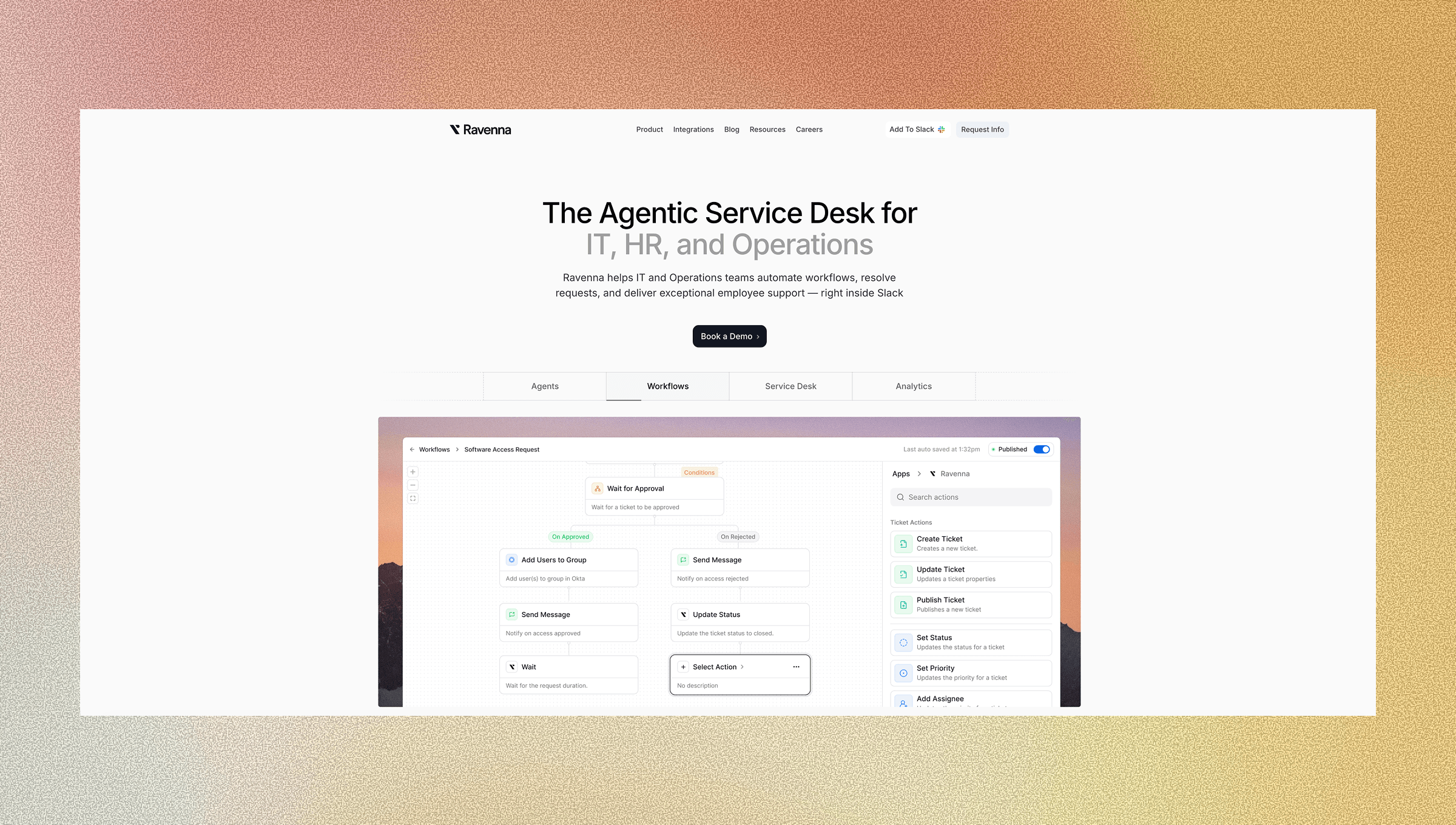
Ravenna collapses the middleware stack into one workflow automation system that lives natively in Slack. The conversational interface, orchestration engine, and SaaS integrations run in a single architecture. There's no AI layer on top of ServiceNow or middleware between your service desk and backend tools.
The visual workflow builder lets you build automations in days without code. Drag-and-drop nodes connect directly to Okta, Google Workspace, BambooHR, Microsoft, and Jamf through native APIs, integrating securely into your broader SaaS ecosystem with built-in authentication controls and real-time data integration. When someone requests access, Ravenna's IT Agent classifies intent, routes approvals, provisions accounts, and closes the loop without opening a ticket in a legacy ITSM system.
This removes dual licensing, integration overhead, and the maintenance cycles that create middleware costs. You configure workflows once, in one place, and they run without connector layers breaking on vendor updates. The result is an augmented IT team, with password resets, access requests, and onboarding handled automatically so staff can focus on higher-value work.
Final Thoughts on Moving Beyond the Middleware Model
The middleware approach forces you to fund two systems indefinitely because neither can work without the other. A native workflow automation system built for Slack helps streamline service delivery, reduce workload, and remove the dual licensing, integration tax, and parallel maintenance that middleware architecture demands. You automate password resets, access requests, and onboarding workflows without touching legacy ITSM or debugging AI-generated code. Connect with us to see the difference in your own IT environment.
FAQ
What exactly is the middleware tax in ITSM?
The middleware tax is the compounding cost of running an AI help desk layer on top of your existing ITSM system instead of replacing it. You're paying for dual licensing, custom integrations to connect both systems, ongoing maintenance when those integrations break, and the technical overhead of managing two separate architectures that do the same work.
How much does middleware typically add to total ITSM costs?
For a 100-person company, you're funding base ITSM licenses ($24,000 to $120,000 annually), plus the AI wrapper subscription at similar costs, plus integration and orchestration expenses. Implementation costs alone typically run 3 to 5 times your annual license spend, meaning a $100,000 license commitment can balloon to $300,000 to $500,000 before the system goes live...and you're doing this twice with middleware.
Why do middleware deployments take 4 to 8 weeks when full-stack platforms deploy faster?
Middleware deployments stretch longer because you're configuring two disconnected systems in parallel: the AI layer for conversational routing, the legacy ITSM for workflows, then custom connectors to pass data between them. Each handoff point needs testing and each integration creates failure modes. Full-stack workflow automation collapses this timeline by giving you one system to configure, one workflow engine to connect, and one data model to manage.
Can I retire my legacy ITSM after adding an AI wrapper?
No. The AI wrapper depends on your legacy ITSM for workflow execution and ticket management, so you can't sunset either system. You're locked into permanent dual overhead where both platforms demand annual maintenance, version upgrades, and compatibility testing indefinitely.
How does Slack-native automation change ITSM economics?
Slack-native workflow automation removes the end-user adoption cost that kills traditional ITSM ROI by enabling real-time self-service requests directly inside Slack. Legacy portals fail because employees ignore them and default to DMing IT directly, meaning you've paid for software no one uses. When your service desk lives in Slack, adoption reaches near 100% because you're not asking anyone to change behavior, and automation coverage climbs because requests flow through structured workflows automatically instead of bypassing the system.