

You're stuck between an AI helpdesk vs traditional ITSM, and the decision feels bigger than it should. Moveworks sells you on AI that handled password resets and access requests without human involvement, but it only works if you connect every system in your company first. Freshworks gives you a ticketing system that does exactly what you expect, but your team still has to manually work through every request that comes in. The gap between these two approaches is massive, and picking the wrong one means either overpaying for features you can't use or staying stuck in a queue that never gets shorter.
TLDR:
Moveworks uses AI to resolve requests instantly but now faces uncertainty after ServiceNow's acquisition.
Freshservice requires manual workflow configuration and form-based ticketing through a web portal.
AI automation handles 80% of support interactions versus manual rule-building in traditional systems.
Ravenna is a Slack-native workflow automation tool with AI-powered orchestration, flat pricing, and setup in days, not months.
What Moveworks Offers: AI-Native Employee Support
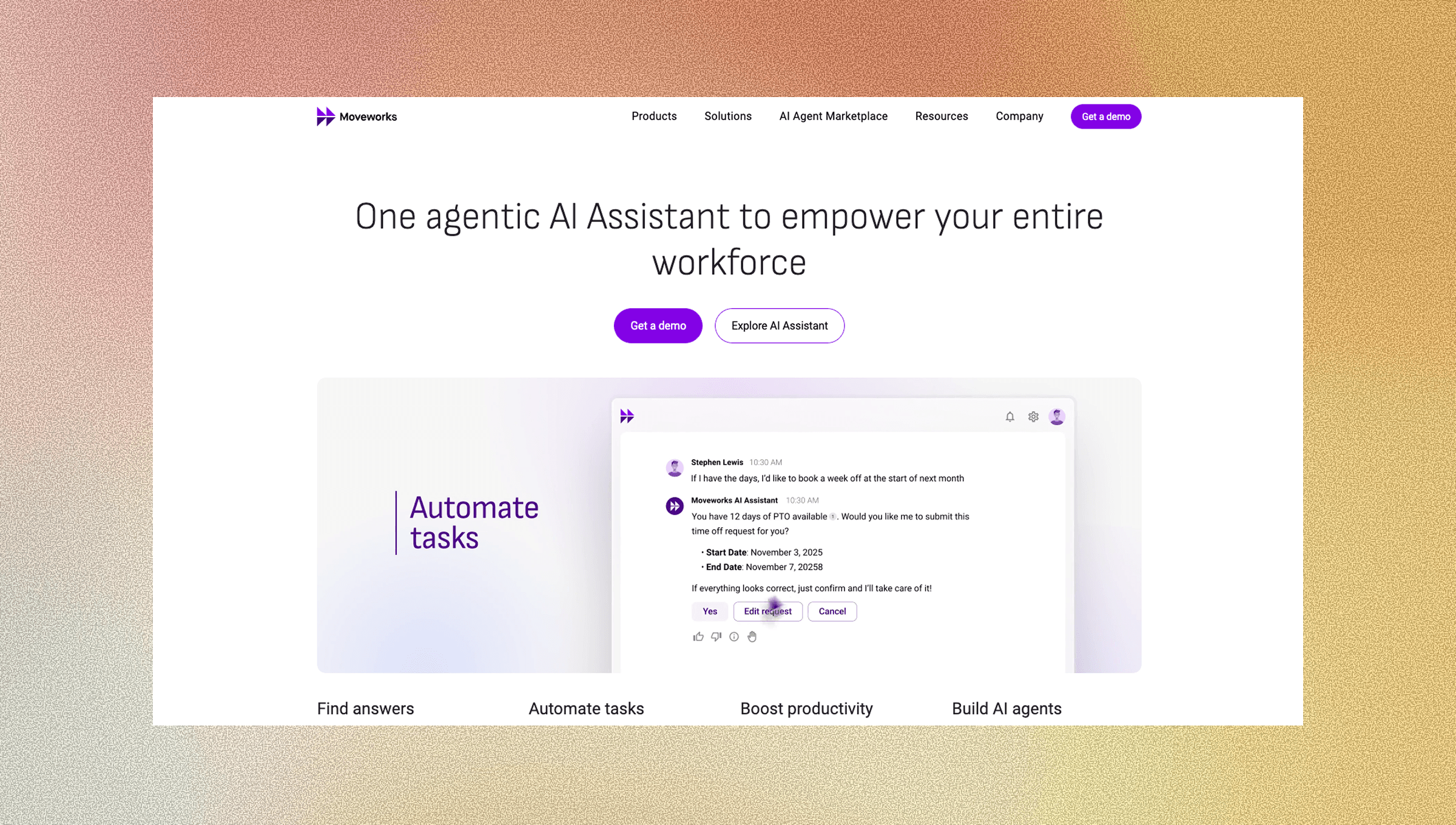
Moveworks intercepts employee support requests through conversational AI across Slack, Microsoft Teams, and web chat. When someone asks "I need access to Salesforce" or "my laptop won't connect to WiFi," the system interprets intent, pulls data from integrated systems, and either resolves the issue instantly or routes it with full context.
The AI handles password resets, software provisioning, policy lookups, and HR questions without human involvement. It ingests knowledge from multiple sources and uses LLMs to generate responses grounded in company documentation, acting as a copilot layer above enterprise systems like ServiceNow, Workday, and Okta through APIs and pre-built connectors.
ServiceNow's $2.85 billion acquisition in March 2025 has created uncertainty around product independence, pricing, and whether the AI assistant will eventually require a ServiceNow subscription, prompting many to research Moveworks alternatives.
Transition periods after acquisitions typically bring integration delays and shifting support priorities as acquiring companies consolidate roadmaps.
What Freshserivce Offers: Traditional IT Service Management
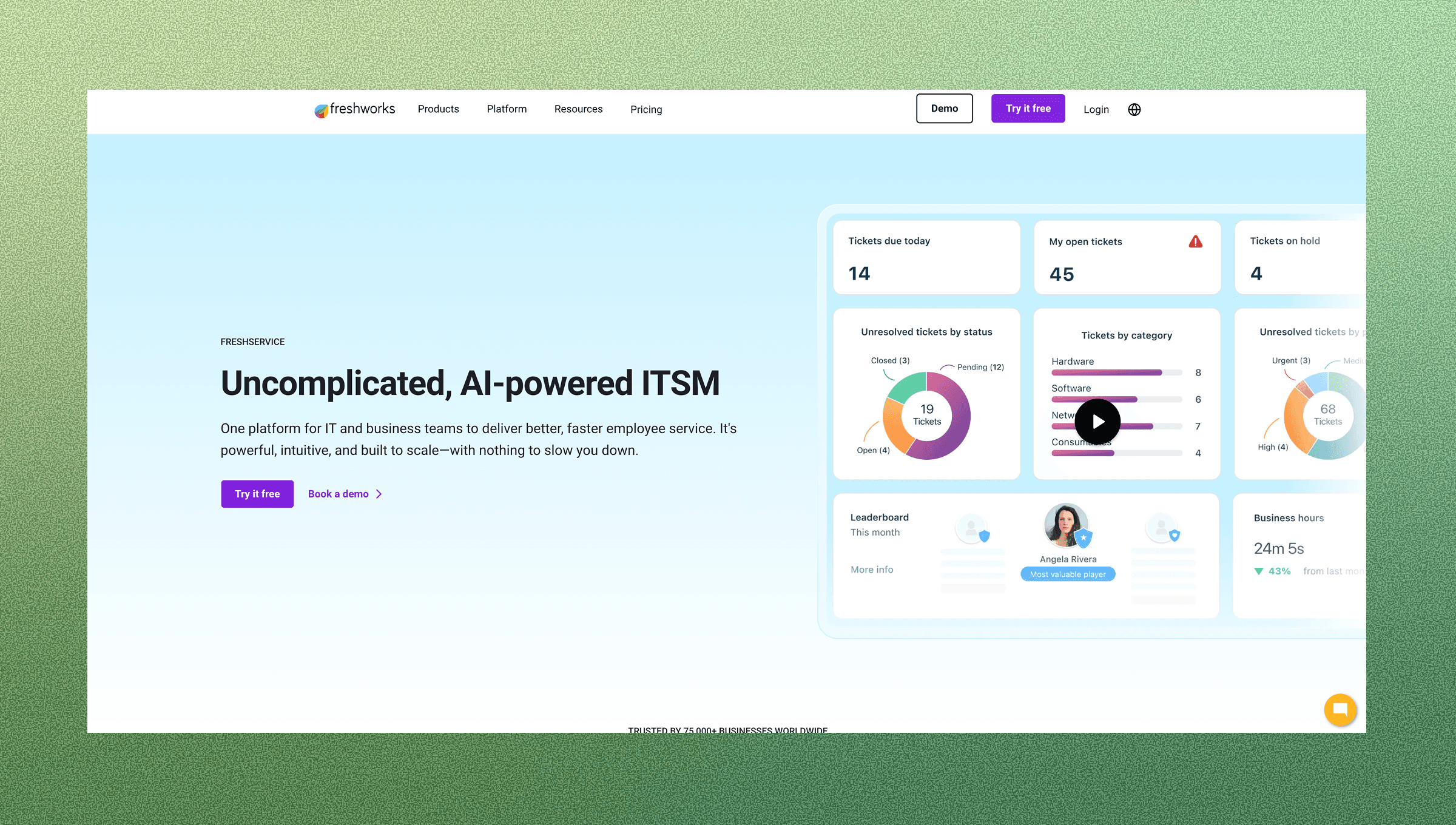
Freshservice operates as a cloud-based ticketing system where employees submit requests through a web portal or email, and IT teams work through queues using predefined categories and forms.
The system handles incident management, change control, and asset tracking. Support agents manually triage tickets, assign them based on rules, and follow workflow templates for common scenarios like access requests or hardware provisioning. A self-service portal lets employees search a knowledge base or browse FAQ articles before opening tickets.
Workflow automation requires configuration through if-then rules and custom fields instead of understanding natural language. Teams build approval chains, set SLA policies, and connect to identity systems through pre-built integrations. The interface relies on forms, asking requesters to categorize their own issues and fill in structured fields.
This approach works well for teams already familiar with ITSM frameworks who need asset management and change tracking in a web-based system.
Feature | Moveworks | Freshservice | Ravenna |
Request Interface | Conversational AI across Slack, Teams, and web chat with natural language understanding | Web portal and email with form-based ticket submission requiring manual categorization | Slack-native workflow automation tool where mployees already work |
Automation Approach | AI learns from past resolutions to automatically categorize, route, and resolve requests with minimal configuration | Manual if-then rules and workflow templates that administrators must build and maintain | AI agents autonomously execute workflows across integrated systems, performing actions like provisioning access, managing devices, and organizing employee lifecycle tasks |
Knowledge Management | Context-aware search based on user identity, department, role, and permissions with LLM-generated responses | Structured knowledge base with article categories, tags, and keyword search matching text strings | AI agents execute workflows across connected systems (Okta, Google Workspace, BambooHR) while maintaining a knowledge base for informational queries |
Implementation Time | Months of upfront integration work to map enterprise systems and configure connectors | Modular setup with individual integrations through app marketplace, still requires manual configuration | Setup takes days with quick integration to knowledge sources and identity systems |
Pricing Model | Enterprise pricing tied to employee count, not publicly listed, focused on ticket deflection ROI | Per-agent pricing from $19 to $119 per month per seat, costs scale directly with team growth | Flat pricing regardless of agent count, no per-seat fees as team grows |
Integration Complexity | Requires upfront mapping across ServiceNow, Workday, Okta, and identity directories | Individual connector setup through REST APIs with separate authentication and field mapping for each system | Visual workflow builder with quick integrations to Okta and similar identity systems in minutes |
Best For | Large enterprises with high ticket volumes, complex tech stacks, and resources for extensive implementation | Teams familiar with ITSM frameworks needing asset management, change tracking, and predictable per-agent costs | Teams using Slack who want to automate mission-critical workflows across IT, HR, and Ops without months-long deployment or scaling costs |
AI Automation vs Manual Workflows
AI agents will handle 80% of support interactions by 2025. So, how do these two solutions use AI?
Moveworks learns from past resolutions to automatically categorize, route, and resolve incoming requests with minimal configuration once integrations are live.
Freshservice requires administrators to manually build and maintain every automation rule. IT teams pre-configure trigger conditions, define routing logic based on keywords or form selections, and update workflows as new request types appear.
Keep in mind that the administrative burden grows with ticket volume in traditional systems, while AI-driven categorization scales without adding headcount. Password resets, access provisioning, and software troubleshooting become fully autonomous with machine learning. Rule-based systems handle these scenarios only after someone has explicitly programmed each variation.
Enterprise Search vs Portal-Based Knowledge Management
Building a knowledge base from resolved tickets is critical for employees to self-service. Here's how Moveworks and Freshservice approach search and knowledge management.
Moveworks Approach to Search and KM
Moveworks builds search around user identity and context. The system knows an employee's department, location, role, and access permissions before surfacing results. When someone asks about PTO policies, the response reflects their country's regulations and tenure bracket instead of a generic answer. This contextual layer extends to security and governance. The AI only retrieves documents a user can access based on their directory groups and clearances, preventing accidental exposure of restricted information.
Freshservice Approach to Search and KM
Freshservice relies on a structured knowledge base with article categories, tags, and folder hierarchies. Employees search through predefined sections or use keyword search that matches text strings without understanding intent. Finding the right information requires knowing how the IT team organized content and which category houses the answer.
Users may often submit tickets because learning the portal takes longer than asking a human. Portal-based search returns articles containing keywords but lacks the intelligence to infer what someone needs or filter results based on who's asking.
Integration Complexity and Implementation Requirements
How long it takes to get an ITSM up and running, including integration into existing system, should be a priority consideration when selecting a solution. Here's a look at the integration and implementation requirements for Moveworks and Freshservice.
Moveworks Integration
Moveworks requires upfront mapping across enterprise systems like ServiceNow, Workday, Okta, and identity directories before the AI can carry out actions. Each connector needs credential setup, permission scoping, and field mapping. Organizations can often spend months deploying traditional ITSM solutions through vendor professional services and internal IT resources.
Freshservice Integration
Freshservice takes a more modular approach. Teams activate individual integrations through app marketplace connectors or REST APIs, configuring each one independently. Connecting to Active Directory for user sync, Okta for access management, and Jira for escalations happens through separate setup flows with their own authentication and configuration screens. This reduces initial complexity compared to enterprise suites but still requires manual integration work. Each connector needs testing, field mapping, and ongoing maintenance when APIs change or systems update. Teams that rely on niche tools may need custom development if pre-built connectors don't exist.
Moveworks bundles integrations into its deployment process but ties you to their supported systems while Freshservice gives you more control over which connections to make first, but transfers the integration burden to your team.
Cost Structure and Scaling Challenges
At the end of the day, a solution needs a proven ROI. If price is too high, the benefits may not be worth it. We took a look at how Moveworks and Freshservice are priced to help you understand what each solution will cost annually.
Freshservice Pricing and Scaling
Freshservice charges per agent, starting at $19 per month and scaling to $119 for enterprise features. A team handling 500 tickets monthly might need five agents at $95 each, totaling $5,700 annually plus onboarding and training costs. Manually handling tickets costs an average of $22 per interaction. Traditional ITSM creates a direct correlation between growth and expenses.
Moveworks Pricing and Scaling
Moveworks pricing isn't publicly listed but follows enterprise software models tied to employee count, not agent seats. The value proposition is all about deflection: if the AI resolves 40% of requests autonomously, you avoid hiring proportionally as the company scales. AI-driven automation has led to a 30% decrease in customer service operational costs.
The break-even calculation depends on ticket volume and complexity. Organizations with high volumes of repetitive requests see faster ROI from AI, while smaller teams with specialized issues may find per-agent pricing more predictable. Automation can significantly reduce labor costs for routine tasks like password resets and access provisioning.
Neither model escapes scaling challenges entirely. AI systems require ongoing tuning, knowledge base maintenance, and integration updates as your tech stack evolves.
User Experience: Conversational vs Form-Based Interactions
How users engage with the ITSM system reveals two things. First, when it's frictionless, users are more apt to use the system. If it requires a lot of steps, URLs to visit and pages to browse, users may balk. Second, it can directly impact employee satisfaction. When employees need IT issues resolved, it's usually an emergency, like a lost password to a system them need to access. Simple but powerful solutions make sure employee IT issues get resolved quickly without a lot of extra work.
Moveworks User Experience
Moveworks lets employees type or speak requests exactly as they would to a colleague. Natural language understanding processes "my laptop won't connect to the VPN" without requiring users to choose between "Network Issue," "Hardware Problem," or "Software Access."
Freshservice User Experience
Freshservice asks requesters to classify their own problems through forms. You select a request type, fill required fields, and submit a structured ticket. This adds friction before anyone reviews the issue, especially when employees don't know IT taxonomy or which category fits their situation.
Slack-Native Workflow Automation That Goes Beyond Both Approaches
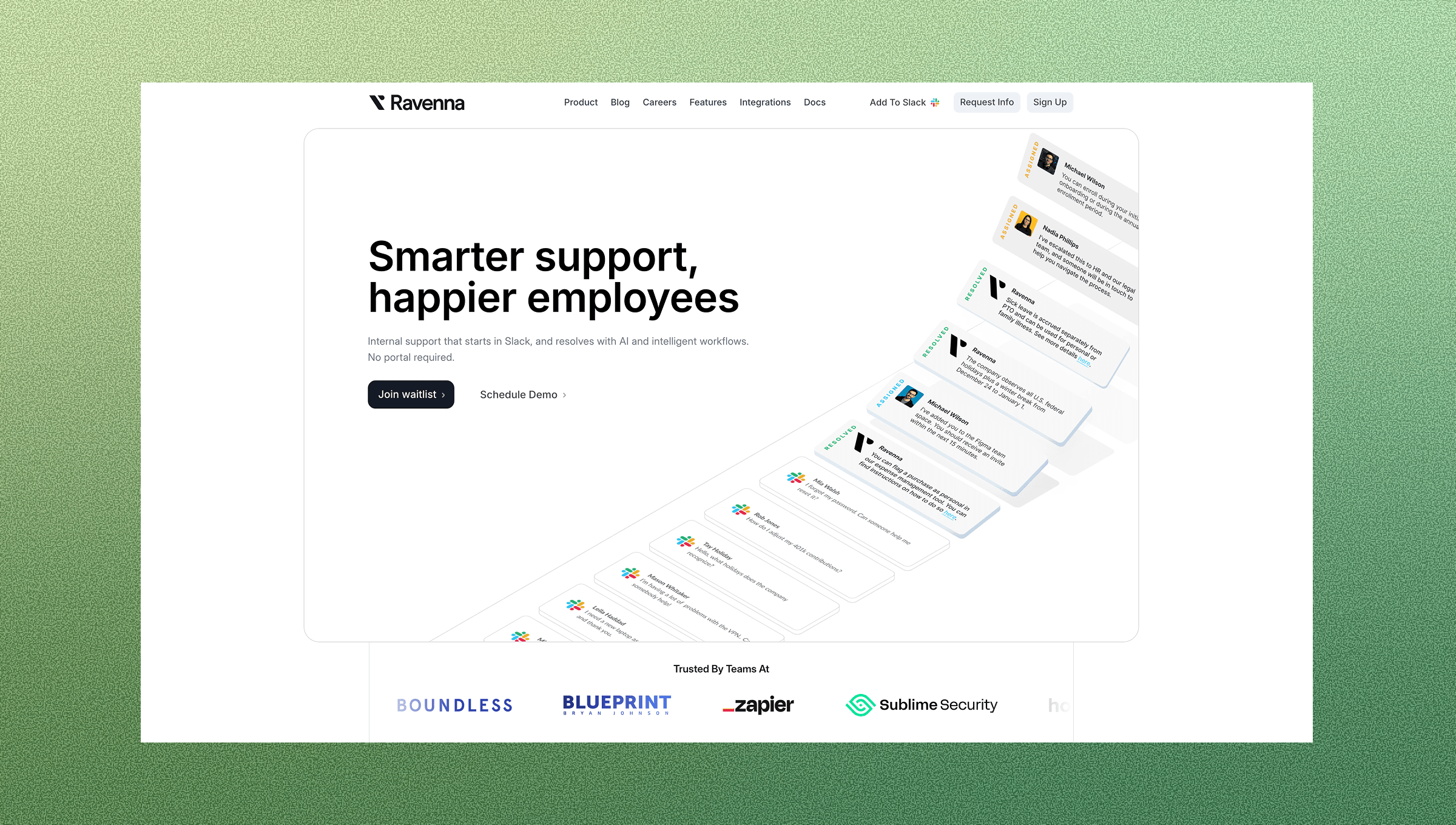
Ravenna operates as a workflow automation tool built natively in Slack, where your team already spends their day. Unlike traditional ticketing systems that require manual processing or AI wrappers that sit on top of legacy tools, Ravenna automates end-to-end workflows across your entire SaaS stack.
When employees submit requests through conversational messages, AI agents don't just route tickets they execute complete workflows. Access requests get automatically provisioned through Okta, onboarding sequences organize across BambooHR and Google Workspace, and device management tasks execute through Jamf or Kandji, all without opening another tab.
The visual workflow builder lets you design complex automations using a drag-and-drop interface or natural language descriptions. Configure conditional logic for approvals, set up multi-step employee lifecycle workflows, and integrate with your existing tools in minutes versus months. Unlike "vibe coding" approaches that generate unmaintainable scripts, Ravenna's structured workflow engine remains transparent and easy for IT teams to manage.
This automation-first approach means Ravenna eliminates tickets entirely by performing the actual work. The tool augments your IT team, converting them from ticket processors into workflow architects who can scale support without proportional headcount growth.
Final Thoughts on Comparing Moveworks with Freshservice
Your IT support comparison should focus on how much automation you need versus how much control you want to keep. Moveworks delivers powerful AI with enterprise complexity, Freshservice offers familiar ticketing with manual workflows, and both have scaling challenges as your company grows. The right choice depends on your ticket patterns and team preferences. Ravenna gives you conversational AI inside Slack without the months-long deployment or per-agent pricing that makes growth expensive. Ready to automate your internal workflows? Schedule a Demo.
FAQs
What's the main difference between AI-native and traditional IT support platforms?
AI-native platforms like Moveworks interpret natural language requests and resolve issues autonomously through machine learning, while traditional systems like Freshservice require manual rule configuration and form-based ticket submission where employees categorize their own problems.
How long does it typically take to implement an AI helpdesk solution?
Moveworks requires months of upfront integration work to map enterprise systems and configure connectors, while Freshservice offers modular setup that teams can deploy incrementally but still demands manual configuration for each integration.
When should I consider switching from a traditional ITSM to an AI solution?
If your team handles high volumes of repetitive requests (password resets, access provisioning, policy lookups) and you're spending over $22 per ticket on manual resolution, AI automation can deliver faster ROI through deflection and reduced agent headcount.
Can an AI helpdesk work alongside my existing ServiceNow or ITSM system?
Yes, AI platforms can act as a conversational layer on top of existing systems through API integrations, though Moveworks' acquisition by ServiceNow in March 2025 has created uncertainty about future independence and whether it will eventually require a ServiceNow subscription.
How do pricing models differ between AI and traditional helpdesk solutions?
Traditional platforms like Freshservice charge per agent ($19-$119 monthly per seat), creating direct correlation between team growth and costs, while AI solutions typically price by employee count with the value proposition centered on deflecting tickets to avoid proportional hiring as you scale.